Cloud Storage Solutions v.18
Công cụ sắp xếp linh hoạt tệp đính kèm Odoo vào thư mục và đồng bộ thư mục với máy khách đám mây: Google Drive, OneDrive/SharePoint, Nextcloud/ownCloud, Dropbox, Amazon S3, Box và NAS. DMS. Trình quản lý tệp. Hệ thống quản lý tài liệu
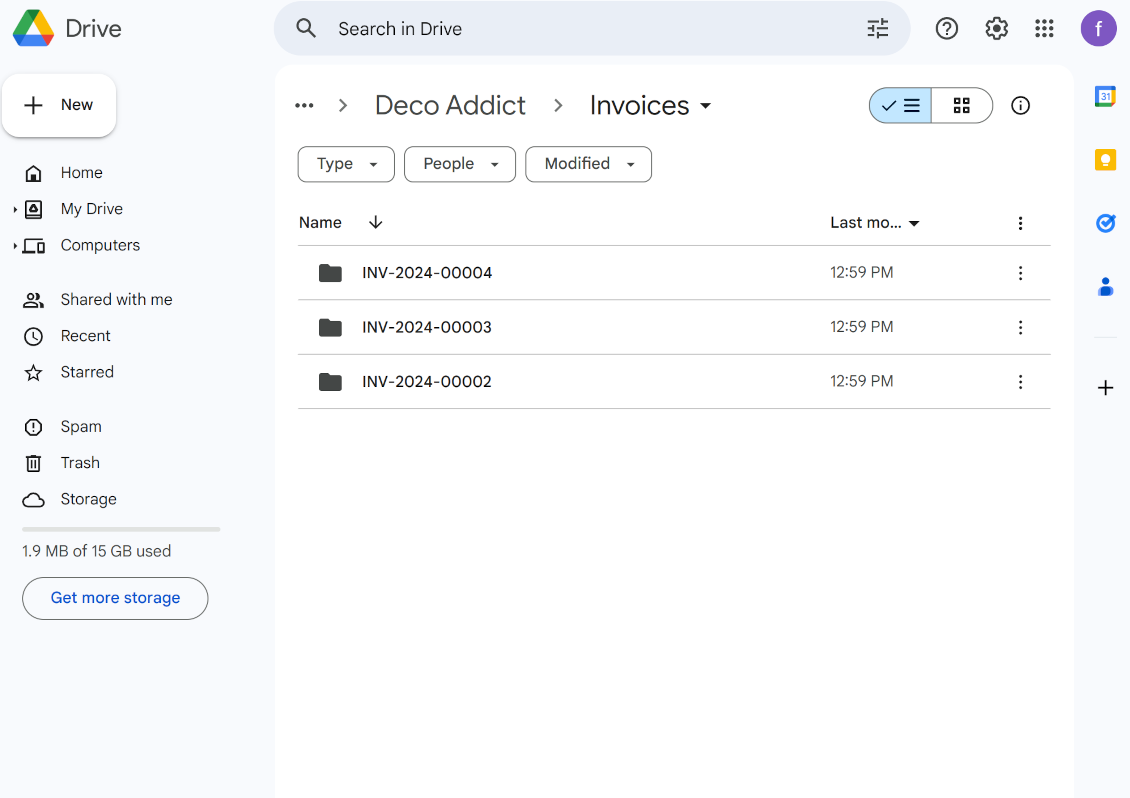
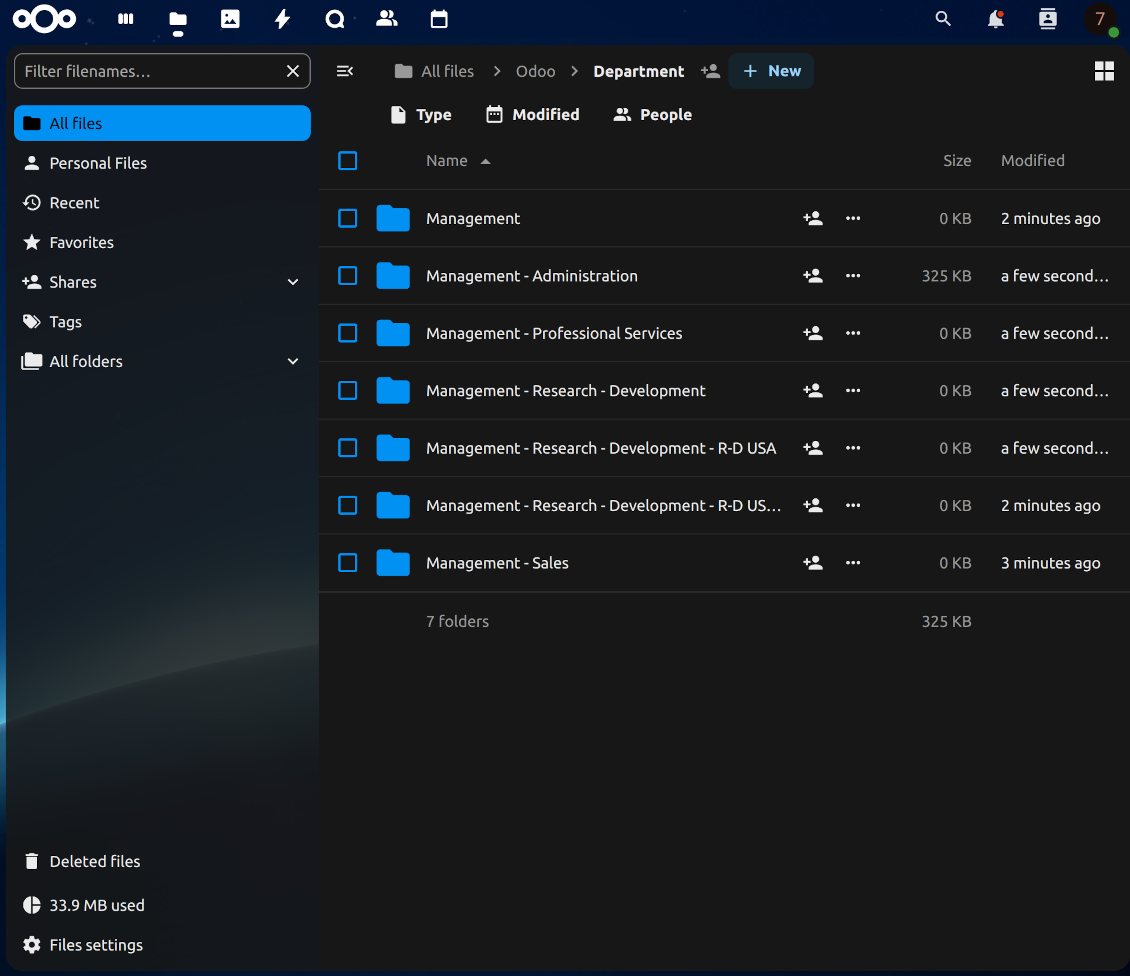
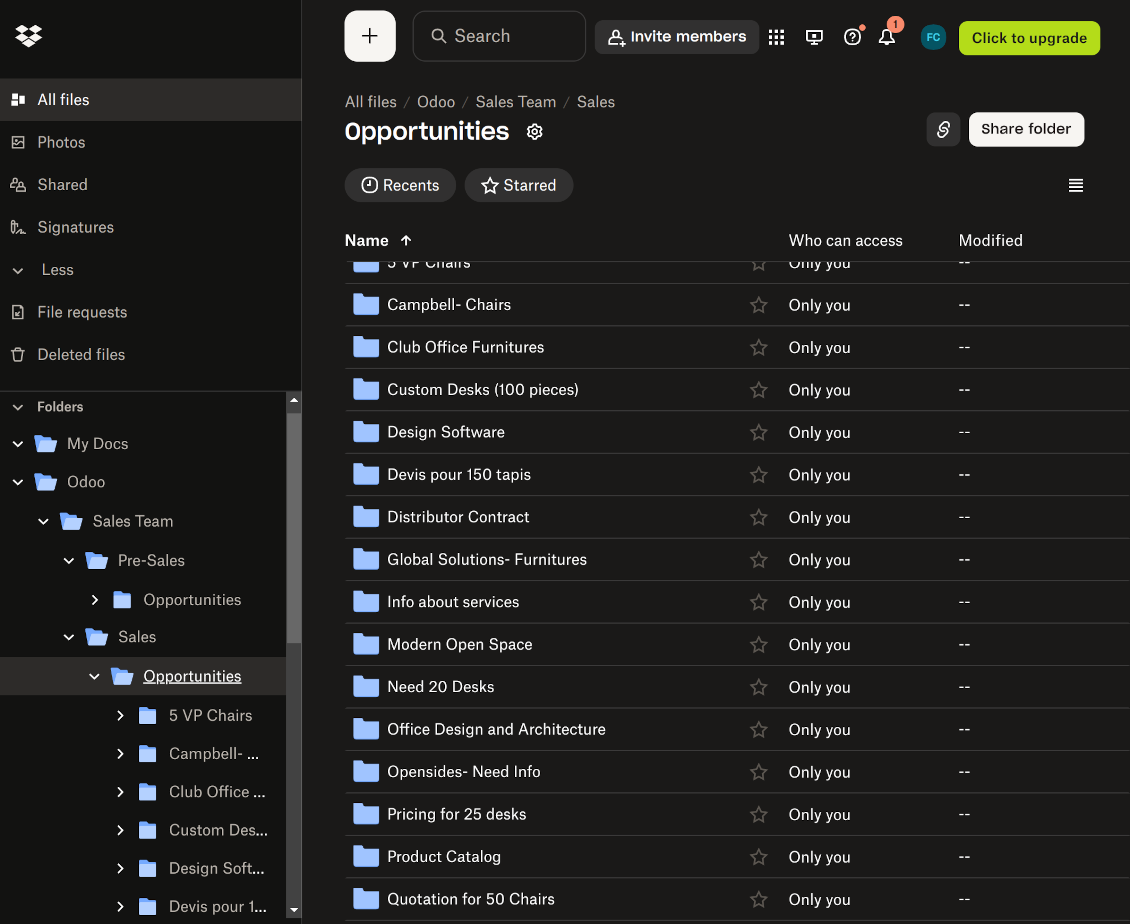
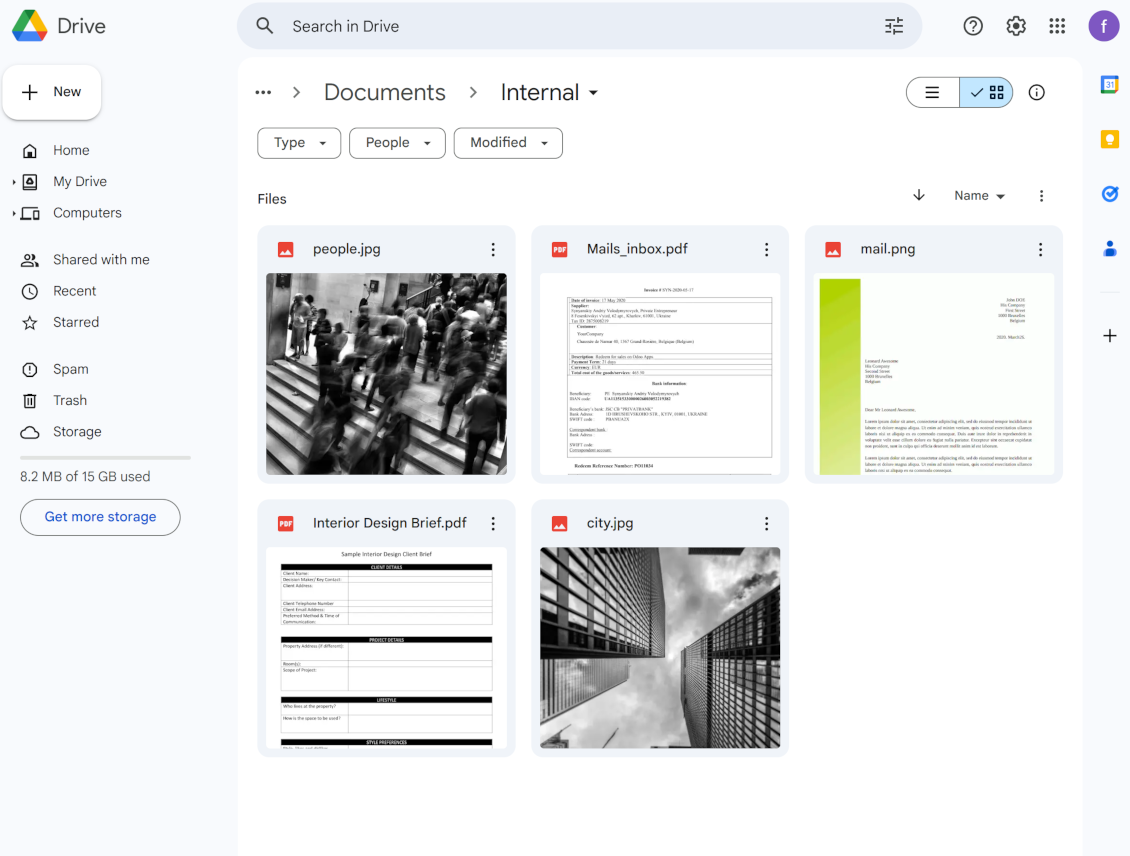

This tool organizes Odoo attachments in folders' trees and synchronizes those with your choice's cloud storage solution(s). The app introduces automatic algorithms to prepare directories for documents and integrate those with workflows of Google Drive, OneDrive/SharePoint, Nextcloud/ownCloud, Dropbox, Amazon/MinIO S3, Box, and NAS/WebDAV (Synology, QNAP, TrueNAS, etc.).
- the core module which introduces the file manager interface and basic mechanics for synchronizations with various cloud clients. Giá là 398€.
- trình kết nối để đồng bộ thư mục và tệp đính kèm Odoo với OneDrive và/hoặc SharePoint. Các tính năng của tiện ích bổ sung này được đánh dấu bằng biểu tượng . Giá là 89€.
- kết nối để đồng bộ thư mục và tệp đính kèm Odoo với Google Drive. Các tính năng của tiện ích này được đánh dấu bằng biểu tượng . Giá là 89€.
- kết nối để đồng bộ thư mục và tệp đính kèm Odoo với Amazon S3. Các tính năng của tiện ích này được đánh dấu bằng biểu tượng . Giá là 89€.
- trình kết nối để đồng bộ thư mục và tệp đính kèm Odoo với Nextcloud và/hoặc ownCloud. Các tính năng của tiện ích bổ sung này được đánh dấu bằng biểu tượng . Giá là 89€.
- trình kết nối để đồng bộ thư mục và tệp đính kèm Odoo với giải pháp NAS (Synology, QNAP, TrueNAS) và lưu trữ WebDAV chung. Các tính năng của tiện ích bổ sung này được đánh dấu bằng biểu tượng . Giá là 89€.
- kết nối để đồng bộ thư mục và tệp đính kèm Odoo với Dropbox. Các tính năng của tiện ích này được đánh dấu bằng biểu tượng . Giá là 89€.
- kết nối để đồng bộ thư mục và tệp đính kèm Odoo với Box. Các tính năng của tiện ích này được đánh dấu bằng biểu tượng . Giá là 89€.
- tiện ích tùy chọn để chuẩn bị thư mục theo không gian làm việc và đồng bộ tài liệu Odoo (do ứng dụng Enterprise 'Documents' đưa vào) với lưu trữ đám mây. Các tính năng của tiện ích này được đánh dấu bằng biểu tượng . Giá là 44€.
Automatic Folders
Decide which Odoo document types should have their folder trees. Directories are regularly updated based on flexible rules and existing Odoo objects
Sync with Cloud Storage Solutions
Synchronize chosen folders and files with specific cloud storage: Google Drive, OneDrive, SharePoint, Nextcloud, Dropbox, Amazon, Box, MinIO S3, NAS/WebDAV (Synology, QNAP, TrueNAS, etc.), and ownCloud. Have as many connections as you need
File Manager Interface
Manage folders and attachments from a single view. Comfortably navigate by directories and tags. Search and download files one by one or in a batch. Upload and move attachments
Enhanced Attachment Box
Organize files of any Odoo object in a set of subfolders. Instantly access folders and files in the attachment box and in synced cloud interfaces
Portal Sharing
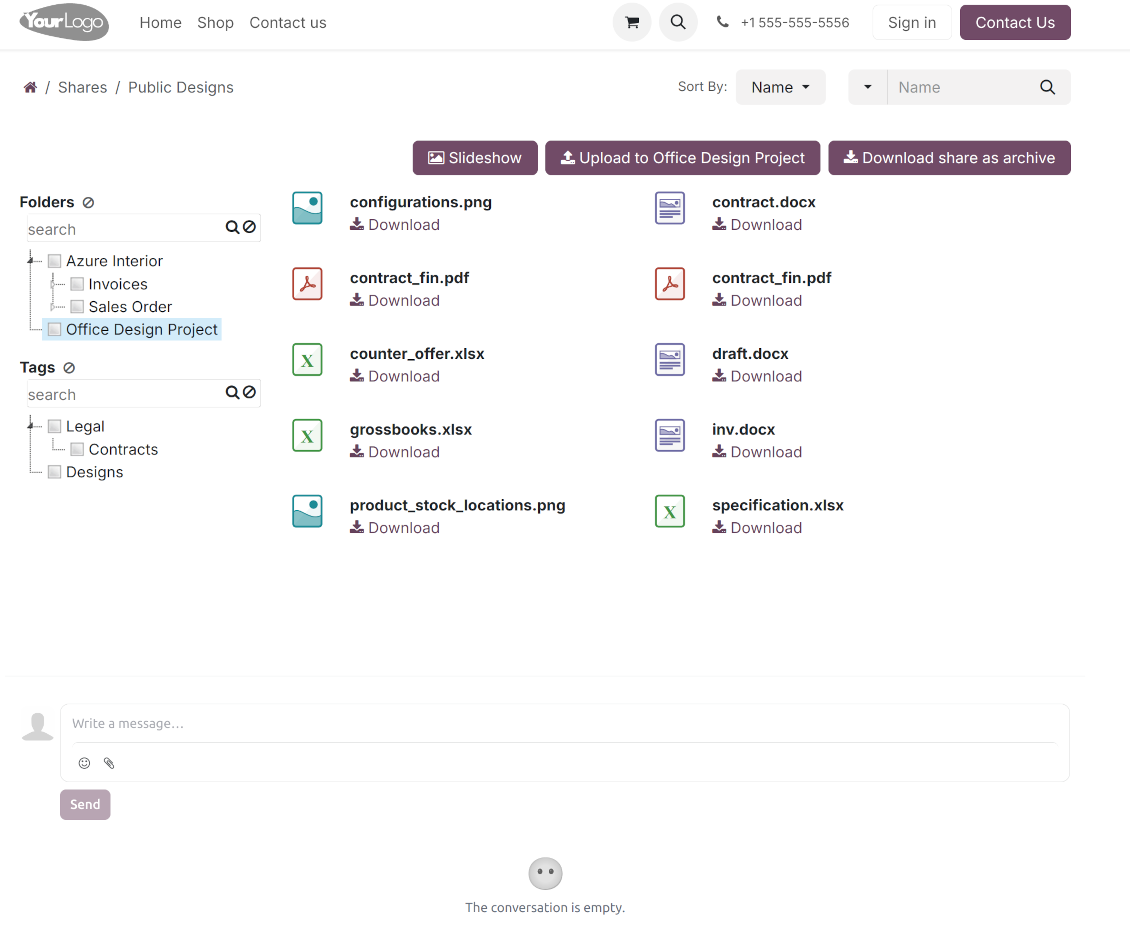
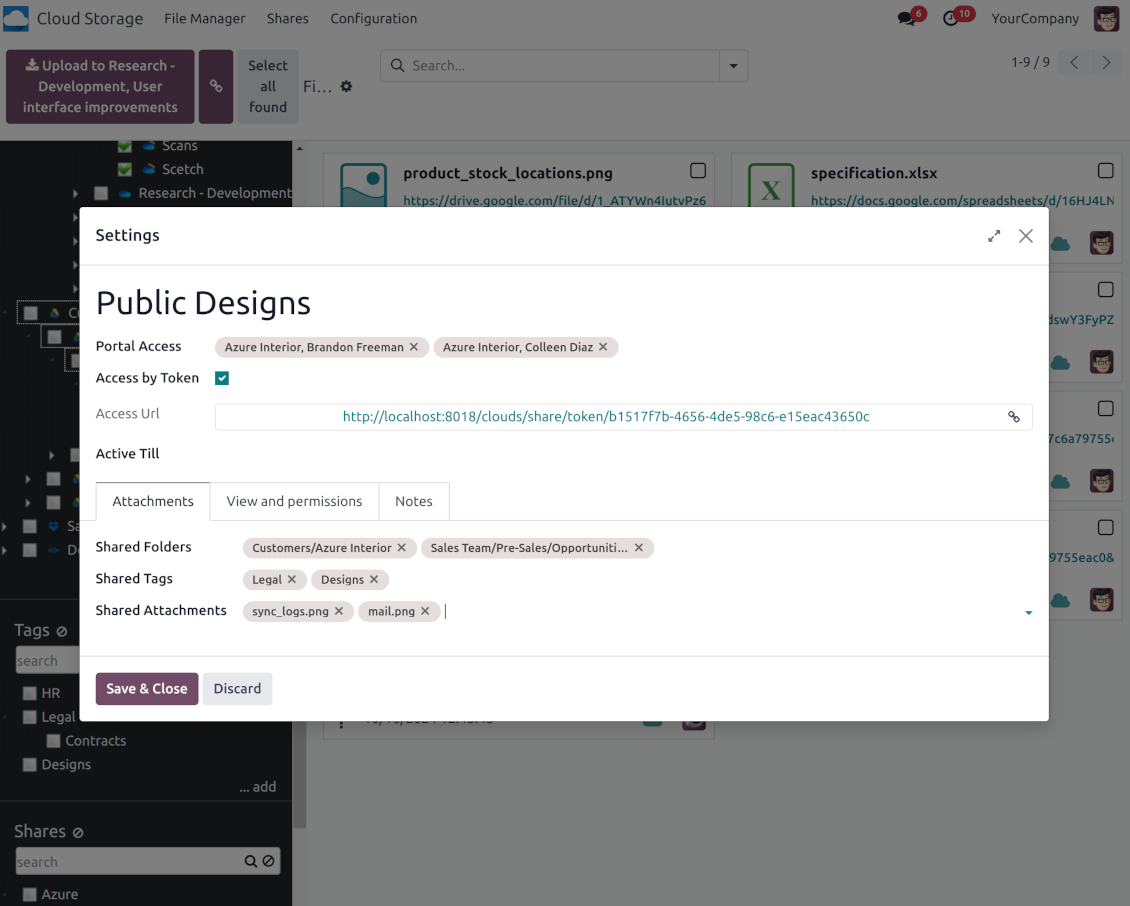
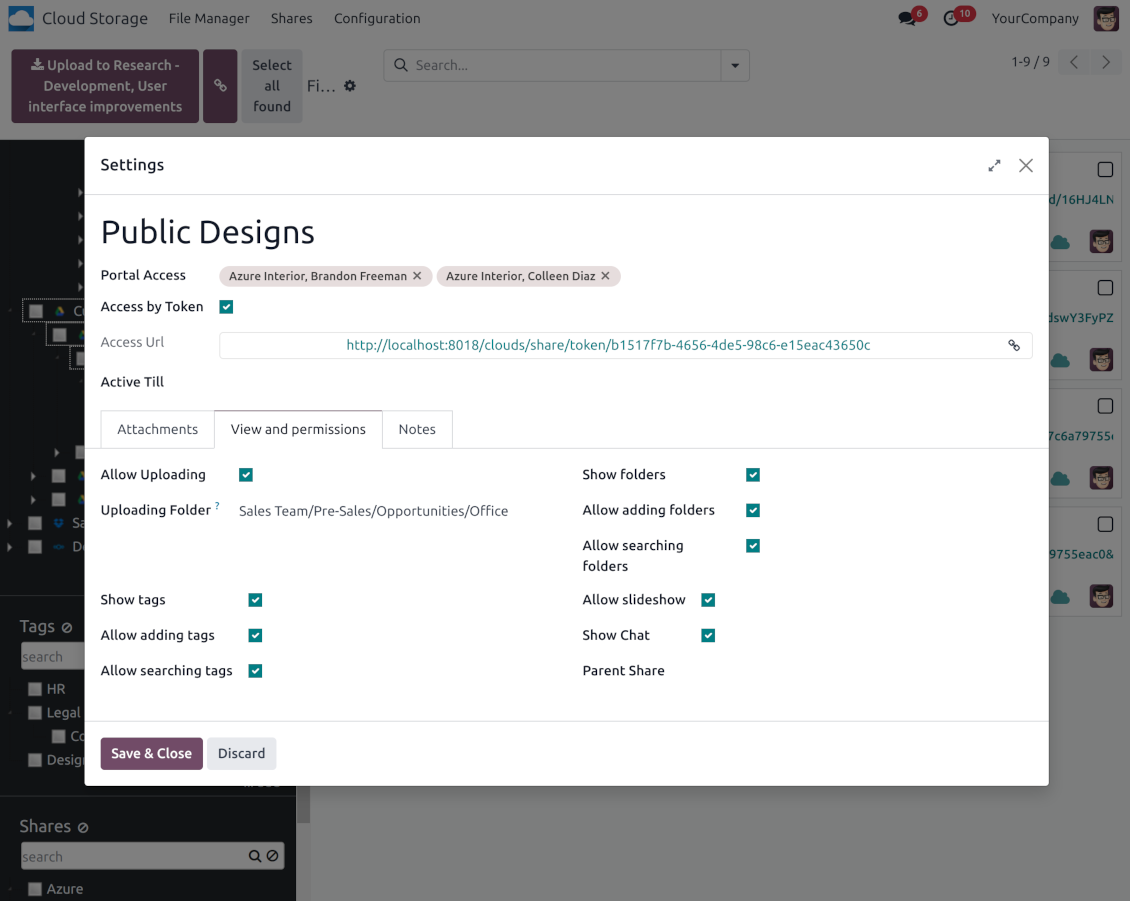
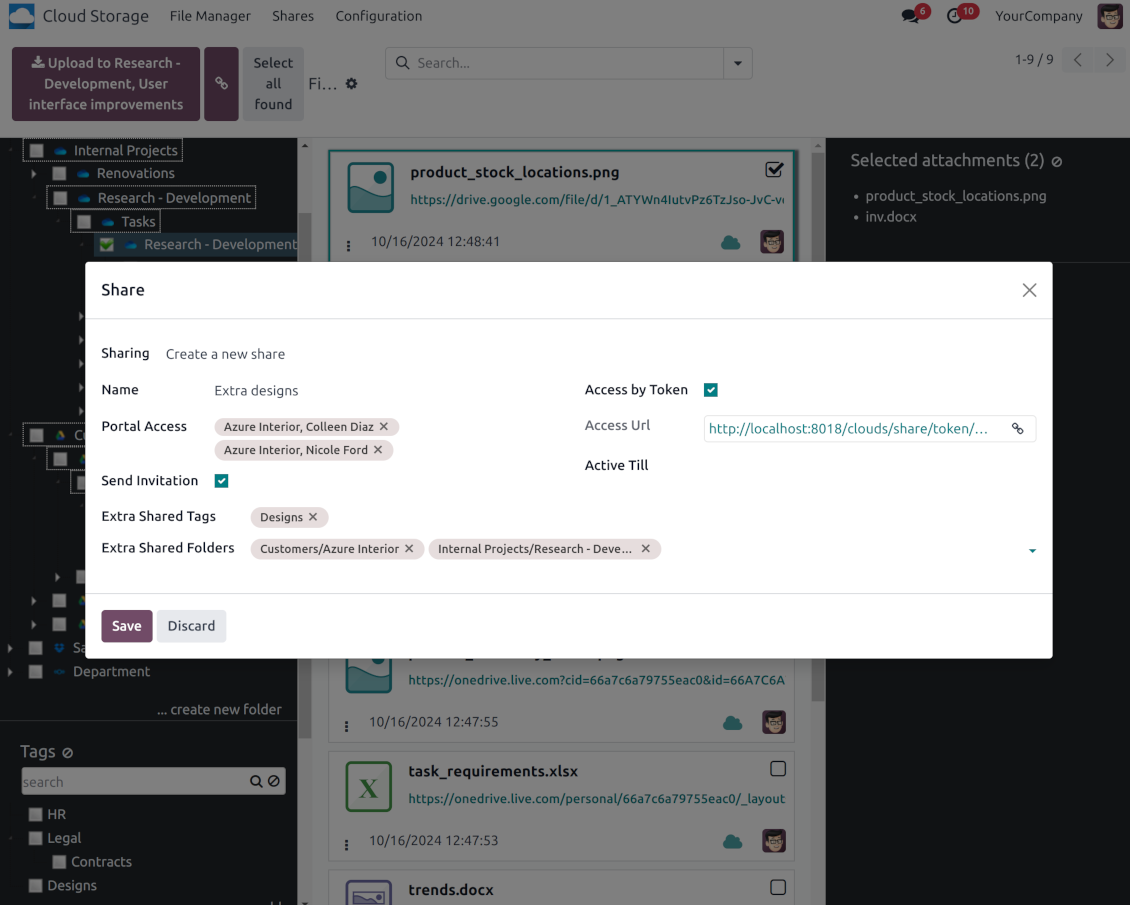
Share files, directories, and tags with particular partners or with an access URL. Let users download whole shares and separate items, upload attachments, and add folders or tags
Enterprise documents compatible
Set up rules to prepare folders based on Odoo Enterprise workspaces. All features, including sharing, downloading, and signing, will work even after the sync
Automatic Regular Sync
Rely on auto-synchronization between Odoo and cloud solutions based on scheduled jobs. No manual interaction is required
Bilateral Sync
Odoo sends attachments to cloud storage solutions and retrieves files from there. Binary content is kept in clouds, while Odoo provides direct access to synced items
Works well with SharePoint. Supportive team
We've been using this with SharePoint and it's been working great. One of the best things is having everything, including logs right in Odoo's interface, so you can actually see what's going on. It's also super convenient that you can view or download synced files from the attachment box without having to leave the page or even log in to Sharepoint.
Setup was pretty smooth for us. When we had a few questions about setting up the folder hierarchy and priorities, the developer team got back to us in just a couple of hours and helped us figure it out. Great support and great extension!
Tricky setup, but works perfectly now
Really solid module. We managed to get a very flexible folder structure (sorted by clients) and synced all our sales orders, invoices and tasks by projects to Google Drive.
Initial setup was a bit of a pain and kinda tricky to configure everything at first, but now it's running smoothly and works perfectly. The faotools team helped a lot. Def worth it if u need to keep your docs organized in Odoo and Google Drive.
Recommended!
Great support, assistance and very good connector!
We are very happy with the support we received when configuring the Sharepoint - Odoo connector. The connector has great functionalities.
All our questions were answered very fast (within one day).
FaOtools helped us optimising our connector and assisted us with future improvements.
We really recommend this connector.
Great module and Great Support!
The module works great! and the support is phenomenal!
A must-buy if it suits your requirements!
very professional app, excellen t customer service
This app is very well programmed and does its job very well. But the best is the excellent customer service who also helps when the problem lies somewhere else. You receive a lot for your money.
Excellent !!!
Great App and great Service from faOtools.
An impressive app and world-class support
I have been very impressed by the way the OneDrive / SharePoint Odoo Integration module synchronises content in both directions and allows me to share documents in Odoo with my SharePoint site. Above all the technical support is top-notch, which greatly increases the value of this product. I highly recommend this product for anyone considering synchronising Odoo with SharePoint/OneDrive.
Very good product
A perfect solution to integrate Owncloud with Odoo. We sync a high volume of objects across multiple Odoo models, which works seamless and stable. For us it is the perfect solution to have an external DMS instead of the Odoo native attachment handling, which also enables us to interchange files between systems in our best-of-breed setup.
The team behind this module is extremely professional and responsive. They helped us on a few occasions and provided clear answers and prompt support when required, and they even went out of their way to assist us with another requirement we had. Cannot recommend the product and team highly enough, try this if you're in the market to connect Odoo with an external document solution.
Works fine, good support
The first experience with the module is excellent. I had some trouble to configure things right on the Microsoft-side, but the team provided quick and good support.
Best module for integration with google drive
The module performs its function correctly and faOtools responds quickly to any problem and, in case of detecting any bug, quickly apply the changes. Its support is 10 stars.
Works according to specs
I have used this app with Odoo 12 and Nextcloud 16 and it works as specified. Odoo Tools offers very responsive support which is really helpful. Of course 5 stars...!
This is Awesome
I have used Cloud Sync on Next/Own Cloud and works really great.
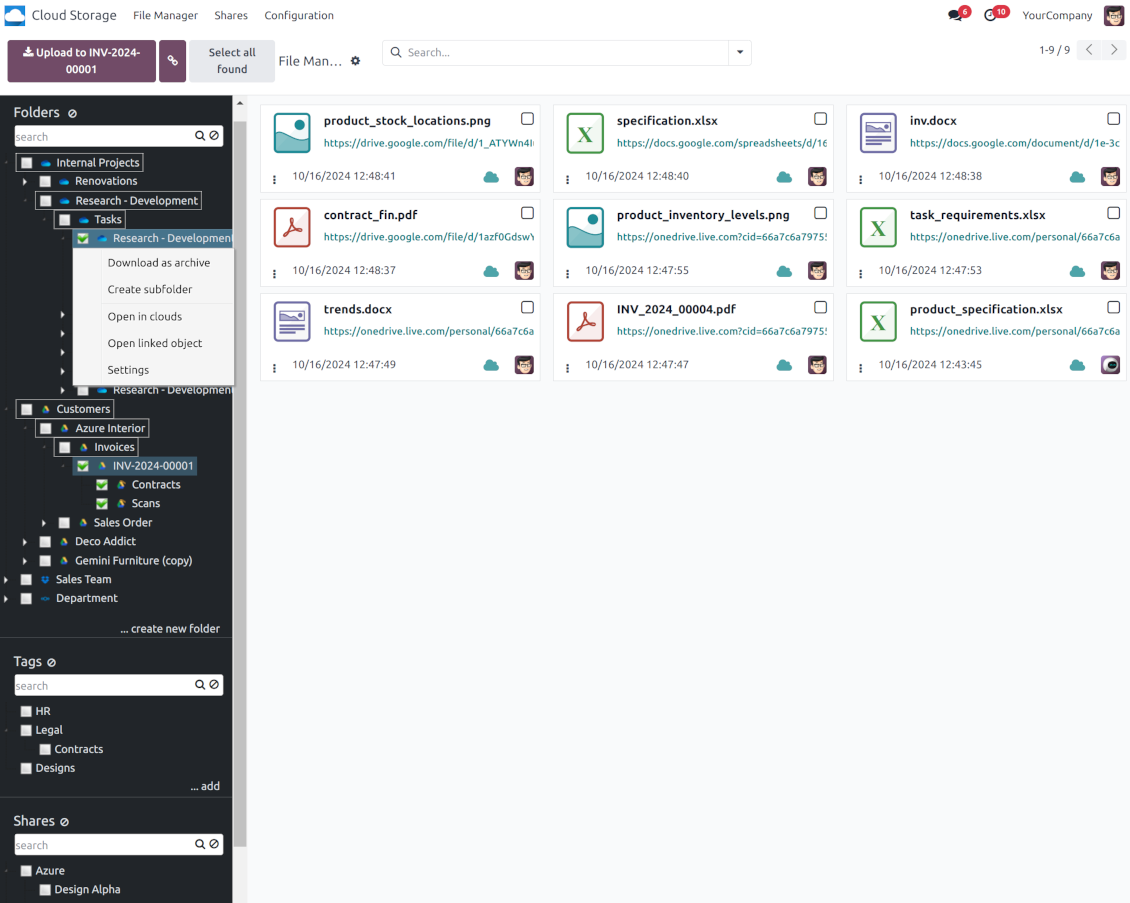
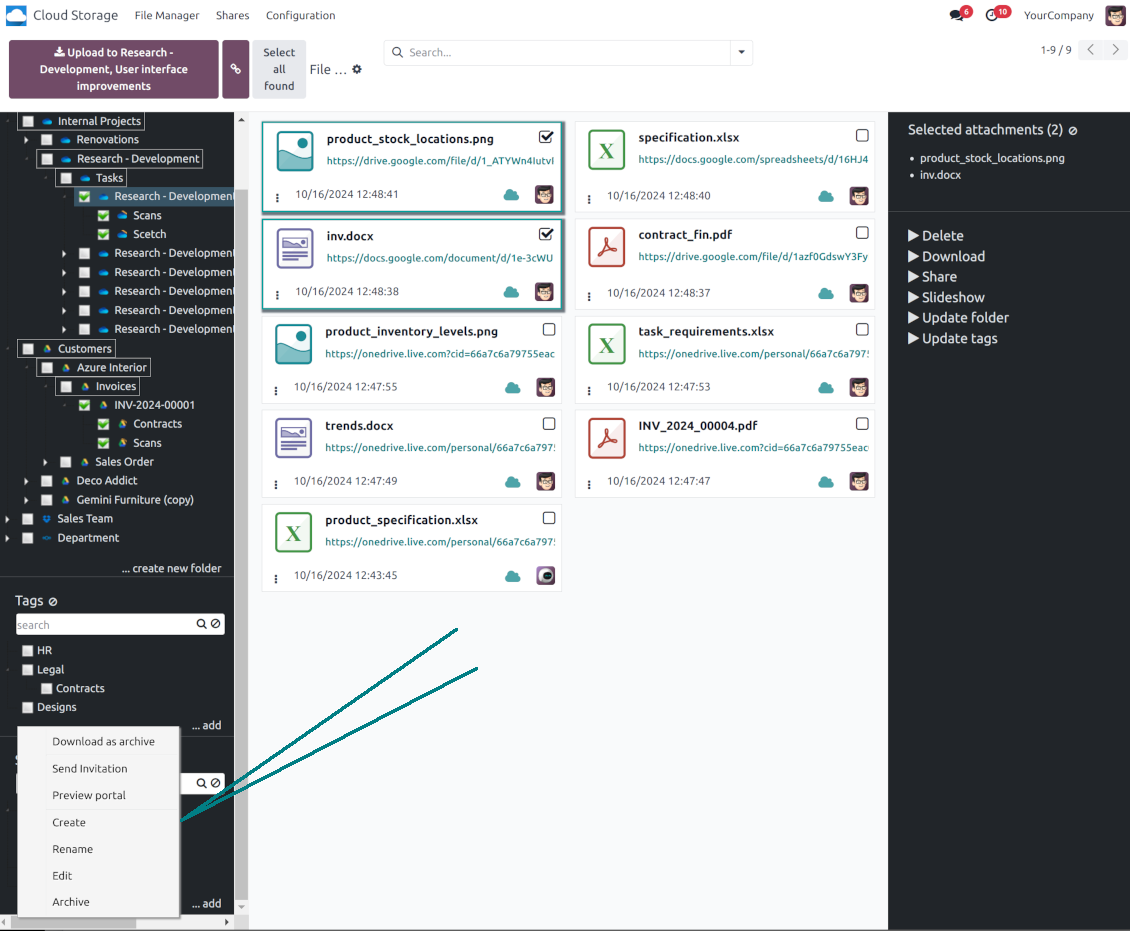
Giao diện trình quản lý tệp Odoo
-
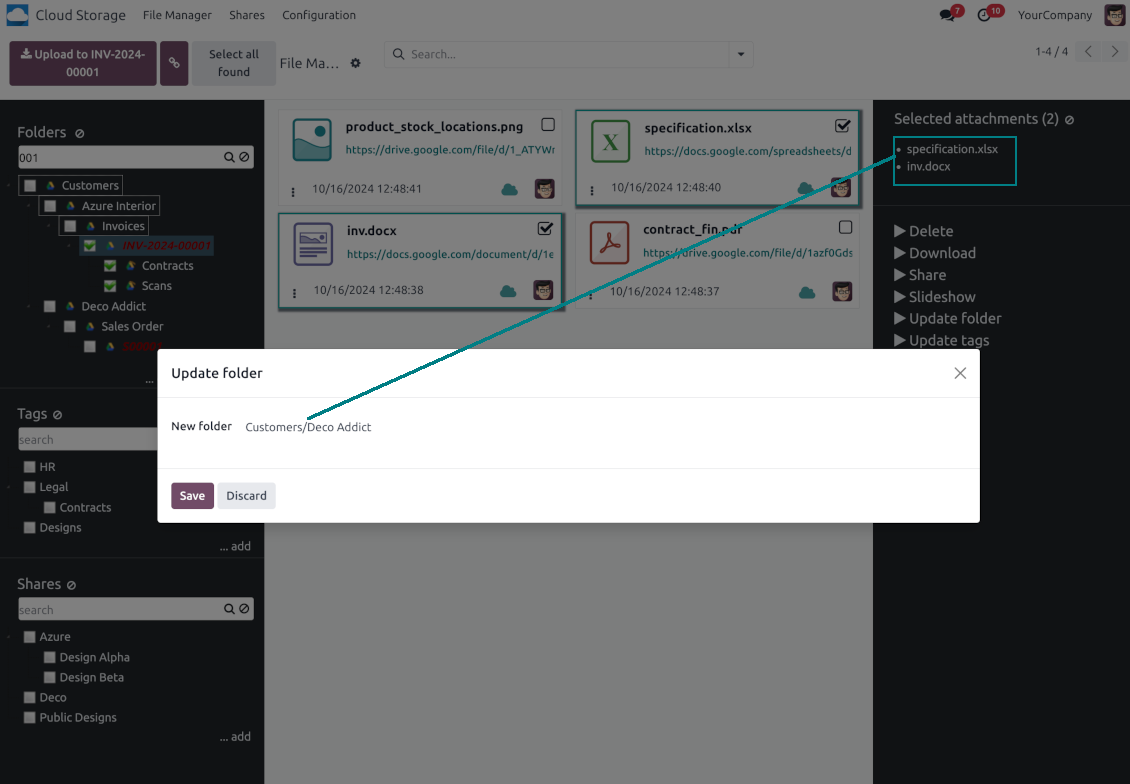
Navigate by folders: select a directory to show its attachments. Expand and hide folders' layers in a click. Add subfolders to any directory (right mouse click > Create subfolder)
-
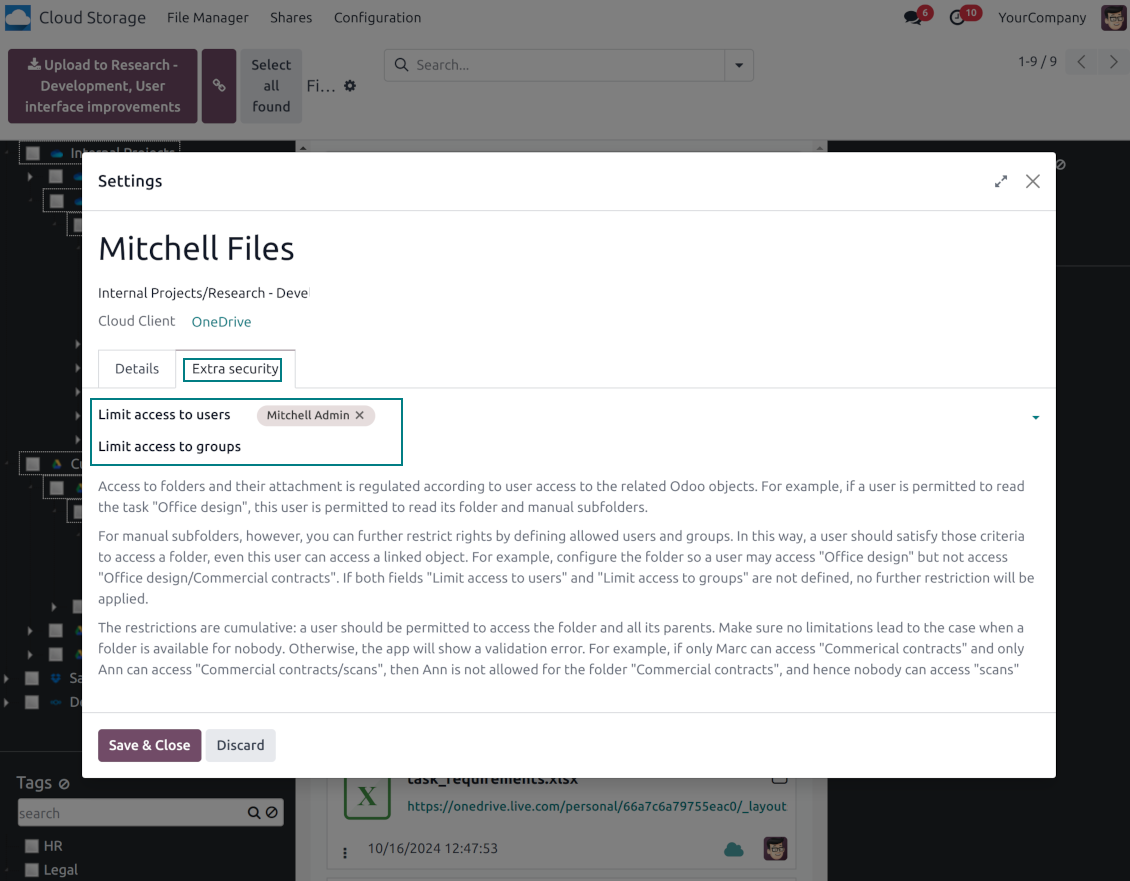
Open any synced folder in its cloud client (right mouse click > Open in clouds). Show a folder peer Odoo object if there is such a connection (right mouse click > Open linked object). Change settings of manually created folders, including granting access rights (right mouse click > Edit Settings)
-
Navigate by attachment tags. Create and edit tags right from the navigation panel
-
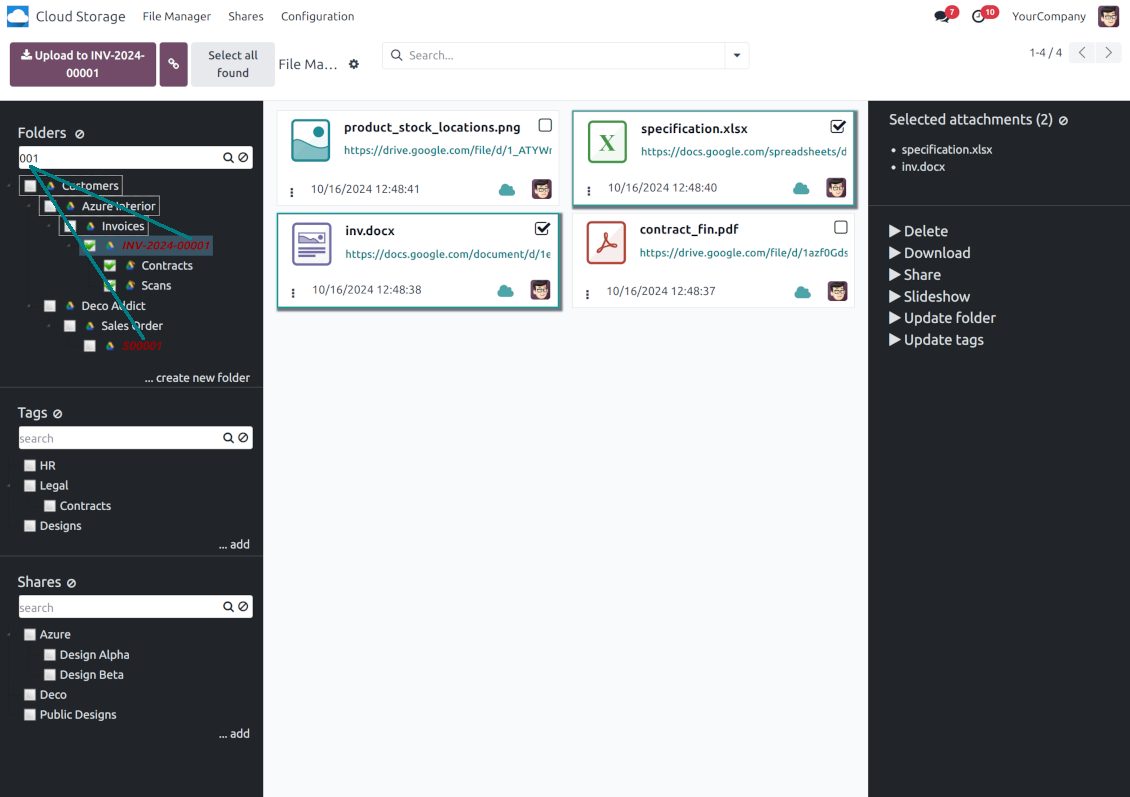
Search and highlight tags and folders in seconds even if there are thousands of items
-
Drag and drop to re-structure folders (relates only to manually created directories; for automatic folders change rules instead) and tags
-
Download any folder or any tag with all its attachments as a single zip archive (right mouse click > Download as archive)
-
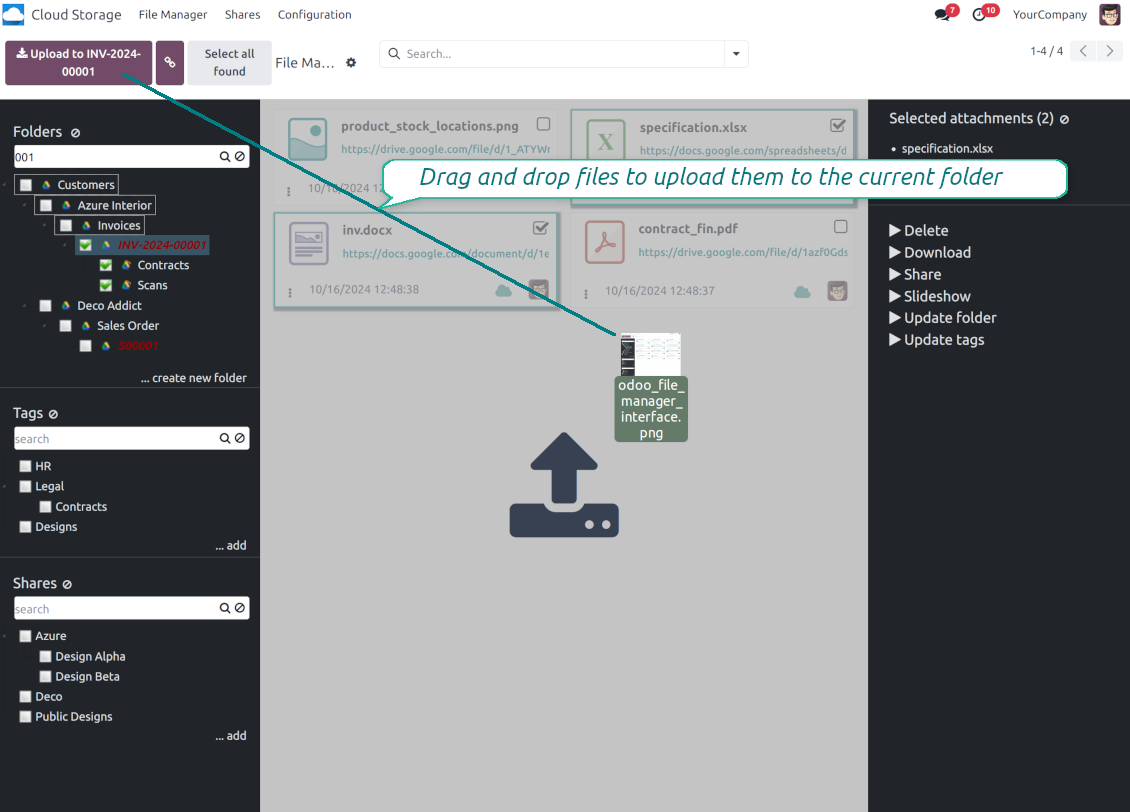
Upload attachments to the current folder. Use the top header button 'Upload file' or drag and drop files
-
Instantly open any synced attachment in a linked cloud client (push the link in the middle of attachment cards)
-
Download any attachment to your local computer disregarding whether it is synced or not (push the icon 'cloud' or 'download' in the footer right corner)
-
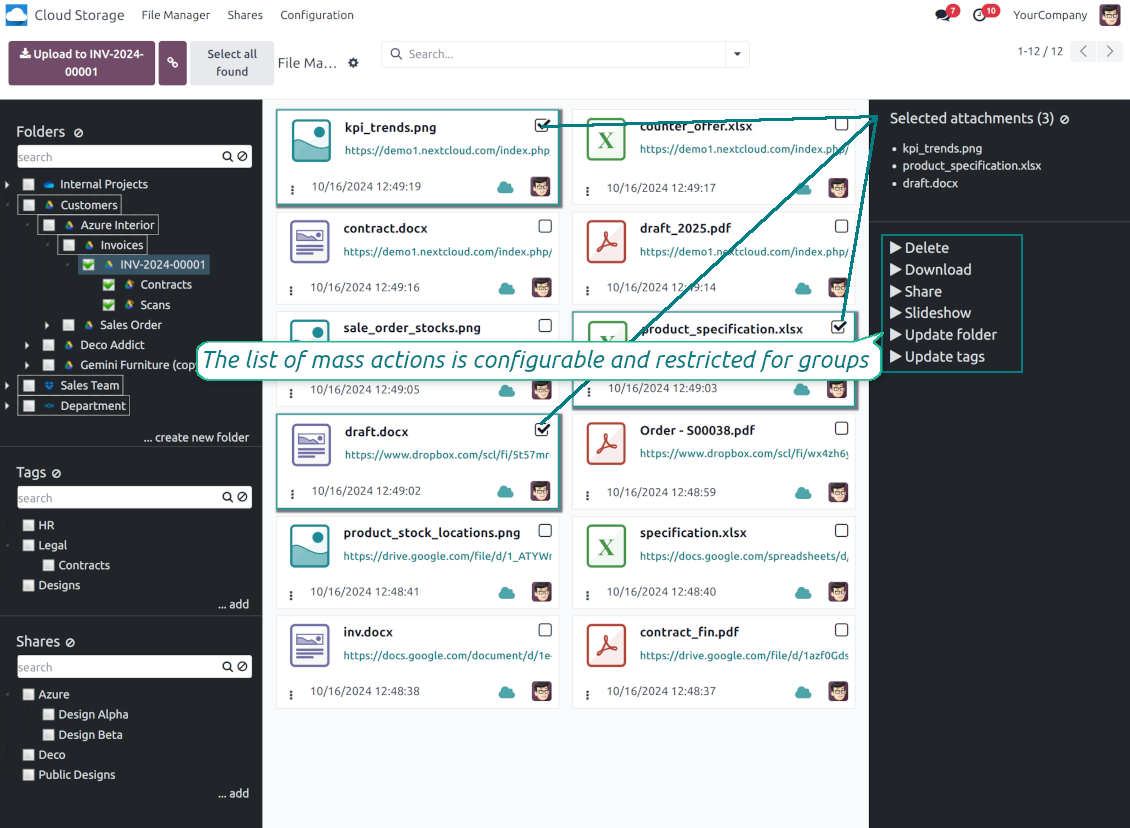
Consequentially select attachments and download them as a single zip archive
-
Move any files to any folder, including re-attaching items between Odoo objects (e.g. from a sale order SO-001 to another quotation or its customer folder). Use the mass action for that end or just drop an attachment to a required directory. Update attachments' tags by dragging those to the left navigation panel or by executing the mass action. Delete attachments in a batch
-
Apply standard attachments search to find required files.
Enhanced Attachment Box
-
Any Odoo object might be linked to its folder. See Automatic folders' structure
-
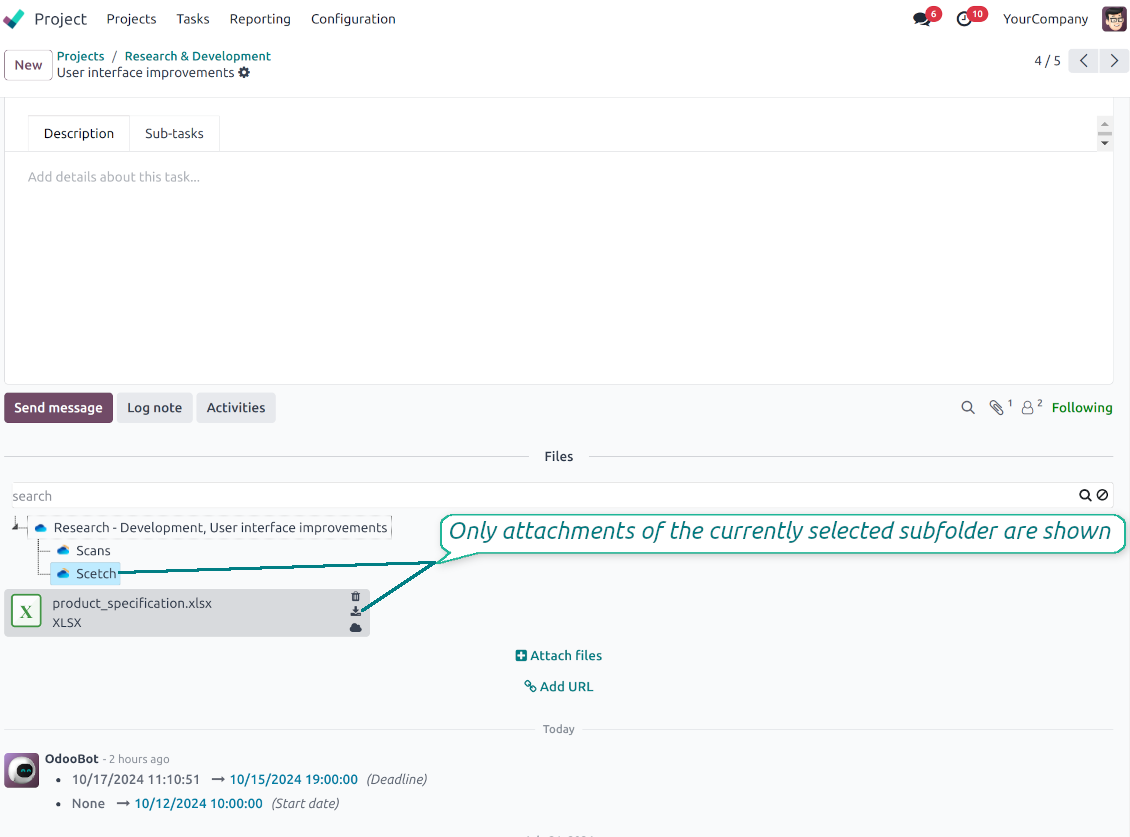
Flexibly define subfolders to organize the structure you need (right mouse click > Create subfolder)
-
Drag and drop to re-structure subfolders
-
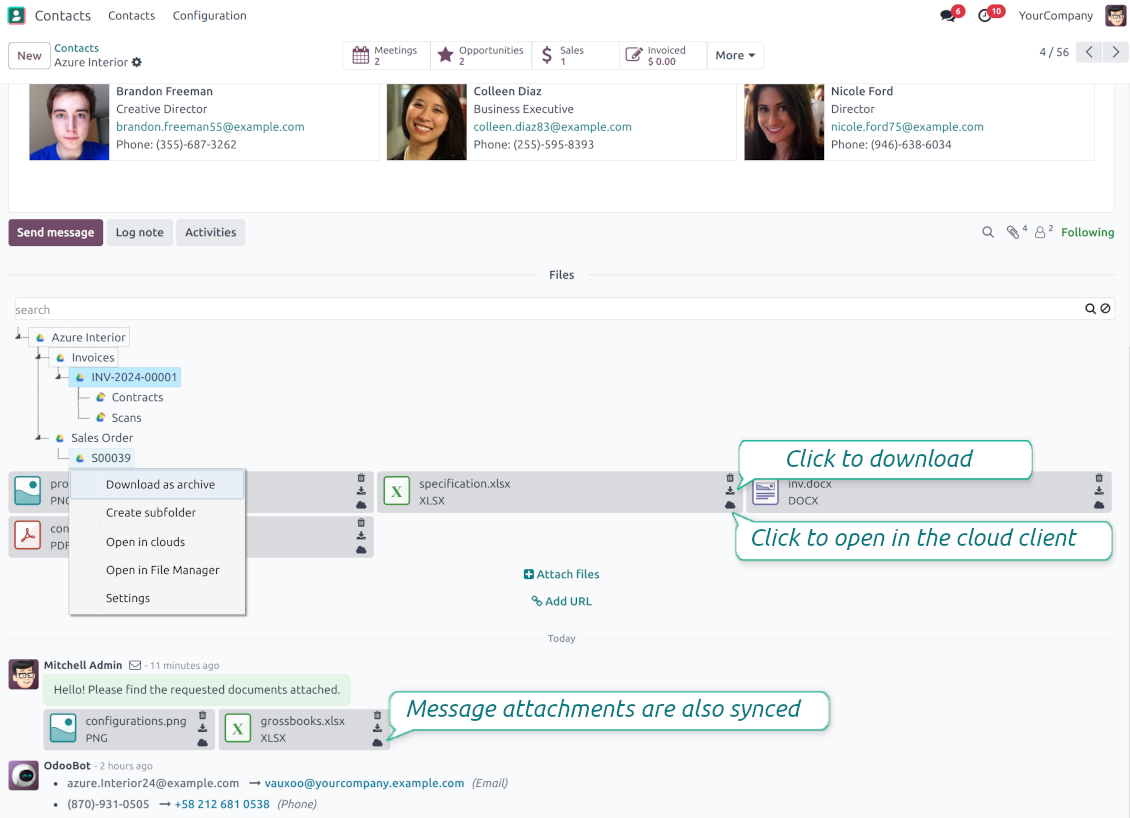
Select a folder to see its attachments. By default, files of the object root directory are shown
-
Download any folder with all attachments as a single zip archive (right mouse click > Download as archive)
-
Open the already synced folder in its cloud client (right mouse click > Open in clouds)
-
Upload attachment to a chosen folder (use the button 'Add attachments' or drag files to the attachment box area)
-
Instantly open any synced attachment in a linked cloud client (push the icon 'clouds')
-
Download any attachment to your local computer disregarding whether it is synced or not (push the icon 'download')
-
Use standard Odoo preview for both synced and local files (click on a file thumbnail)
-
Delete attachments as usual
-
All actions are equally applicable to object attachments and attachments related to messages.
Đồng bộ Cloud Storage
Multi synchronization
-
Use optional add-ons to synchronize the document management system with the cloud client(s) of your choice: Google Drive, OneDrive, SharePoint, Nextcloud, Dropbox, Amazon, Box, MinIO S3, NAS/WebDAV (Synology, QNAP, TrueNAS, etc.), and ownCloud. Have as many connections as you need
-
Establish multiple connections to different cloud clients simultaneously. For example, sync sales-related folders to Google Drive; tasks and projects - to SharePoint or OneDrive; HR documents - to Nextcloud/ownCloud; manufacturing specifications - to Dropbox. Take into account that a specific folder might be synced to only a single cloud storage solution. Its children would be synced to the same client
-
For each cloud client, the app lets set up a few instances. For example, for Google Drive, you may share some folders to your personal drive, others - to one of your team drives, and the rest - to your teammate's drive
-
To establish a connection with particular cloud storage, follow the instructions that are specific for client types. See the tab Configuration for details
-
Any connection might be paused manually if it is needed. It might be also auto-stopped if there are critical issues during the sync. Then, you should re-connect to a target cloud client
Cloud clients
-
Synchronization for all cloud clients is based on the same principles and on the same queue. Simultaneously, there might be differences in sync results due to different features of various cloud storage solutions
-
Establishing connections for different types of cloud clients assumes installing optional add-ons, different approaches for Odoo, and external API configuration. Follow the instructions on the tab 'Guidelines'
-
Google Drive Odoo Integration allows establishing a connection with any personal or team drive
-
OneDrive / SharePoint Odoo Integration assumes synchronization with any drive of personal/business/SharePoint tariffs
-
ownCloud/Nextcloud Odoo Integration et integrate Odoo with any instances of ownCloud and Nextcloud. In comparison to other clients, the app allows setting the type of attachment links. By default, Odoo links are internal: only authorized users may access them. Optionally make links public (the setting 'Use Public URLs'). See details on the guidelines tab
-
Dropbox Odoo Integration works for all DropBox tariffs, including Personal DropBox (Basic, Plus, Family) and business DropBox (Professional, Standard, Advanced). In comparison to other clients, the app allows choosing whether cloud items would be shared or internal. See details on the guidelines tab
-
Amazon S3 Odoo Integration (amazon_s3_odoo) synchronizes Odoo folders and attachments with Amazon S3 buckets
-
NAS/WebDAV Odoo Integration (nas_odoo) connects Odoo documents with NAS and WebDAV-compatible storage, including Synology, QNAP, and TrueNAS
-
Box Odoo Integration (box_odoo) synchronizes Odoo folders and attachments with Box cloud storage
Automatic two-sided sync
-
Integration is based on scheduled jobs and is fully automatized. The app regularly checks changes in systems and runs sync operations
-
Synchronization is bilateral. Updates in Odoo are reflected in cloud clients (direct sync); changes in cloud clients modify Odoo folders and attachments (backward sync)
-
Tắt đồng bộ từ đám mây trên một máy khách để giữ đồng bộ một chiều. Thay đổi trong Odoo vẫn được đẩy lên kho đám mây, nhưng tệp và thư mục được tạo, đổi tên hoặc xóa ở đó không xuất hiện trong Odoo. Tắt lại tùy chọn sẽ áp dụng các thay đổi đã tích lũy, kể cả việc xóa, ở lần đồng bộ tiếp theo
-
Any cloud connection might be reset. In this way, the app assumes getting back all items back to Odoo (reverse sync)
-
Odoo folders and attachments might be re-attached to a new cloud client. Hence, items will be first taken back to Odoo (reverse sync) and then put will be put to the new cloud storage (direct sync)
Queue-based synchronization
-
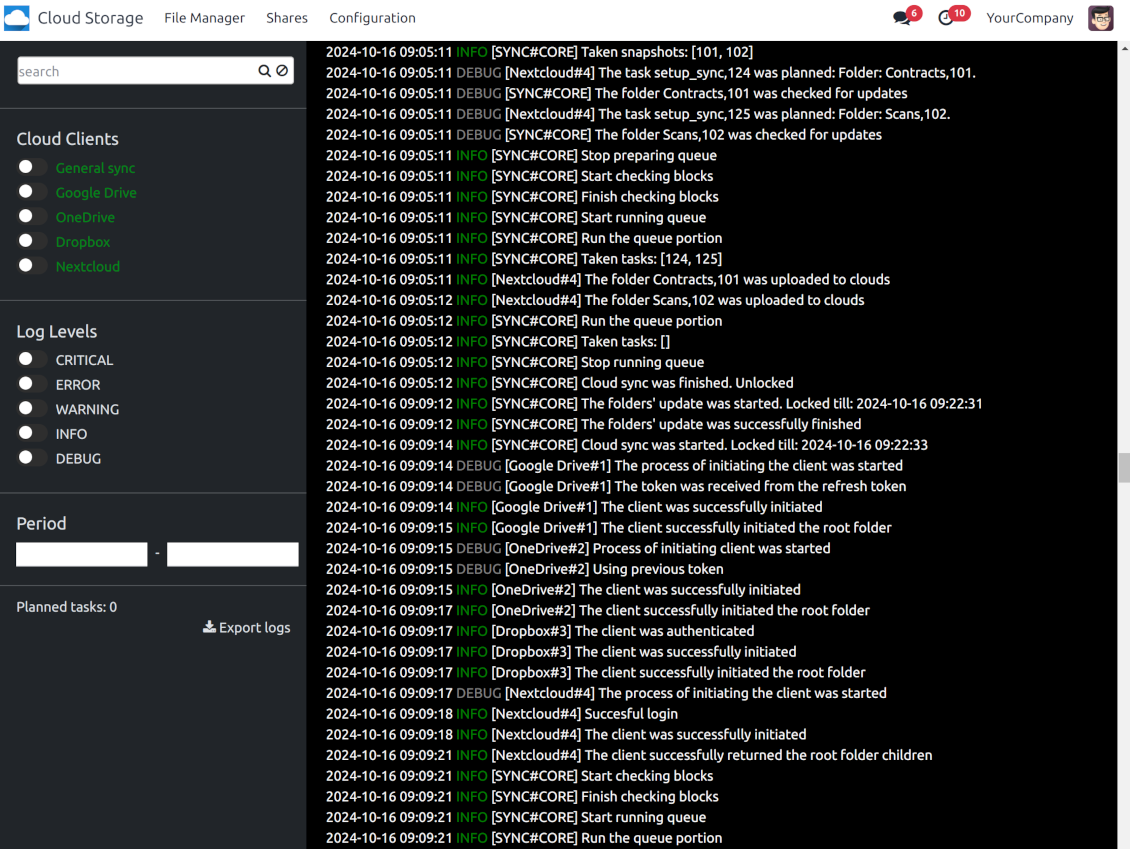
Once in 15 minutes, the app examines updates in Odoo and cloud storage(s) to prepare a synchronization queue
-
Folders' checks follow the First-In-First-Out (FIFO) principle. So, directories that have not been examined for the longest will be processed first
-
Once in 15 minutes, the sync queue is run by the special scheduled job. Firstly, the most important (blocking) tasks would be done
-
Control planned jobs and their fulfillment in the special Odoo logs interface (Cloud Storage > Configuration > Sync Logs). Subscribe for particular cloud clients notifications
-
If the app faces sync failures, it will re-try operations afterward. Sync queue processing would not be stopped if there are items not blocked by such failures
Odoo attachments for cloud storage: direct sync
-
Direct sync prepares the folders' hierarchy and uploads Odoo attachments for cloud storage
-
Direct sync checks whether attachments are added or deleted for synced directories. If so, they would be created or removed in cloud storage. In particular, it means that any file added to a folder-related Odoo object (e.g. Quotation), would be automatically moved to a linked cloud client
-
Direct sync makes all synced Odoo attachments change their type to a link (URL), while binary content is removed with one of the next Odoo cleaners. So, no actual files would be stored on your Odoo server
-
Direct sync checks whether a new folder is added. Disregarding whether it is done manually or automatically, the app would generate a peer directory in a cloud storage
-
Direct sync checks whether there are any updates in folders. If so, such changes are reflected in a cloud client
Cloud storage files and folders for Odoo: backward sync
-
Backward sync checks whether any files or subfolders are added to cloud storage folders. If so, the app would create URL attachments/subdirectories inside linked Odoo directories (and hence Odoo objects if any)
-
Backward sync checks whether there are any updates in folders or attachments. Such updates would be then reflected in Odoo
-
Backward sync checks whether any files are deleted/moved in a cloud document folder. If so, a linked Odoo attachment would be also unlinked or moved
-
If you deleted a cloud storage folder related to a folder rule / Odoo object, their child files would be deleted as well. Thus, Odoo would remove related attachments. The folders, however, will be recovered with a direct sync
-
In case of conflicts, direct sync changes are in general considered more important than backward updates.
Resetting or changing cloud client: reverse sync
-
In case you decided to reset the connection with a specific cloud client, files would be moved back to Odoo
-
Tắt đồng bộ ngược trên một máy khách khi bản sao trên kho đám mây phải là bản duy nhất, hoặc khi kết nối bị hỏng. Gỡ, đặt lại hoặc tắt máy khách đó khi đó không tải tệp về và không xóa gì trên kho đám mây. Kết nối giữa các đối tượng Odoo và mục đám mây của chúng bị cắt. Liên kết đã lưu vẫn mở tệp trên kho đám mây, nhưng Odoo không còn tải xuống, xem trước hoặc mở các thư mục và tệp đó. Kết nối này không khôi phục được
-
In case you decided to change the cloud client of a folder rule or a folder, files would be first taken back to Odoo, and then direct sync for a new client would be done
-
Reverse sync operations are prioritized to direct and backward sync operations
-
Not all items can be correctly reversed to Odoo due to cloud client peculiarities. For example, there are documents that may exist only in cloud storage environments (e.g. Google Sheets). The app would try to convert such documents, but in some cases, it would require manual interactions.
Automatic Folder Structure
Rules for automatic folders
-
The app allows preparing its own folder for any Odoo object
-
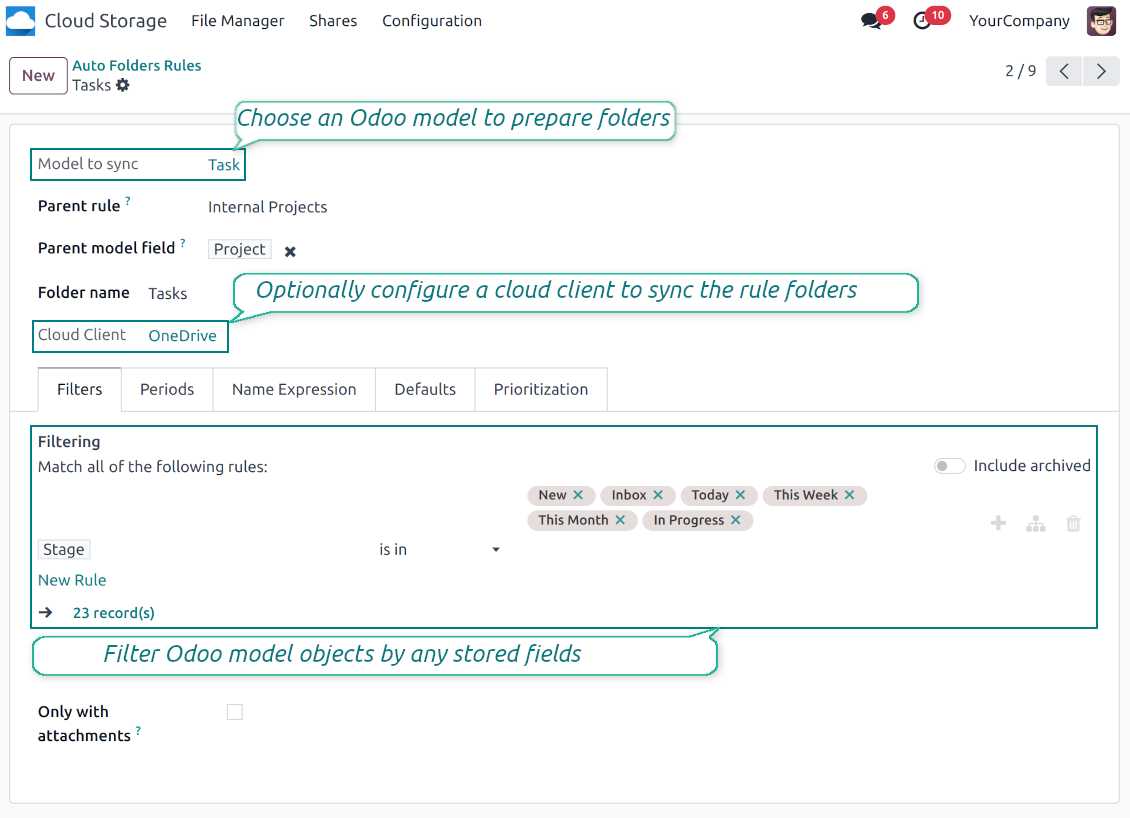
To configure a particular Odoo document type to generate a folder, you should just prepare a new folder rule (Cloud Storage > Configuration > Folder rules). For example, select the model 'Task' to make Odoo add a folder for each project task, so Tasks > Task 1, Task 2, ...
-
Automatically created directories would contain all attachments their linked objects have
-
Folders are updated regularly based on the scheduled job
Multi directories for each model
-
Each Odoo model might have a few linked folders
-
Apply any model storable field to filter Odoo objects and, in this way, split objects into a few super directories. For example, have own folders for individuals and companies, for European and American opportunities, for quotations and confirmed orders, for each project
-
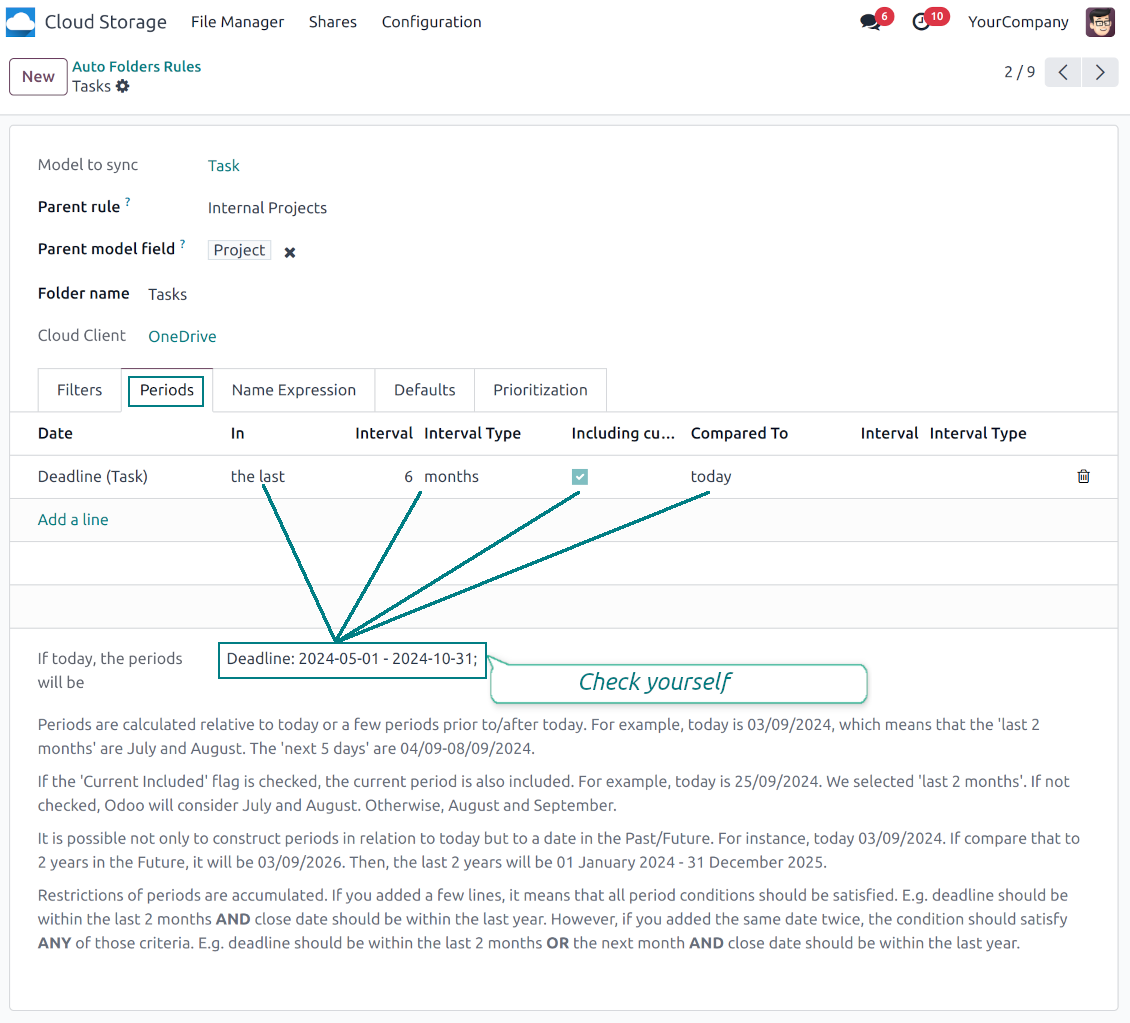
Filter Odoo objects by relative periods by applying date fields of linked documents. For example, leads registered in the last 3 months or invoices updated in the last week
-
As a result, the app lets have paths like 'Odoo > Quotations Europe > SO-001' or ' Odoo > the last year posted invoices (America) > SO-001'
Flexible folders' tree
-
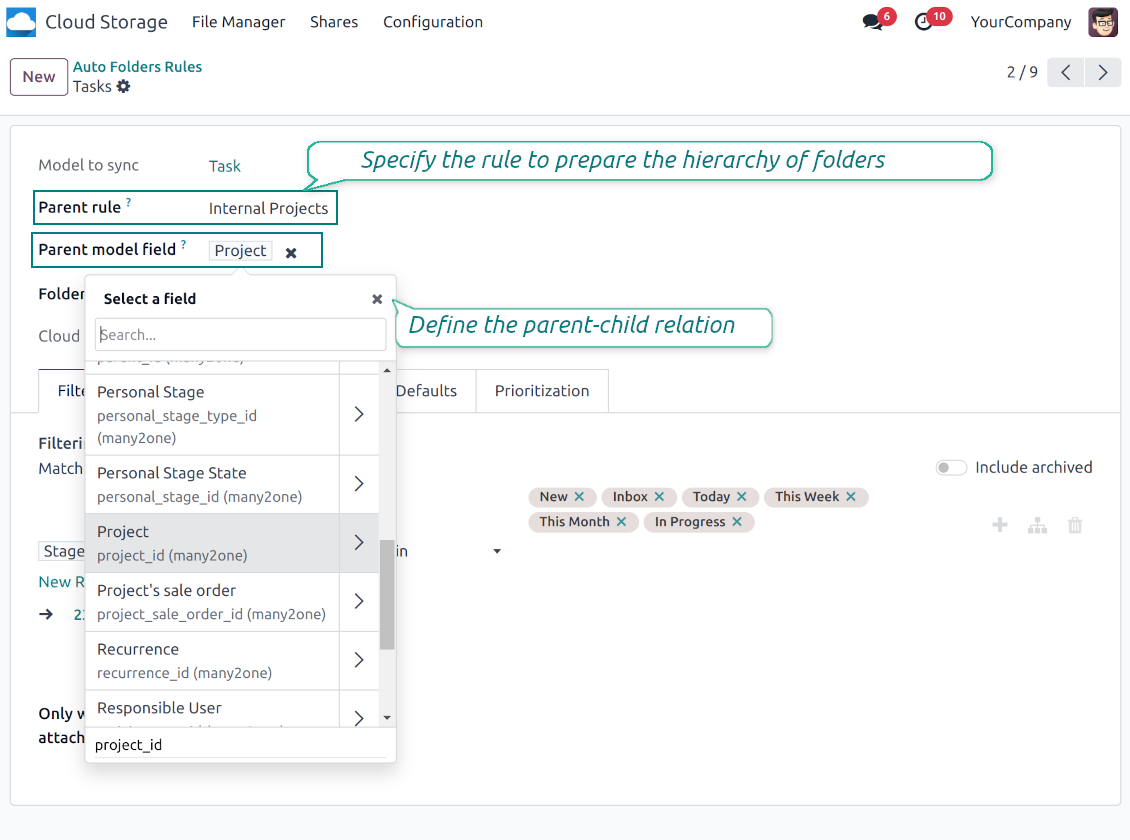
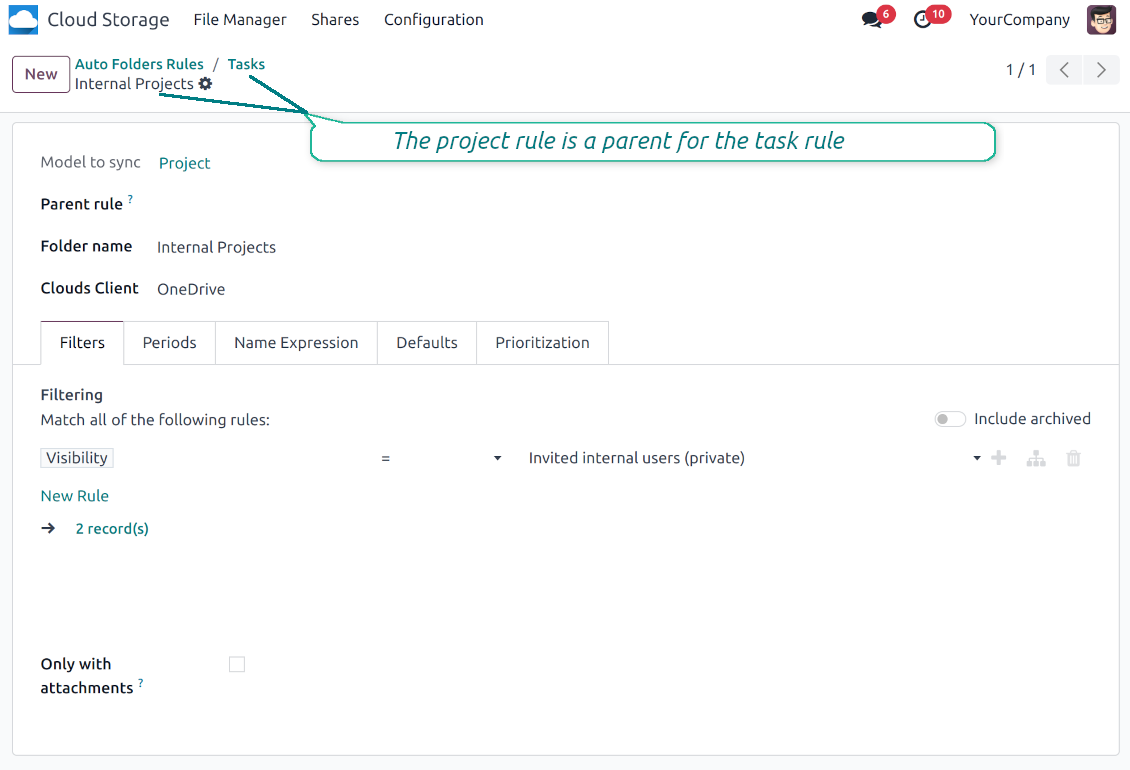
It is possible to set up a hierarchy of folder rules to prepare a more flexible directories structure
-
To that goal define a parent rule for a required folder configuration. For example, use a project-related rule as a parent for a task-related rule, a customer-related rule - for invoices-related rules
-
In order for folder relations to work correctly, it is also needed to enter a parent model field. So, it is the field that links models between each other (many2one relation). For example, 'Project' of a task, 'Customer' of a sales order, or 'Sales Team' of an opportunity
-
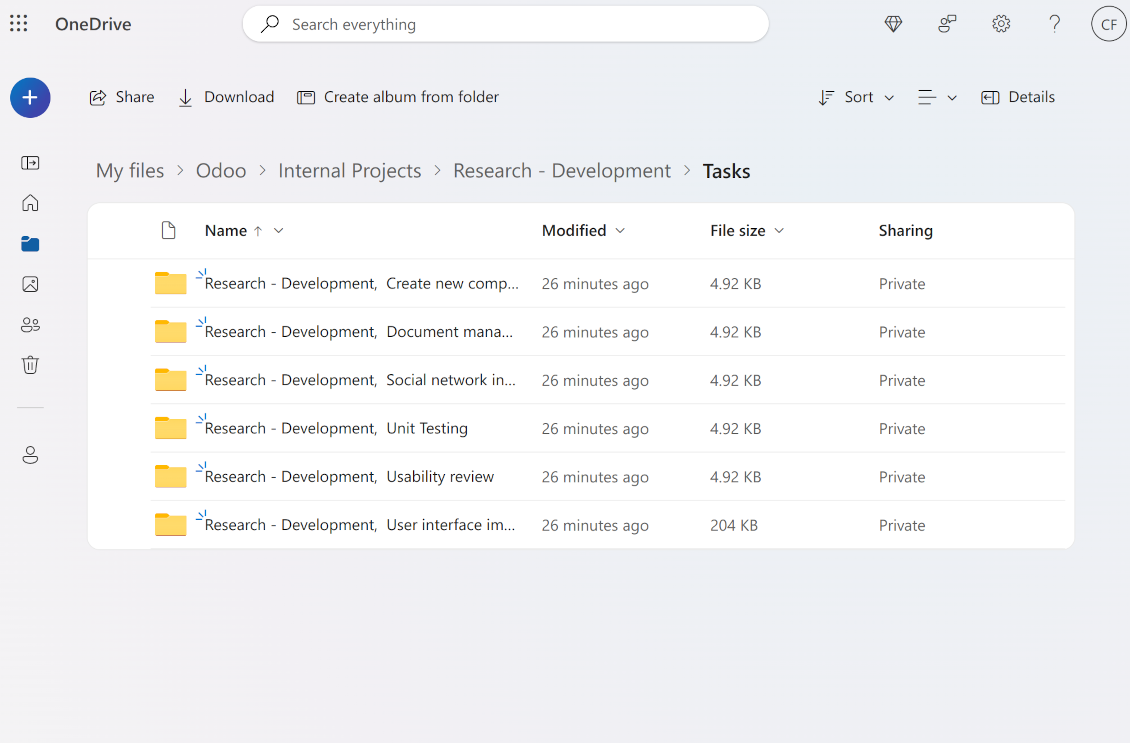
As a result, the tool allows reflecting your Odoo workflow logic and have paths like 'Odoo > Customers > Azure Interior > Projects > Software Design > Prepare Specification' and 'Odoo > Customers > Azure Interior > Quotations > SO-001'
Subfolders, default folders, and default files
-
The app lets add an unlimited number of manual subfolders for each folder. In particular, you may have a directories tree right in each object attachment box
-
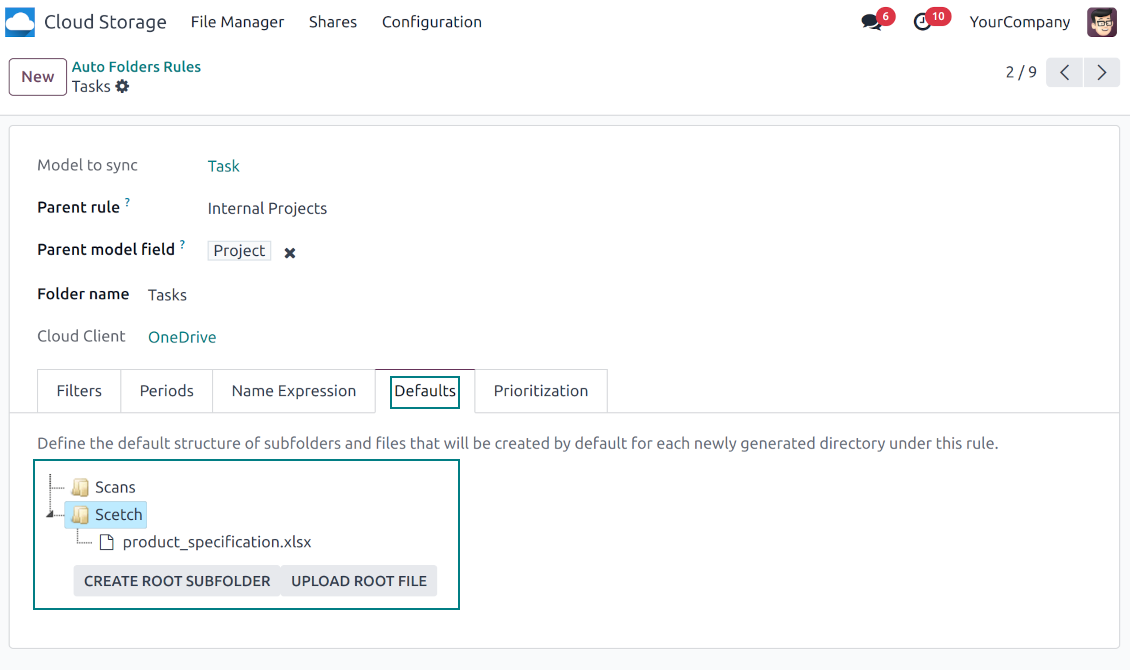
For the first generation, it is possible to define default folders, so subdirectories would be auto-generated for a specific Odoo object folder. Afterward, you may add delete/edit those or add new ones
-
The same mechanics are applied to prepare default files. For example, to have contract/personal card templates which then are assumed to be filled with real data
Configurable folder titles
-
Each folder rule assumes to generate a directory. Names for such directories are assigned right on a rule form. For example, introduce 'Jobs' for a task-related rule or 'HR' for employees' folders. By default, the Odoo model name would be used
-
For object-related folders, the names are generated based on the Odoo standard display names. So, if not defined the opposite, it would be the same title as you see in the Odoo form view header
-
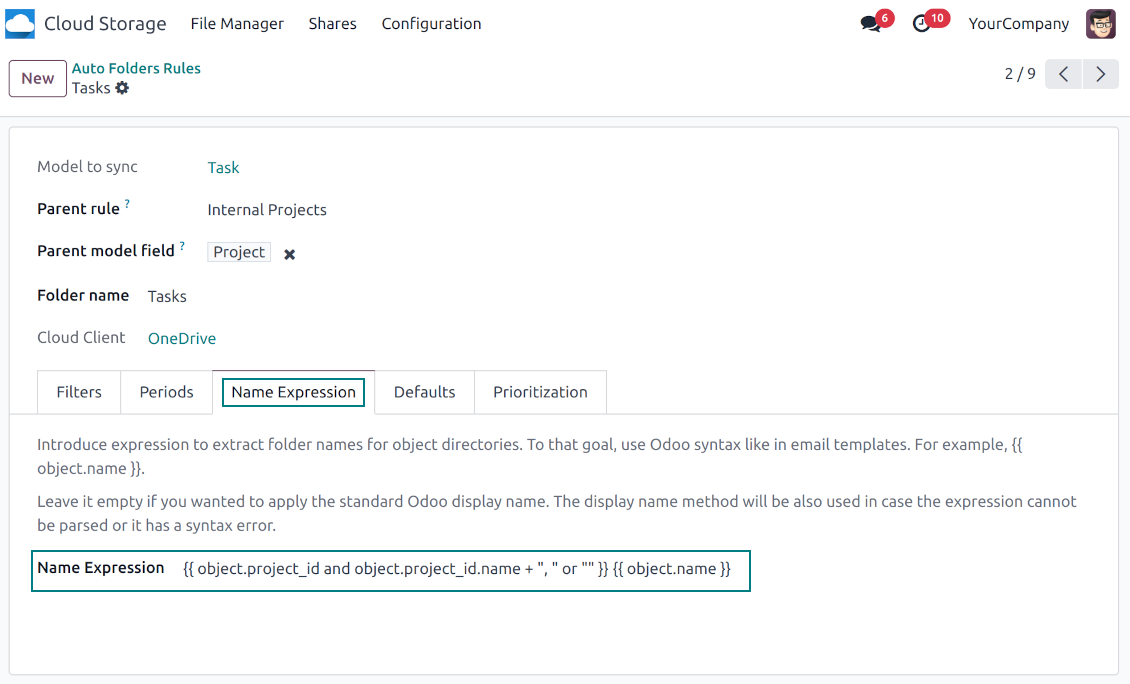
The app lets define complex name expressions for object-related folders (the tab 'Name Expression' on a folder rule form). To that goal, apply the syntax used in Odoo email templates. For example, {{ object.project_id.name }}, {{ object.name }} to reflect a project name in tasks folders
-
Avoid the following symbols in folders' and files' names: *, ?, ", ', :, <, >, /, +, %, !, @, \, /,. Direct sync will replace such symbols with '-'. It is done to avoid conflicts with file systems. Avoid also too long names: e.g. more than 100 symbols
Enterprise Documents
-
The app allows generating folders for workspaces introduced by the Odoo Enterprise apps 'Documents'
-
To force Odoo to prepare workspace-related directories, define folder rule(s) of the type 'Workspace-Related rule'. The tool would automatically create linked folders and sync those for chosen cloud storage with one of the next jobs
-
It is not obligatory to reflect the whole DMS structure. Thus, it is possible to filter workspaces by any storable field. For example, to add a folder only for workspaces that contain the keyword 'Internal'. Take into account: if a workspace was synced, all its child workspaces would be also synced
-
If you generated a subfolder for any workspace-related folder, the app would also create such a Documents workspace
Typical use cases
-
Customers: add all partner files in a single super directory. Optionally distinguish companies and individuals. For example, Odoo > Customers > Azure Interior > Contacts > John Brown
-
Sales orders and invoices: keep all sale-related printings and contracts in your own quotation directories for each customer. For example, Odoo > Customers > Azure Interior > Orders > SO-001 and Odoo > Customers > Azure Interior > Invoices > INV-00001
-
Opportunities: store all specifications, requirements, and any files which would let you make a good offer carefully structured by each sales team and case. For example, Odoo > Sale teams > Europe > Leads > Interest in 50 chairs
-
Project and tasks: prepare a folder for each customer project and task. For example, Odoo > Customers > Azure Interior > Projects > Software design > Tasks > Specification
-
Human resources: gather all files by each employee in a single folder: photos, document scans, contracts. Structure employees by department. For example, Odoo > Departments > Accounting department > Employees > Anita Olivier.
Chia sẻ tệp và thư mục
-
Share particular attachments, whole directories, or even all files of specific tags
-
Grant access to chosen Odoo contacts. Send an invitation to any Odoo portal users at any moment
-
Generate a special access link for public use (even without a user). Change it to make the previous one outdated
-
Make shares for temporary use or available constantly until archived
-
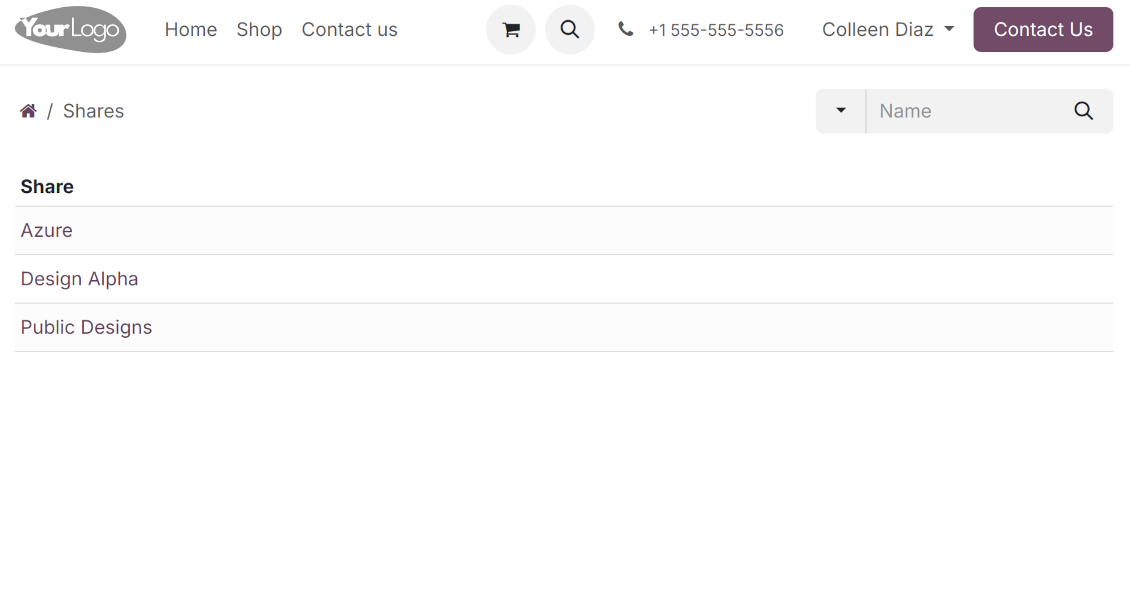
Create an unlimited number of shares with any setups and attachments involved. Portal users might access those through the special entry "Shares" in the Odoo's portal
-
For single-view purposes, shares support hierarchy so as to make comfortable navigation by those
-
Share users can download any shared file, a whole share, a particular directory, or a tag as a ZIP archive
-
Optionally let upload files to the selected or default folder. Files drag and drop is supported
-
Users are always allowed to search attachments by title, linked folder, and tags
-
Optionally allow navigation by folders and/or tags. Shared tags/folders, their children, and ones linked to shared attachments will be available
-
Let users add tags and folders by themselves. Show/hide searching items in tags/folders navigation trees
-
Turn on/off a chat per each share.
Quản lý tài liệu và quyền truy cập đồng bộ
-
Access for each Odoo automatic folder is regulated based on a linked object. If such an Odoo object is available for a specific user, its directory would be also available for her/him. For example, if Anita Olivier is the task manager of 'Prepare specification', then she may access the folder 'Tasks' and 'Tasks > Prepare Specification'
-
Access to Odoo manual folders is regulated based on its user groups and users stated in those folders' settings. If nobody is specified, a manually created folder is available for everyone. For example, if Anita Oliver is a sales manager, she may access the quotation-related folder 'Odoo > Orders > SO-001'
-
To access any folder, a user should be able to access all its parents. For example, if Anita Oliver has rights for employees but does not have for departments, then she might not read 'Odoo > Departments > Administration > Employees > Mitchel Admin'. However, if the folder 'Employees' becomes a stand-alone folder without a parent, then Anita would be able to access 'Odoo > Employees > Mitchel Admin'
-
The app does not regulate access levels for cloud clients and their items. The tool regulates rights only for Odoo objects and synchronizes those to required storage. After the sync, if necessary, you should apply the settings for a target cloud client, folders, and files
-
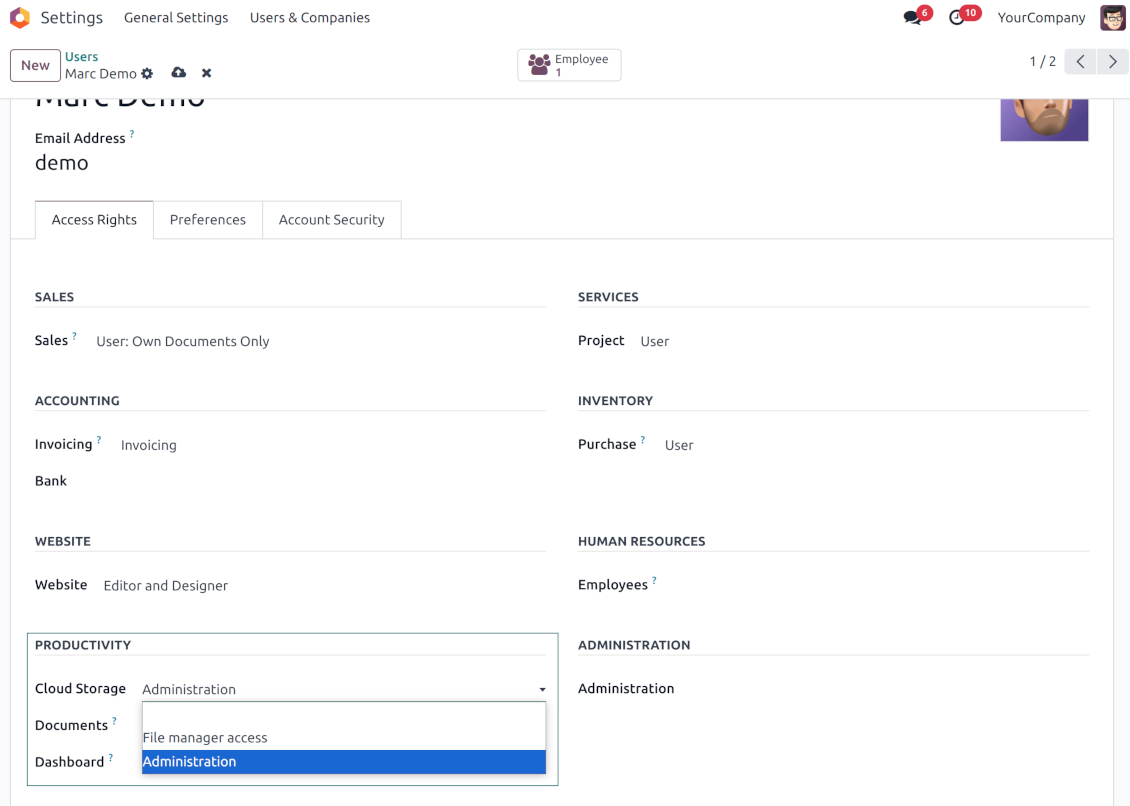
To observe the menu 'Cloud Storage' and the app file manager, a user should belong to the security group 'Cloud Storage > File Manager Access'
-
To configure automatic folder rules, establish connections with various cloud clients, control sync logs, and apply the app settings, a user should belong to the security group 'Cloud Storage > Administration'.
Ghi chú sử dụng
-
The app assumes automatic regular synchronization with various cloud clients. Please take into account that synchronization is not real-time but is based on tasks queue and scheduled jobs. Depending on the number of folders and attachments, it might take time for the app to check all directories and do the jobs. That's why, until the sync is done, Odoo attachment interfaces work as in standard Odoo.
-
Cloud connections rely upon the API of the related cloud clients. Such communication between systems is risky by concept due to possible disconnections, API updates, and unsolvable conflicts. The app is designed to cope with such risks by carefully processing failures and checking cloud client states. Simultaneously, make sure that you have configured a proper backup strategy for both Odoo and cloud clients.
-
The special factors of risks are sync scope and reverse operations. The higher the sync scope is, the more it would take Odoo to finish integrations. Hence, more space for errors exists. Try to decrease sync scope logically by choosing only required folders. Reverse operations might be risky since assume reflecting cloud clients' features which might be absent in Odoo. For example, Google Sheets cannot be opened outside Google Docs. The app would try to solve the scenarios by applying similar features (e.g. by converting a file to simple electronic tables). However, that is not always possible, and in this way, manual interactions would be required.
Mẹo cấu hình và cài đặt cho Cloud Storage Solutions Odoo v.18
Cấu hình máy chủ Odoo
Để đồng bộ hoạt động đúng, đặt timeout phù hợp trong tệp cấu hình Odoo: LIMIT_TIME_CPU, LIMIT_TIME_REAL, LIMIT_TIME_REAL_CRON phải lớn hơn 900 giây.
Với Odoo.sh việc này không nên làm, vì thời gian chờ đã định sẵn và không cấu hình được.
Cũng tránh đổi tần suất cron mà ứng dụng giả định: '[Cloud Storage] Prepare Cloud Folders', '[Cloud Storage] Run / Prepare sync queue'. Các việc đó được cấu hình chạy mỗi 15 phút, và tần suất đó được dùng trong thuật toán để tránh gián đoạn và mất dữ liệu. Nếu cần dừng đồng bộ một lúc, hãy tạm dừng từng cloud client.
Phụ thuộc Python chung
Công cụ phụ thuộc thư viện ngoài 'sortedcontainers'. Cài cho máy chủ Odoo bằng lệnh:
pip3 install sortedcontainersThiết lập tích hợp OneDrive hoặc/và SharePoint
Phụ thuộc Python
Công cụ phụ thuộc thư viện ngoài 'microsoftgraph'. Cài cho máy chủ Odoo bằng lệnh:
pip3 install microsoftgraph-python
Cấu hình và đăng nhập
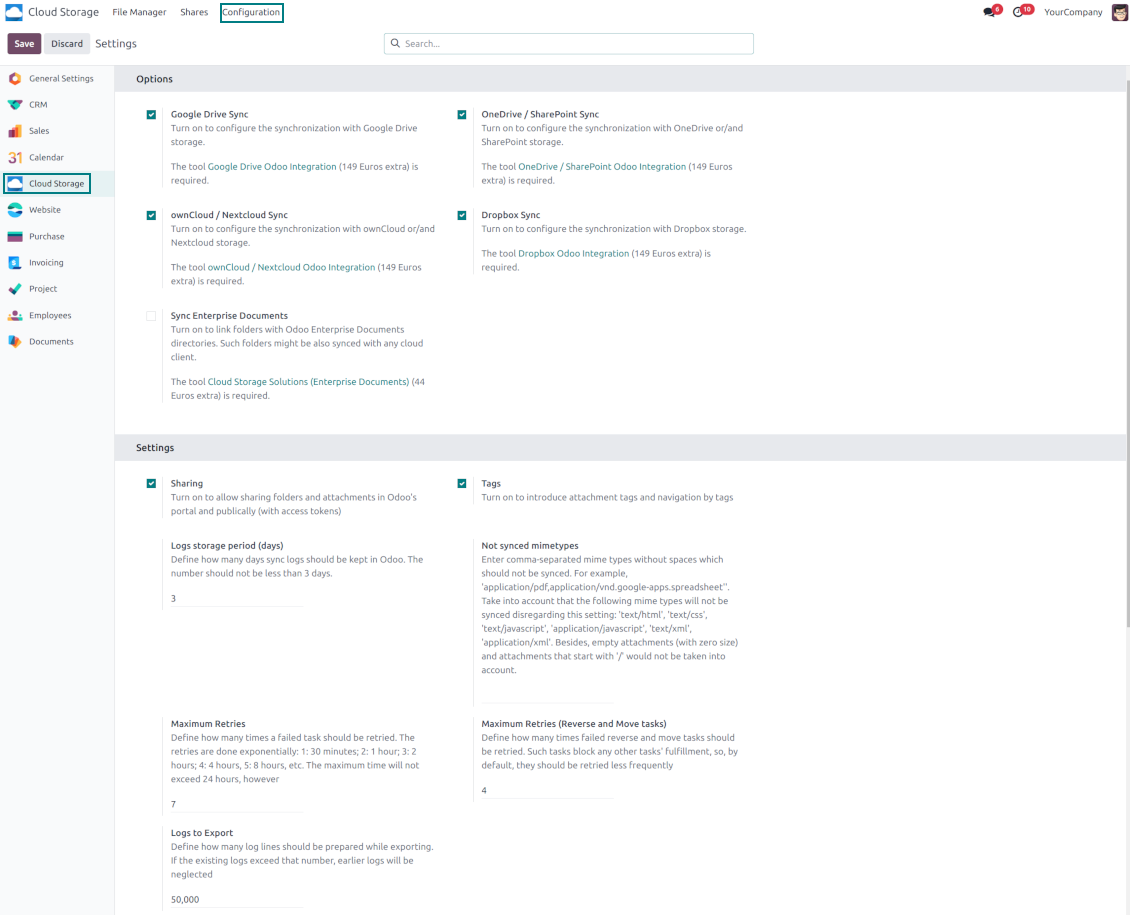
- Bật tùy chọn 'OneDrive / SharePoint Sync' (cloud Storage > Configuration > Configuration). Cần add-on tùy chọn OneDrive / SharePoint Odoo Integration
- Hãy chắc Microsoft user của bạn có quyền quản trị đầy đủ cho OneDrive / SharePoint muốn kết nối với Odoo. User này chỉ cần để cấp quyền; dữ liệu user sẽ không được giữ trong Odoo và sẽ không được dùng sau đó. Ngoài ra, bảo đảm một địa chỉ email Microsoft bạn dùng không bị chuyển hướng (thường xảy ra khi cấu hình tên miền, trong khi địa chỉ chính vẫn thuộc miền Microsoft như @outlook.com, @office365, v.v.)
- Vào Azure Portal của bạn: https://portal.azure.com/#blade/Microsoft_AAD_RegisteredApps/ApplicationsListBlade
Ứng dụng phải được đăng ký trong một directory (tenant). Microsoft không còn cho phép tạo ứng dụng mới ngoài directory.
- Nếu bạn đã có directory Microsoft 365 / Azure của công ty, chuyển cổng (góc trên phải) sang directory đó rồi tiếp tục.
- Nếu bạn chỉ có tài khoản cá nhân (@outlook.com, @hotmail.com, @live.com) và thấy "these applications are associated with the account ... but are not contained within any directory", bạn chưa có directory. Đăng ký tài khoản Azure miễn phí với cùng tài khoản Microsoft: https://azure.microsoft.com/free/ - Dùng thử Azure miễn phí. Thao tác này tạo Default Directory không mất phí.
- Microsoft yêu cầu thẻ chỉ để xác minh danh tính; tạm giữ khoảng 1 USD rồi hoàn lại. Bạn không bị tính phí directory hay đăng ký ứng dụng.
- Directory (Microsoft Entra ID Free) và mọi ứng dụng đăng ký trong đó vẫn chạy độc lập với tín dụng dùng thử Azure 30 ngày / 200 $. Tín dụng đó dành cho tài nguyên Azure trả phí mà bạn không dùng ở đây. Ứng dụng của chúng tôi không yêu cầu thanh toán.
- Nếu cả directory hoàn toàn không được dùng trong thời gian rất dài (ngưỡng của Microsoft khoảng 200 ngày không hoạt động), Microsoft có thể gửi email cảnh báo rồi đóng nó. Vì Odoo gọi ứng dụng này mỗi lần đồng bộ, kết nối đang chạy giữ directory hoạt động — điều này chỉ quan trọng nếu bạn ngừng đồng bộ hoàn toàn trong nhiều tháng.
- Khi đã ở directory thật (không phải "Microsoft Services"), mở App registrations tại đó.
- Nhấp «New registration»
- Introduce a new name for the application and assign the redirect URI as [YOURODOOSITENAME]/one_drive_token (e.g. https://odootools.com/one_drive_token). As the supported account types choose 'Accounts in any organizational directory (Any Azure AD directory - Multitenant) and personal Microsoft accounts (e.g. Skype, Xbox)'.
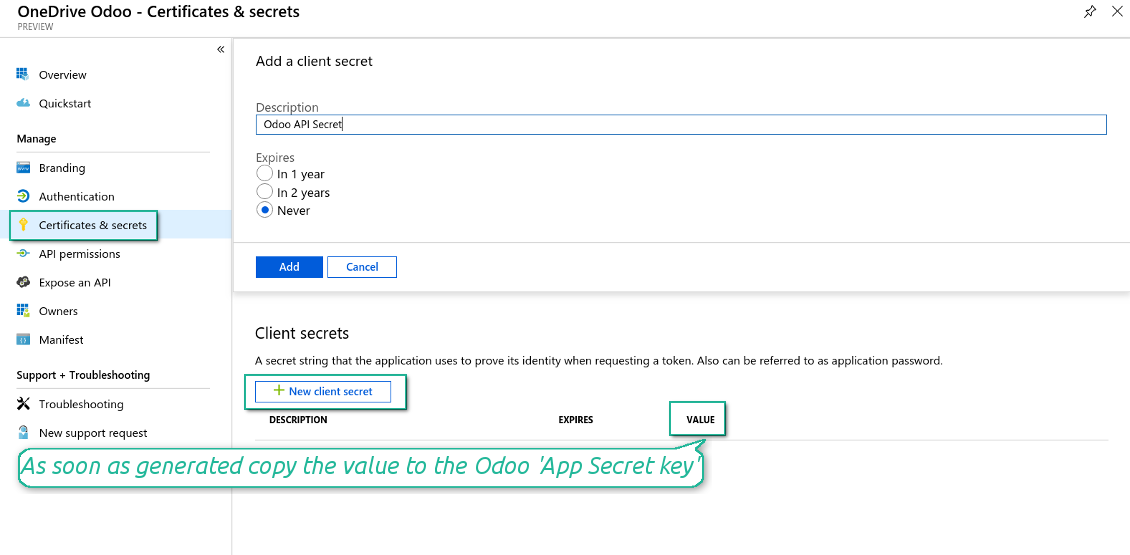
- Vào Certificates & secrets - Nhấp 'New Client Secret'. Lưu giá trị secret ở đâu đó
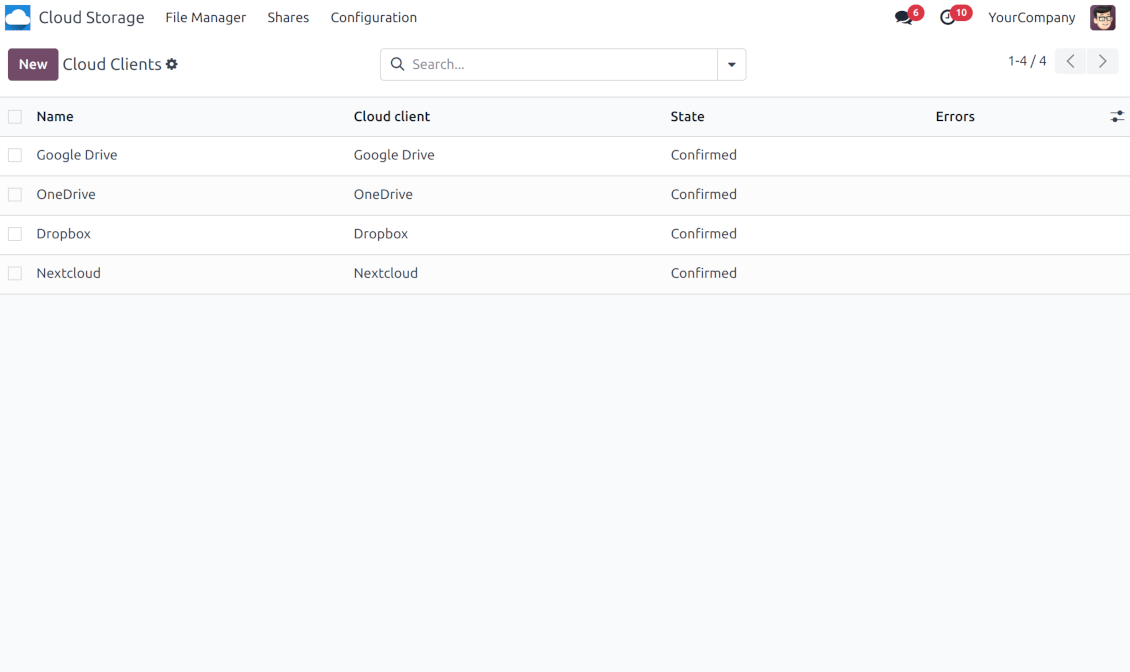
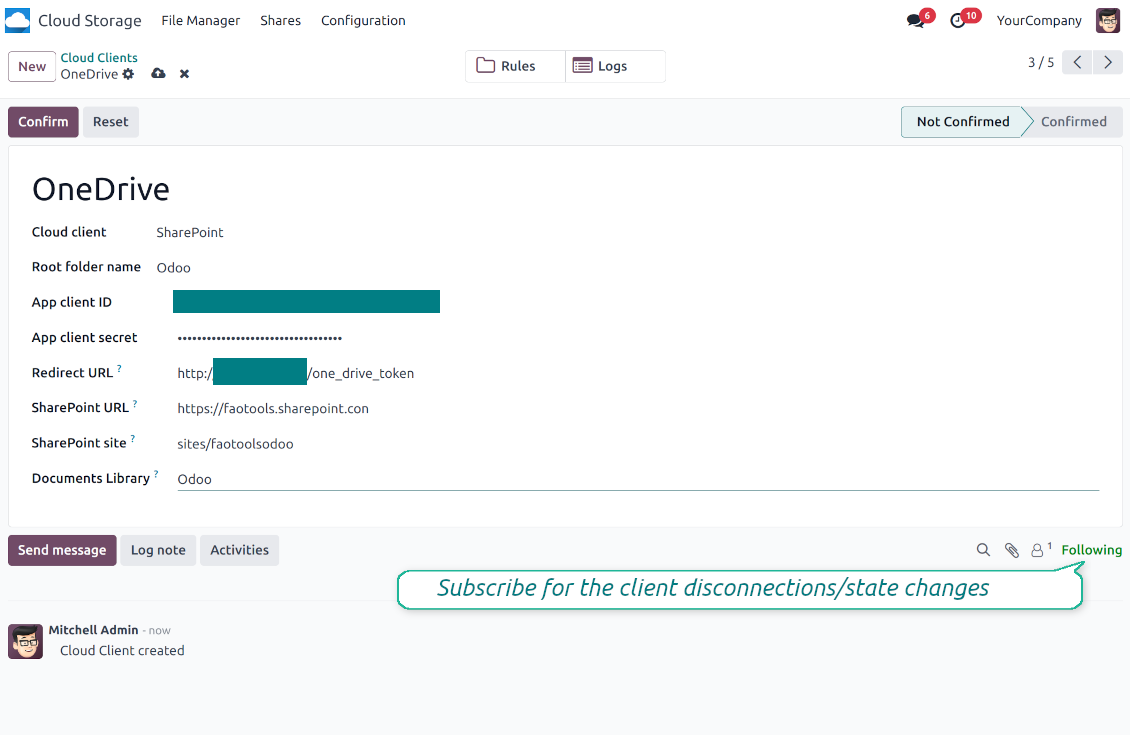
- Vào Odoo Cloud Storage > Cấu hình > Cloud Clients rồi nhấn 'Create'
- Với tham chiếu, nhập tên rõ với mọi người dùng
- Với Cloud client, chọn 'OneDrive' hoặc 'SharePoint' tùy phần mềm bạn đang dùng
- Với tên Root folder, nhập tiêu đề sẽ dùng làm OneDrive directory cha cho mọi thư mục đồng bộ. Ví dụ 'Odoo' hoặc 'OdooERP'
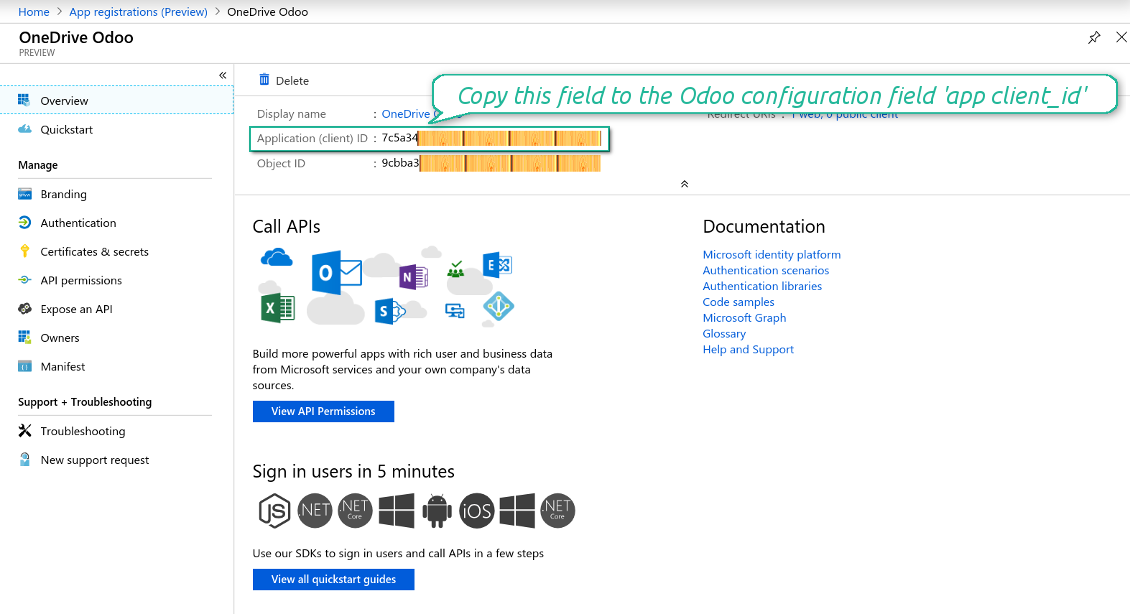
- Sao chép 'Application Client ID' vào 'App client ID'
- Sao chép giá trị bí mật vào trường 'App client secret'
- Chèn URL chuyển hướng đã tạo trước
- Nếu bạn dùng SharePoint:
- Vào site SharePoint và chuẩn bị thư viện tài liệu (drive) mới. Có thể dùng thư viện sẵn có, ví dụ 'Documents'. Thư mục Odoo sẽ được đặt ở đó sau đó và không thể chuyển sang thư viện khác
- URL SharePoint phải dạng https://[URL]/. Dấu '/' cuối là bắt buộc - không gồm tên site. Ví dụ, https://odootools.sharepoint.com/
- Site SharePoint phải là root (chính site gốc SharePoint), my_site_name (khi đó được coi là sites/my_site_name) hoặc sites/my_site_name (thay vì 'sites' có thể là 'teams' v.v.). Không được có '/' ở đầu hoặc cuối. Ví dụ, sites/odootools
- Với Documents Library, dùng thư viện tạo trong SharePoint
- Nhấn 'Confirm'. Odoo chuyển bạn tới trang đăng nhập Microsoft. Kiểm tra trong hệ thống, đồng ý mọi điều kiện và cấp mọi quyền được hỏi. If Microsoft shows an account already signed in and says it does not exist in tenant 'Microsoft Services' (or any other unrelated tenant), do not click that row. Click 'Use another account' and sign in with the Microsoft account that owns the app's directory
- Sau khi đăng nhập, OneDrive chuyển bạn trở lại Odoo. Đồng bộ OneDrive - Odoo đã sẵn sàng
- Áp dụng cloud client vừa tạo cho quy tắc thư mục và/hoặc thư mục thủ công cần đồng bộ với phiên bản OneDrive hoặc SharePoint đó
- Chờ công việc đồng bộ đã lên lịch khởi chạy. Chỉ dùng để kiểm thử: kích hoạt tích hợp thủ công từ Cloud Storage > Cấu hình > Cấu hình > nút 'Launch sync'.
Xem thêm video cấu hình
Tạo ứng dụng Azure
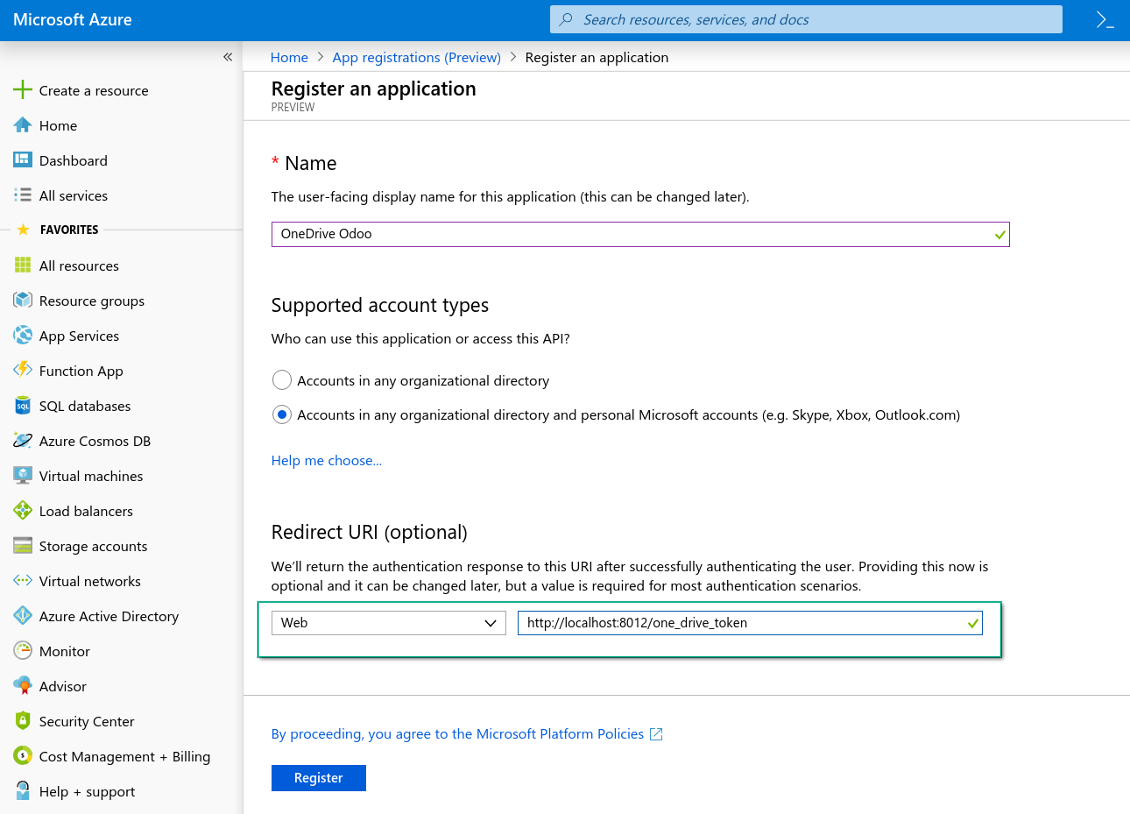
Nền tảng web OneDrive mới và URL chuyển hướng
Tạo bí mật mới cho ứng dụng Azure
Nhập khóa cấu hình trong Odoo
Thiết lập tích hợp Google Drive
- Bật tùy chọn 'Google Drive Sync' (cloud Storage > Configuration > Configuration). Cần add-on tùy chọn Google Drive Odoo Integration
- Vào Google Cloud Console qua URL https://console.cloud.google.com
- Chọn hoặc tạo một dự án
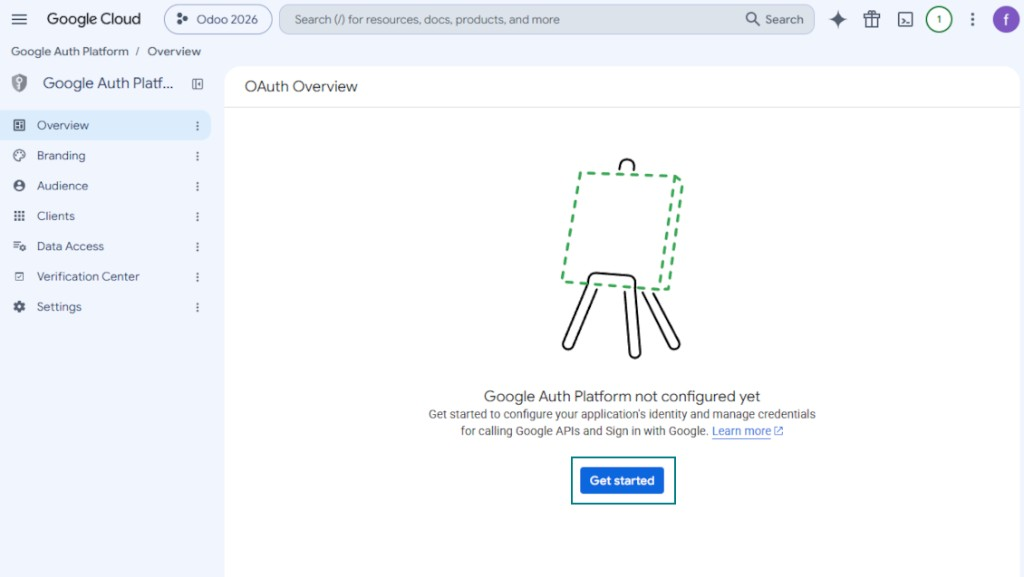
- Sau khi chọn dự án, bảng điều khiển mở Google Auth Platform. Nhấn 'Get Started'
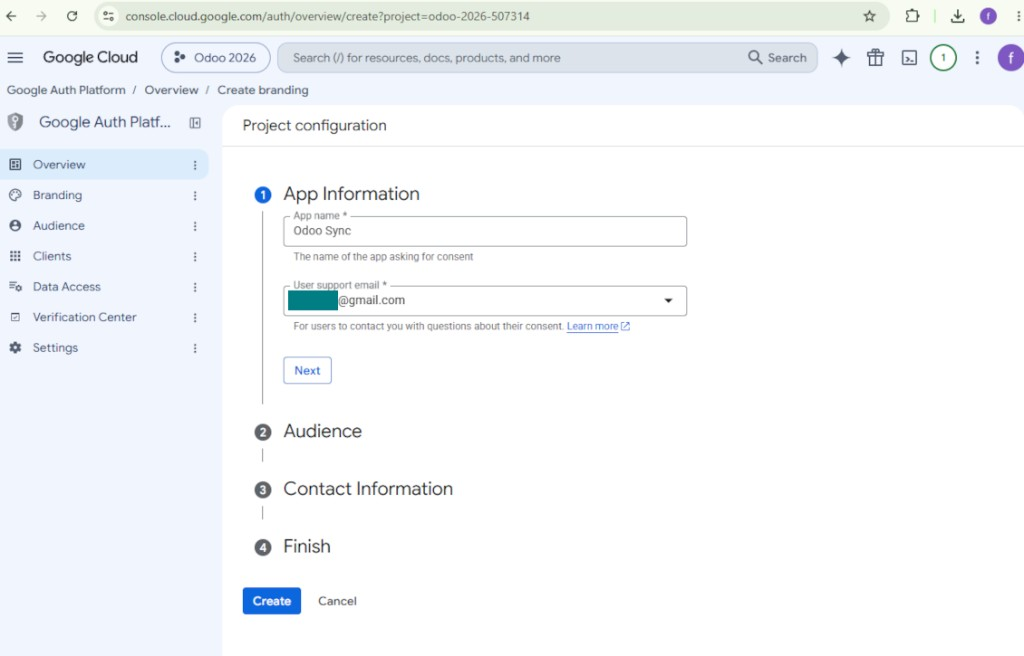
- Thêm thông tin ứng dụng
- Với tên ứng dụng, chọn bất kỳ tên phù hợp
- Với email hỗ trợ người dùng, chọn địa chỉ của bạn
- Nhấn 'Next'
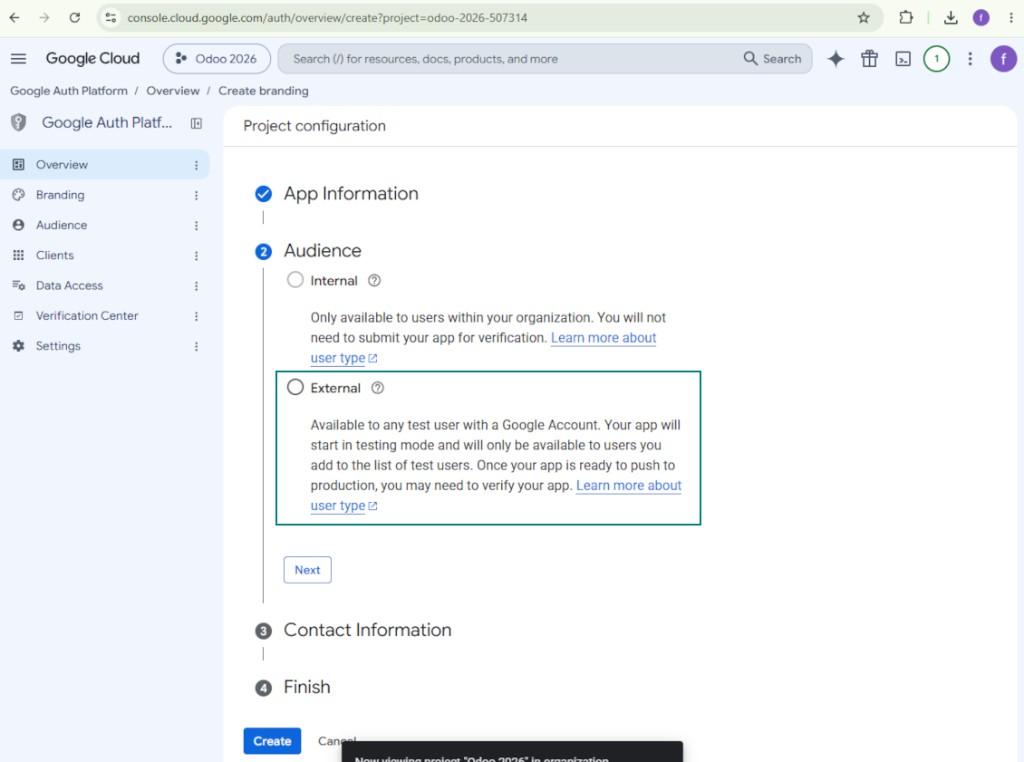
- Với audience chọn 'External' rồi nhấn 'Next'. Lưu ý: bạn vẫn chỉ dùng ứng dụng này cho kết nối Odoo của mình
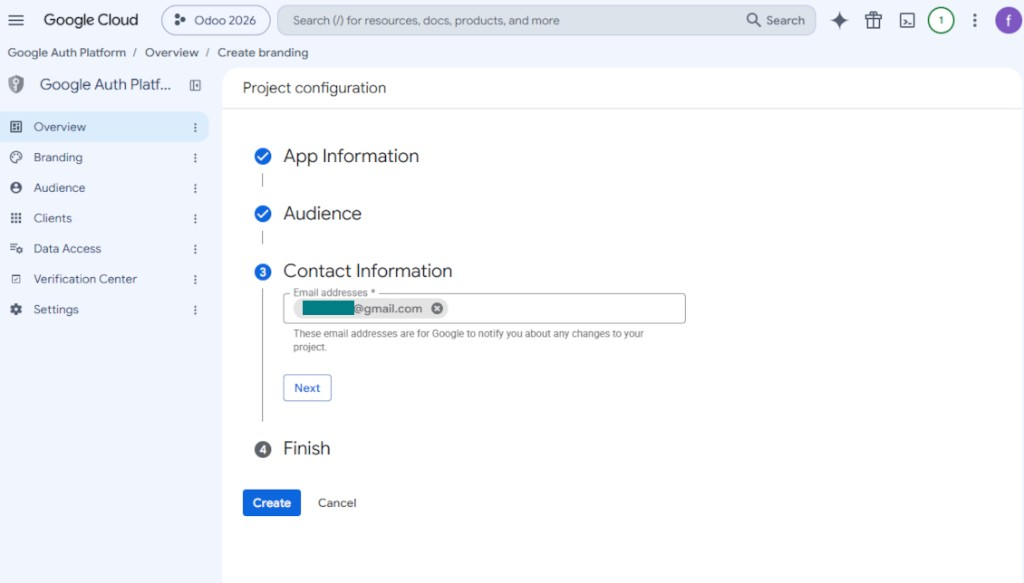
- Với thông tin liên hệ, nhập địa chỉ email Google hoặc Google Workspace rồi nhấn 'Next'
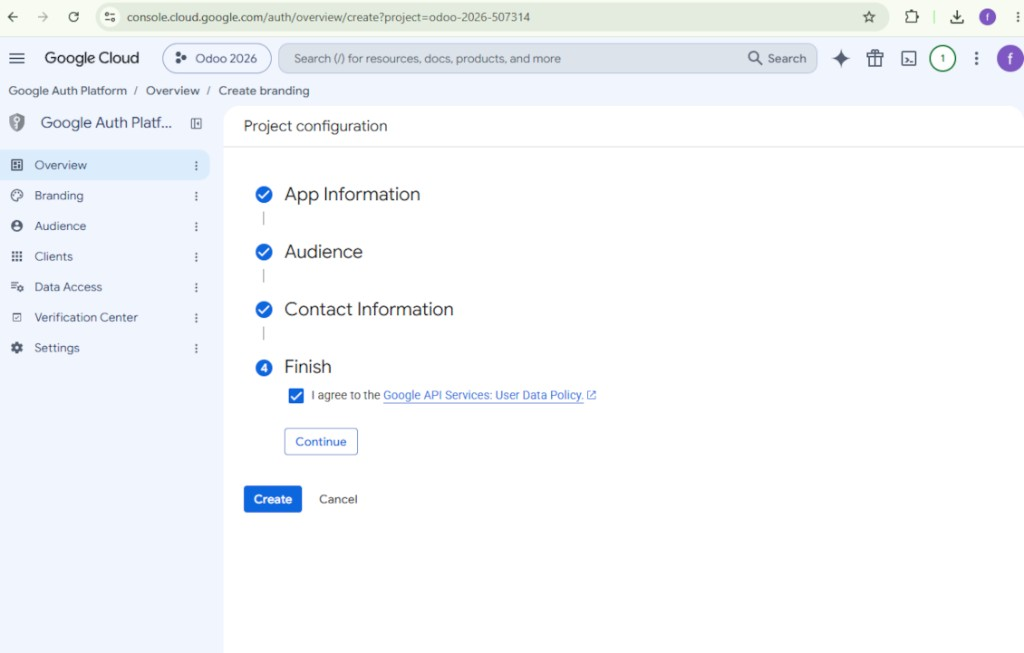
- Đồng ý Google API Services User Data Policy, nhấn 'Continue', rồi nhấn 'Create'
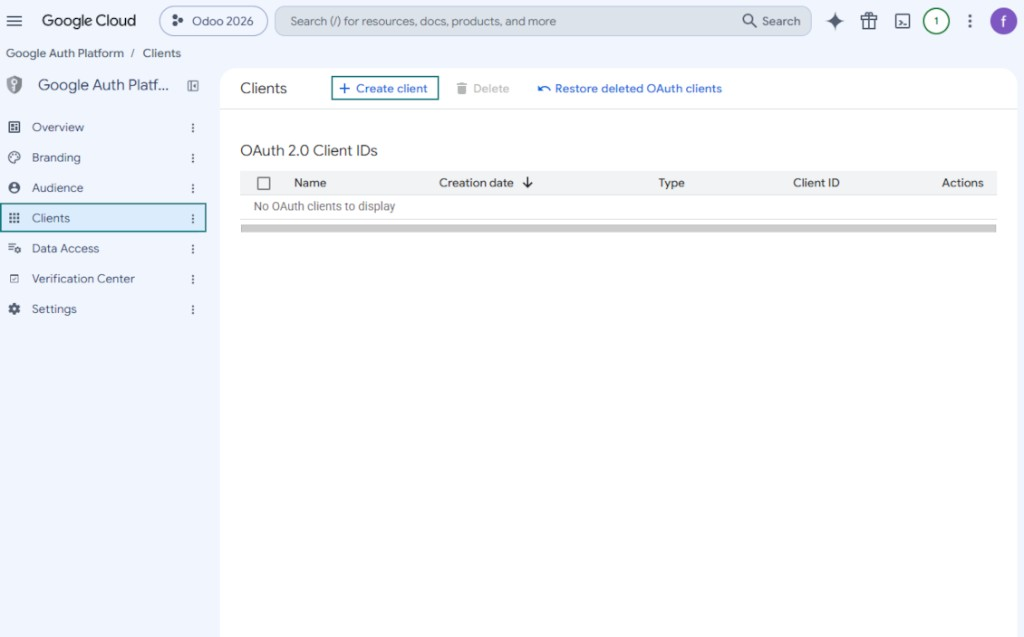
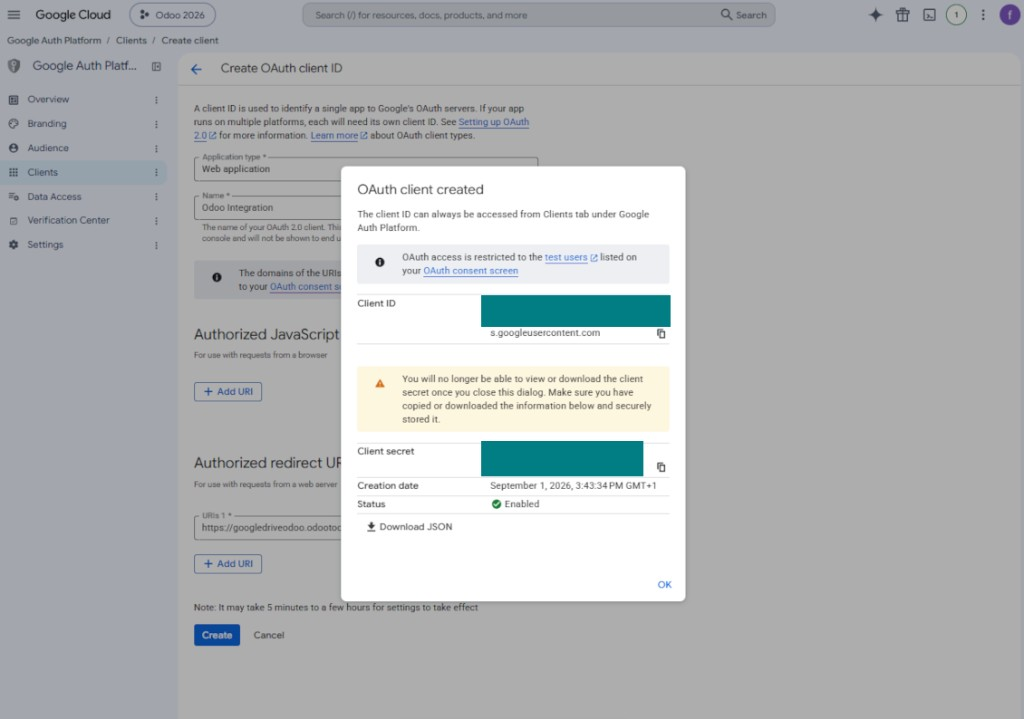
- Vào 'Clients' và nhấn 'Create client'
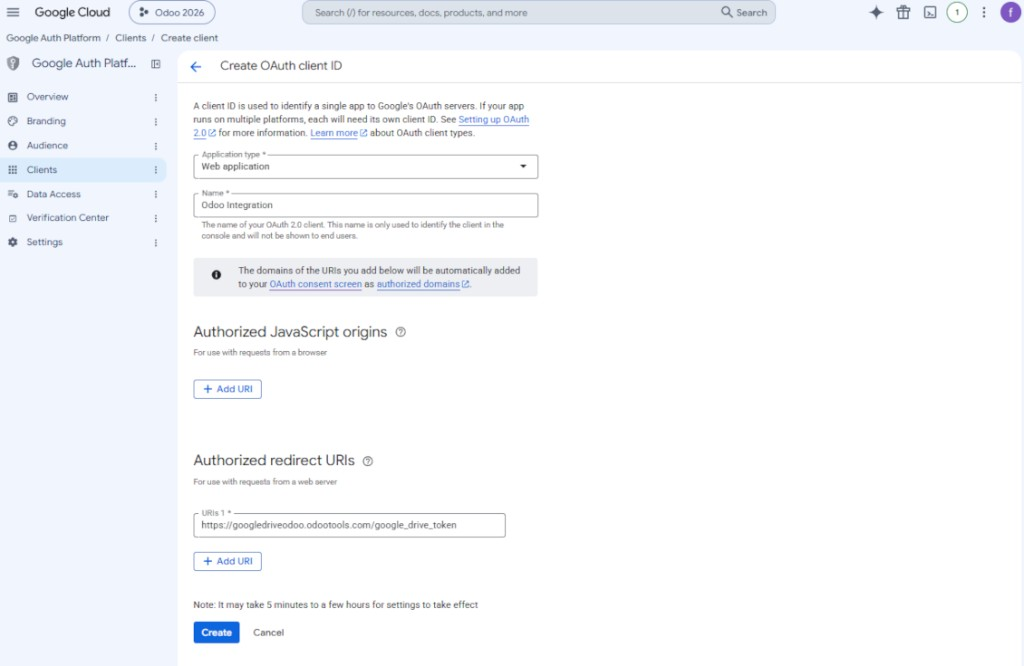
- Với loại ứng dụng, chọn «Web application»
- Với tên, chọn bất kỳ tên phù hợp
- Làm URI chuyển hướng được ủy quyền, hãy thêm liên kết theo dạng [YOURODOOSITENAME]/google_drive_token (ví dụ https://odootools.com/google_drive_token).
- Nhấn 'Create'
- Sao chép và lưu an toàn 'Client ID' và 'Client secret'. Client secret chỉ hiện một lần
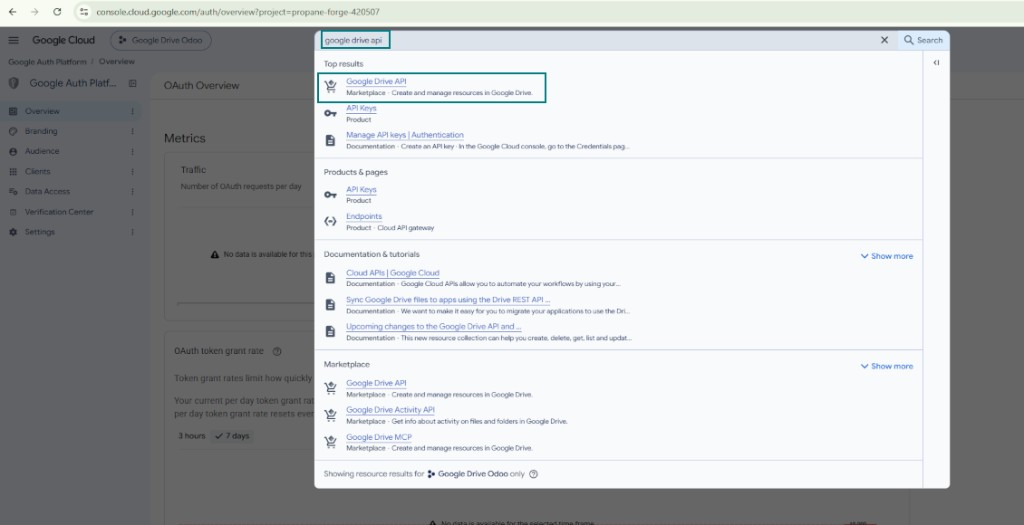
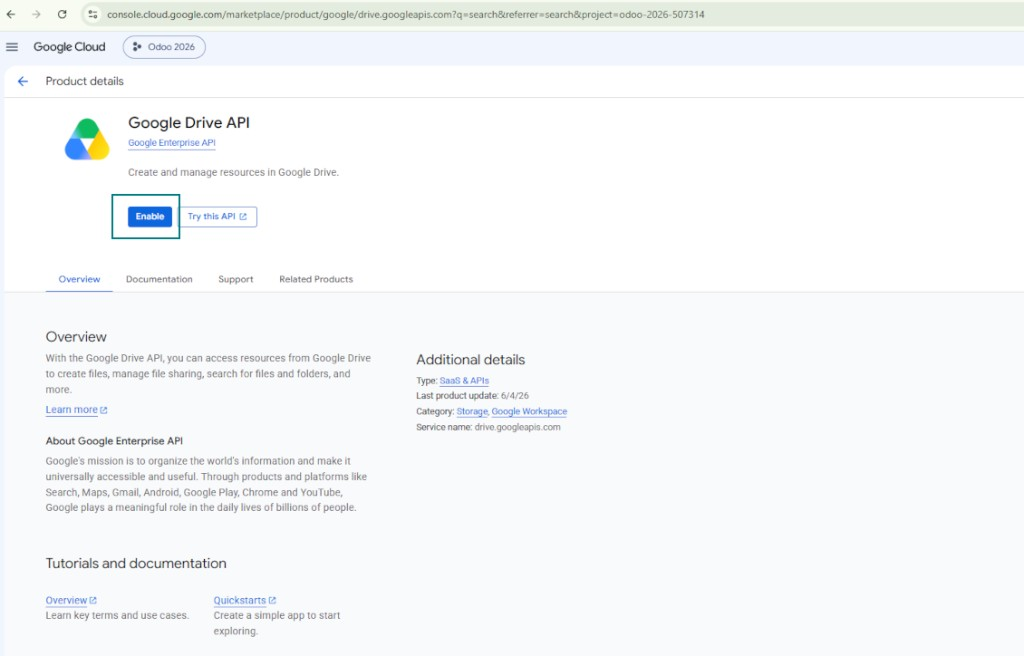
- Bật Google Drive API cho dự án này: gõ 'Google Drive API' vào ô tìm phía trên, mở sản phẩm tìm thấy và nhấn 'Enable'
- Vào 'Audience' và thêm địa chỉ email của bạn làm người dùng thử
- Xuất bản ứng dụng. Nếu không, ứng dụng ở trạng thái thử nghiệm và mã hết hạn mỗi 7 ngày
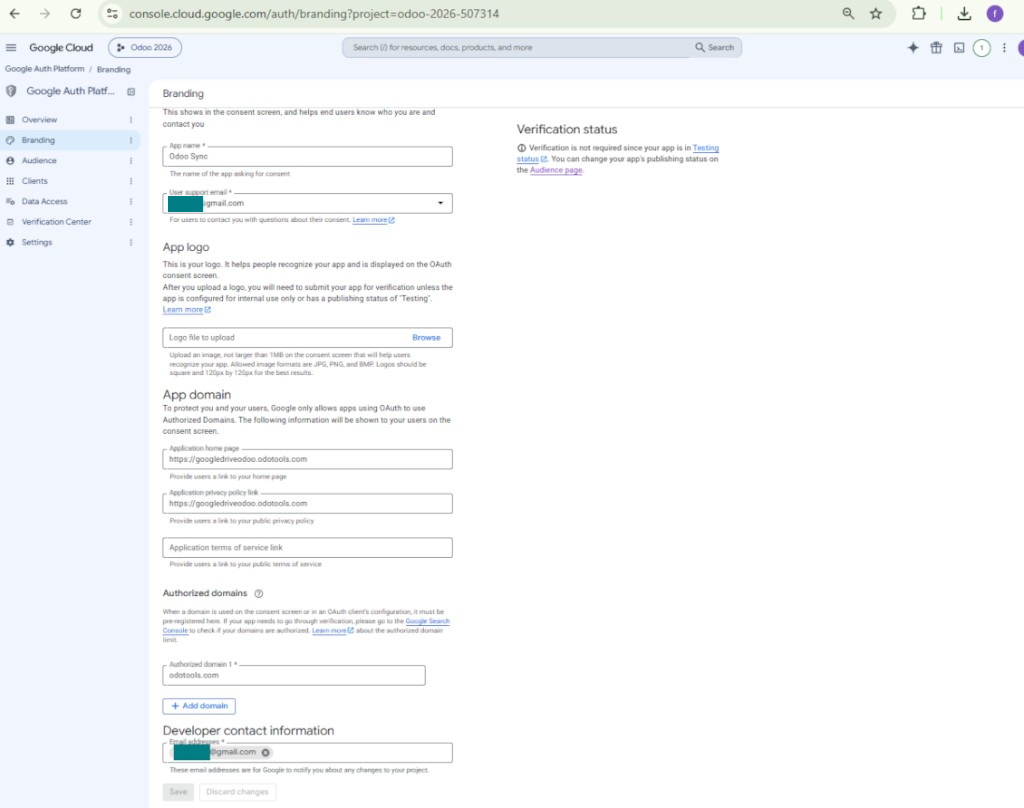
- Mở 'Branding' và điền trang chủ ứng dụng cùng liên kết chính sách quyền riêng tư (ví dụ liên kết tới website Odoo). Thêm miền của các liên kết đó làm authorized domains
- Mở 'Audience' và nhấn 'Publish app'
- Đừng tải lên logo ứng dụng. Việc đó sẽ kích hoạt quy trình xác minh Google dài và phức tạp mà bạn thực sự không cần
- Vào Odoo Cloud Storage > Cấu hình > Cloud Clients rồi nhấn 'Create'
- Với tham chiếu, nhập tên rõ với mọi người dùng
- Với Cloud client, chọn «Google Drive»
- Với tên Root folder, nhập tiêu đề sẽ dùng làm Google Drive directory cha cho mọi thư mục đồng bộ. Ví dụ 'Odoo' hoặc 'OdooERP'
- Sao chép 'Client ID' từ bước 9 vào trường 'App client ID'
- Sao chép 'Client secret' từ bước 9 vào trường 'App client secret'
- Chèn URL chuyển hướng bạn đã nhập ở bước 9
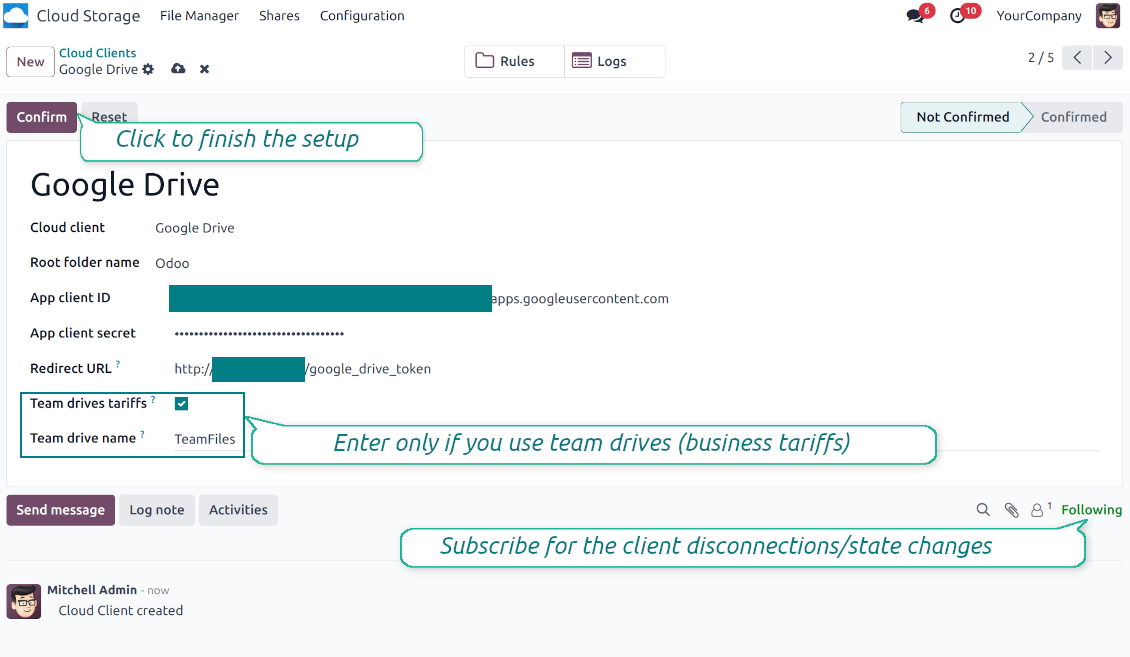
- Nếu dùng ổ nhóm, đánh dấu hộp liên quan. Đảm bảo bạn thật sự dùng ổ nhóm. Trong Google Drive bạn phải thấy mục 'Team Drives' ở thanh bên trái. Tính năng chỉ có trên gói business và enterprise
- Nếu tùy chọn 'Team Drive' bật, nhập tên. Phải tuyệt đối giống như bạn thấy trong Google Drive. Đảm bảo người dùng có đủ quyền cho mọi ổ Google (thường là cùng người cấu hình Google Drive nhóm)
- Nhấn 'Confirm'. Odoo chuyển bạn tới trang đăng nhập Google. Kiểm tra trong hệ thống, đồng ý mọi điều kiện và cấp mọi quyền được hỏi
- Sau khi đăng nhập, Google chuyển bạn trở lại Odoo. Đồng bộ Google Drive - Odoo đã sẵn sàng
- Áp dụng cloud client vừa tạo cho quy tắc thư mục và/hoặc thư mục thủ công cần đồng bộ với Google Drive đó
- Chờ công việc đồng bộ đã lên lịch khởi chạy. Chỉ dùng để kiểm thử: kích hoạt tích hợp thủ công từ Cloud Storage > Cấu hình > Cấu hình > nút 'Launch sync'.
Xem thêm video cấu hình, Lưu ý: phần Google console trong video đã lỗi thời; hãy làm theo các bước ở trên
Mở Google Auth Platform
Thêm thông tin ứng dụng
Chọn đối tượng bên ngoài
Thêm thông tin liên hệ
Đồng ý với chính sách và tạo ứng dụng
Tạo máy khách OAuth
Cấu hình máy khách ứng dụng web
Sao chép ID máy khách và bí mật máy khách
Tìm Google Drive API
Bật Google Drive API
Điền nhận diện thương hiệu để xuất bản ứng dụng
Nhập thông tin xác thực ứng dụng Google vào Odoo
Thiết lập Amazon S3
- Bật tùy chọn 'Amazon S3 Sync' (Cloud Storage > Cấu hình > Cấu hình). Cần tiện ích bổ sung tùy chọn Amazon S3 Odoo Integration
- Mở bảng điều khiển Amazon S3: https://console.aws.amazon.com/s3/
- Tạo bucket mới hoặc chọn bucket có sẵn. Sao chép đúng tên bucket: phải điền vào Odoo trong trường 'Bucket'
- Mở chi tiết bucket và sao chép AWS Region. Điền vào Odoo trường 'Region' (ví dụ eu-west-1 hoặc us-east-1)
- Mở bảng điều khiển AWS IAM: https://console.aws.amazon.com/iam/
- Tạo người dùng IAM mới hoặc chọn người dùng kỹ thuật có sẵn. Người này phải có toàn quyền liệt kê, đọc, tạo, ghi, sao chép và xóa đối tượng trong bucket đã chọn. Bạn có thể chọn admin đủ quyền, hoặc tạo chính sách mới (xem bên dưới)
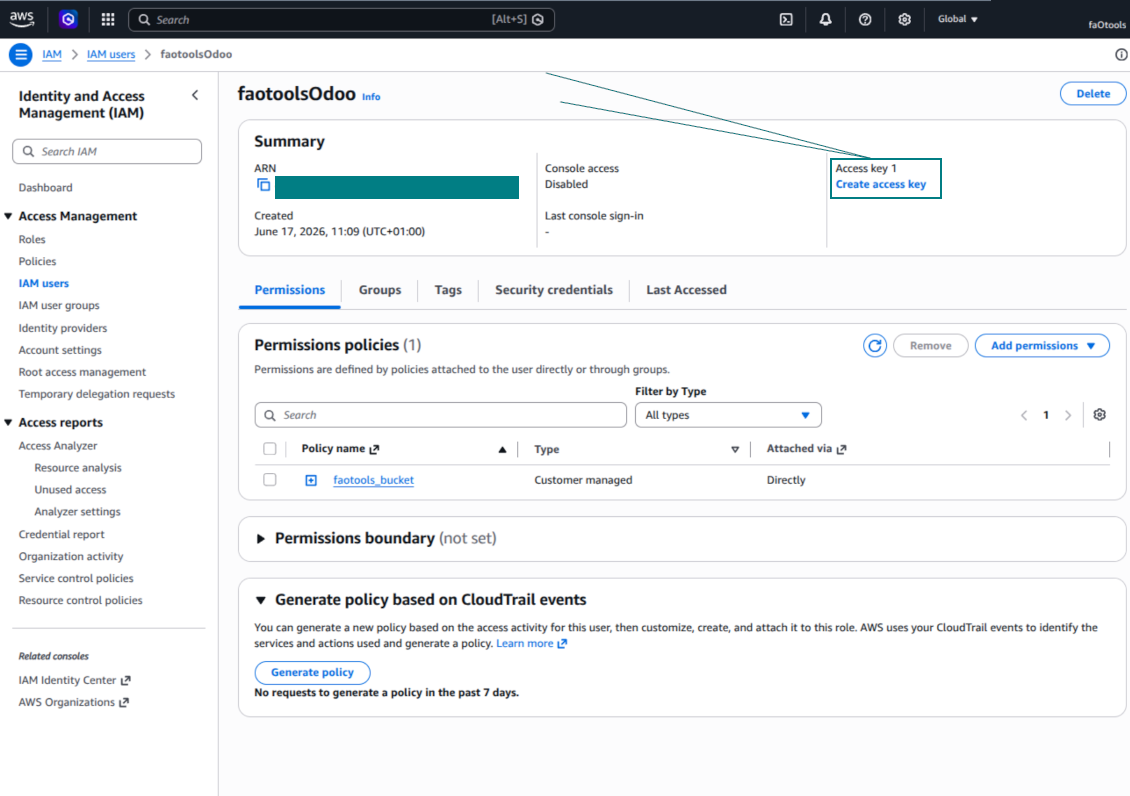
- Trên biểu mẫu người dùng IAM, mở tab 'Security credentials' rồi nhấn 'Create access key'
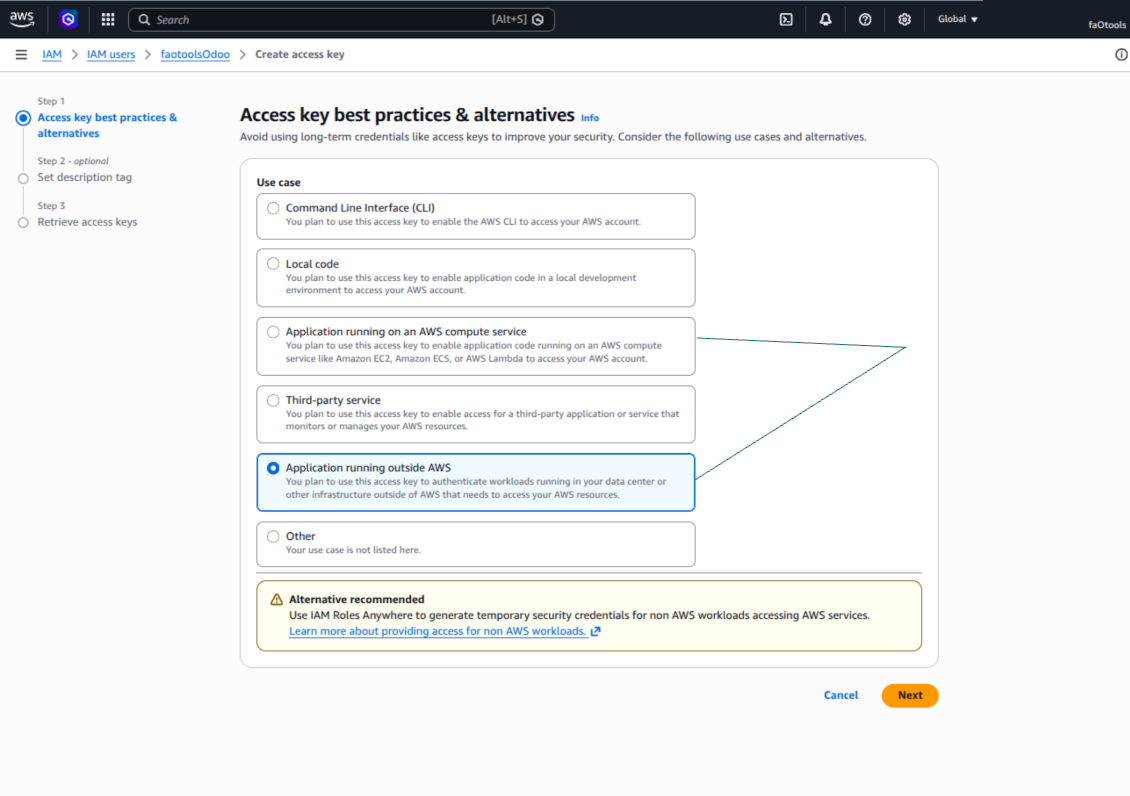
- Trên trang 'Access key best practices & alternatives', chọn Application running outside AWS. Đây là lựa chọn đúng khi máy chủ Odoo kết nối S3 bằng khóa truy cập từ ngoài AWS, từ Odoo.sh, từ máy chủ của bạn hoặc nhà cung cấp hosting khác. Nếu Odoo cài trên phiên bản AWS EC2, bạn có thể chọn Application running on an AWS compute service, nhưng các trường sao chép sang Odoo vẫn giống nhau
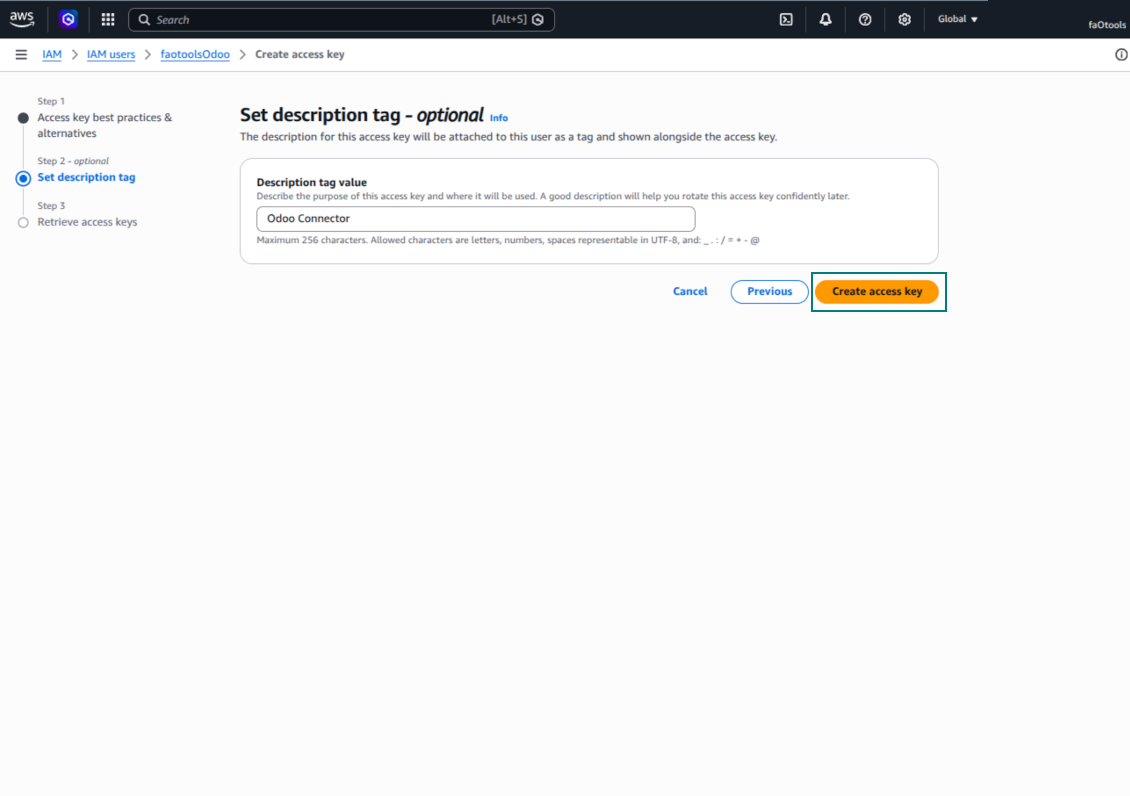
- Nhấn 'Next'. Ở bước tiếp, tùy chọn nhập thẻ mô tả như Odoo S3 Sync, rồi nhấn 'Create access key'
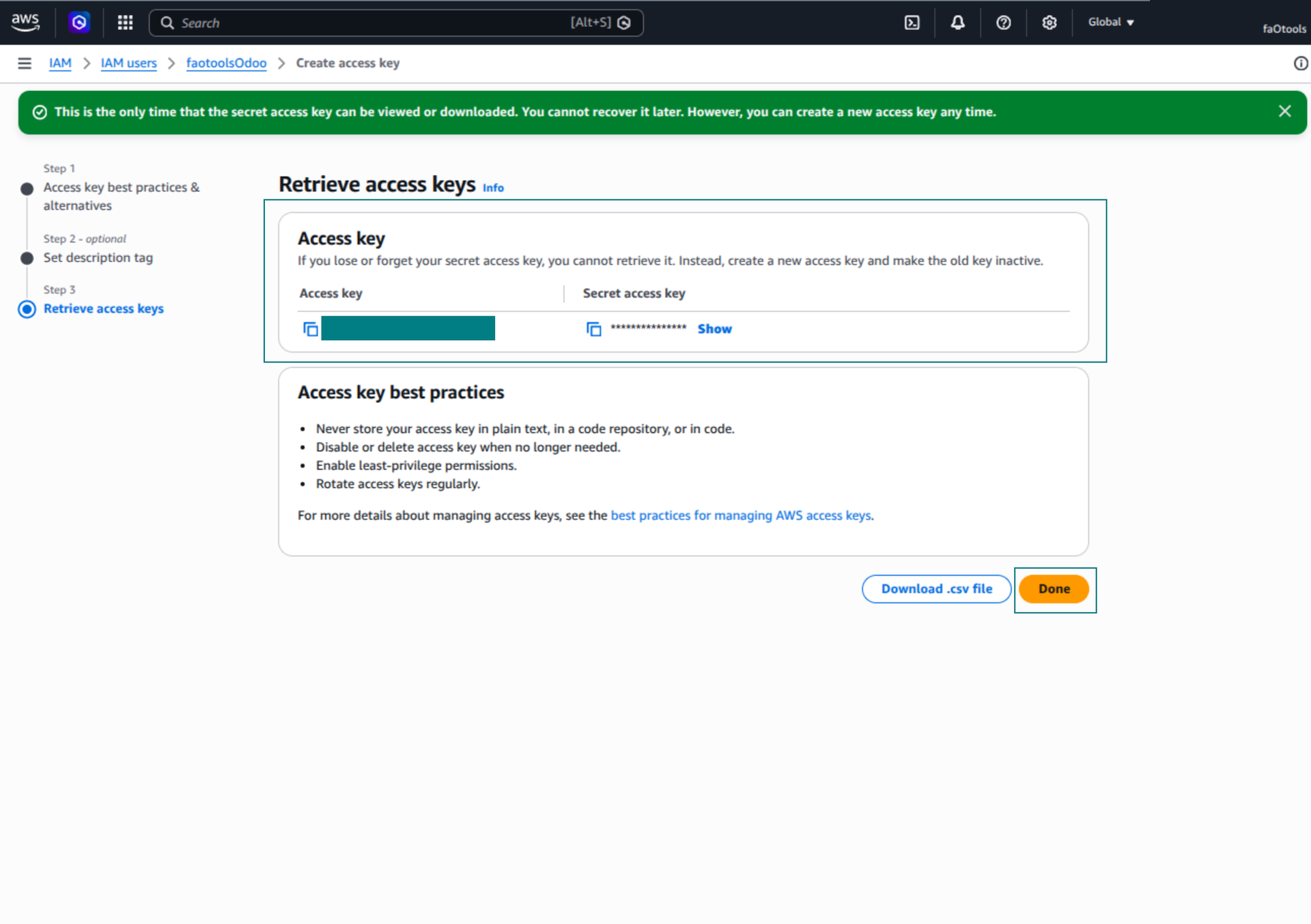
- Trên trang AWS cuối, sao chép Access key hoặc Access key ID vào trường Odoo 'Access Key'
- Sao chép Secret access key vào trường Odoo 'Secret Key'. Quan trọng: AWS chỉ hiện khóa bí mật một lần, hãy lưu trước khi đóng cửa sổ
- Nếu dùng nhà cung cấp tương thích S3 thay AWS S3, sao chép URL endpoint từ bảng quản trị của nhà cung cấp rồi dán vào Odoo trường 'Amazon S3 endpoint URL'. Ví dụ MinIO thường dùng URL như https://minio.example.com hoặc http://localhost:9000; LocalStack thường http://localhost:4566
- Vào Odoo Cloud Storage > Configuration > Cloud Clients rồi nhấn 'Create'
- Với tham chiếu, nhập tên rõ với mọi người dùng
- Với Cloud client, chọn «Amazon S3»
- Với tên Root folder, nhập tiêu đề sẽ dùng làm S3 prefix cha cho mọi thư mục đồng bộ. Ví dụ 'Odoo' hoặc 'OdooERP'
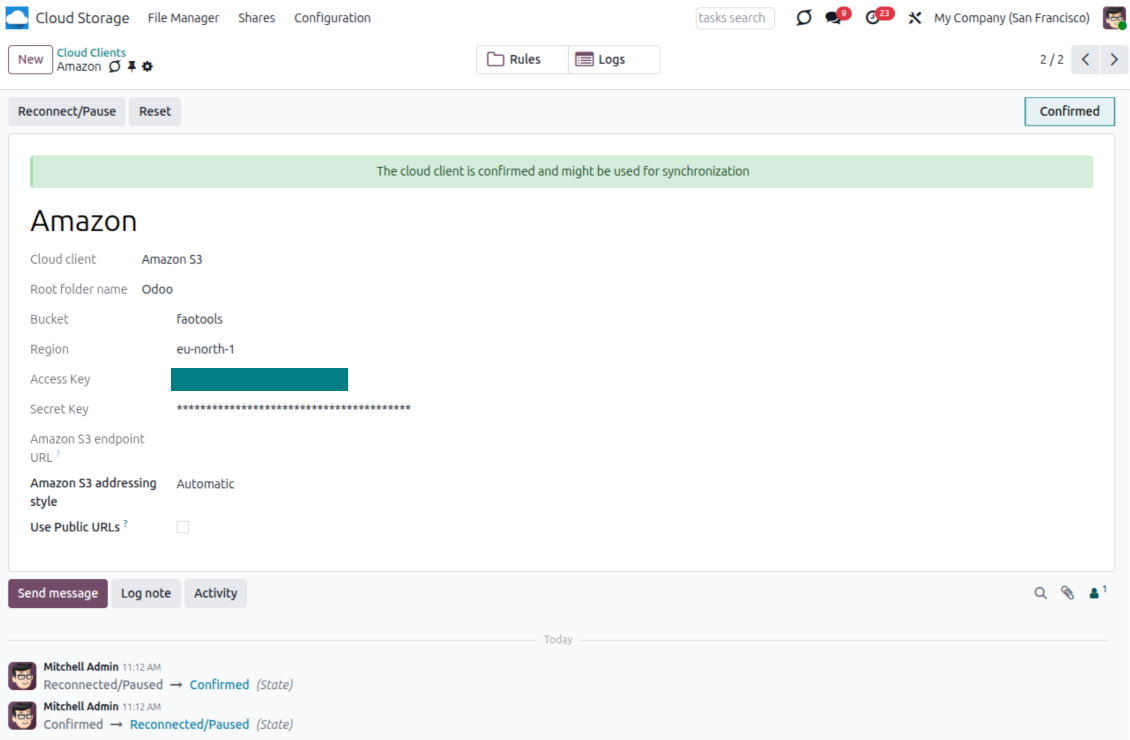
- Điền các trường 'Bucket', 'Region', 'Access Key', 'Secret Key' và nếu cần, 'Amazon S3 endpoint URL' cùng kiểu địa chỉ
- Chọn Odoo dùng URL presigned tạm thời hay URL bucket/CDN công khai. Với bucket riêng, giữ URL presigned bật và đặt thời hạn theo giây
- Nhấn 'Confirm'. Odoo kiểm tra quyền bucket và tạo hoặc xác minh tiền tố thư mục gốc. Đồng bộ Amazon S3 - Odoo đã sẵn sàng
- Áp dụng cloud client vừa tạo cho quy tắc thư mục và/hoặc thư mục thủ công cần đồng bộ với bucket Amazon S3 đó
- Chờ công việc đồng bộ đã lên lịch khởi chạy. Chỉ dùng để kiểm thử: kích hoạt tích hợp thủ công từ Cloud Storage > Cấu hình > Cấu hình > nút 'Launch sync'.
Tài liệu AWS hữu ích: tạo S3 bucket: https://docs.aws.amazon.com/AmazonS3/latest/userguide/creating-bucket.html, quản lý khóa truy cập IAM: https://docs.aws.amazon.com/IAM/latest/UserGuide/id_credentials_access-keys.html.
Ví dụ chính sách bucket
    {
    "Version": "2012-10-17",
    "Statement": [
        {
            "Sid": "ListObjectsInBucket",
            "Effect": "Allow",
            "Action": [
                "s3:ListBucket"
            ],
            "Resource": "arn:aws:s3:::NAME_OF_YOUR_BUCKET"
        },
        {
            "Sid": "AllObjectActions",
            "Effect": "Allow",
            "Action": [
                "s3:GetObject",
                "s3:PutObject",
                "s3:DeleteObject"
            ],
            "Resource": "arn:aws:s3:::NAME_OF_YOUR_BUCKET/*"
        }
    ]
}
Tạo người dùng AWS IAM mới
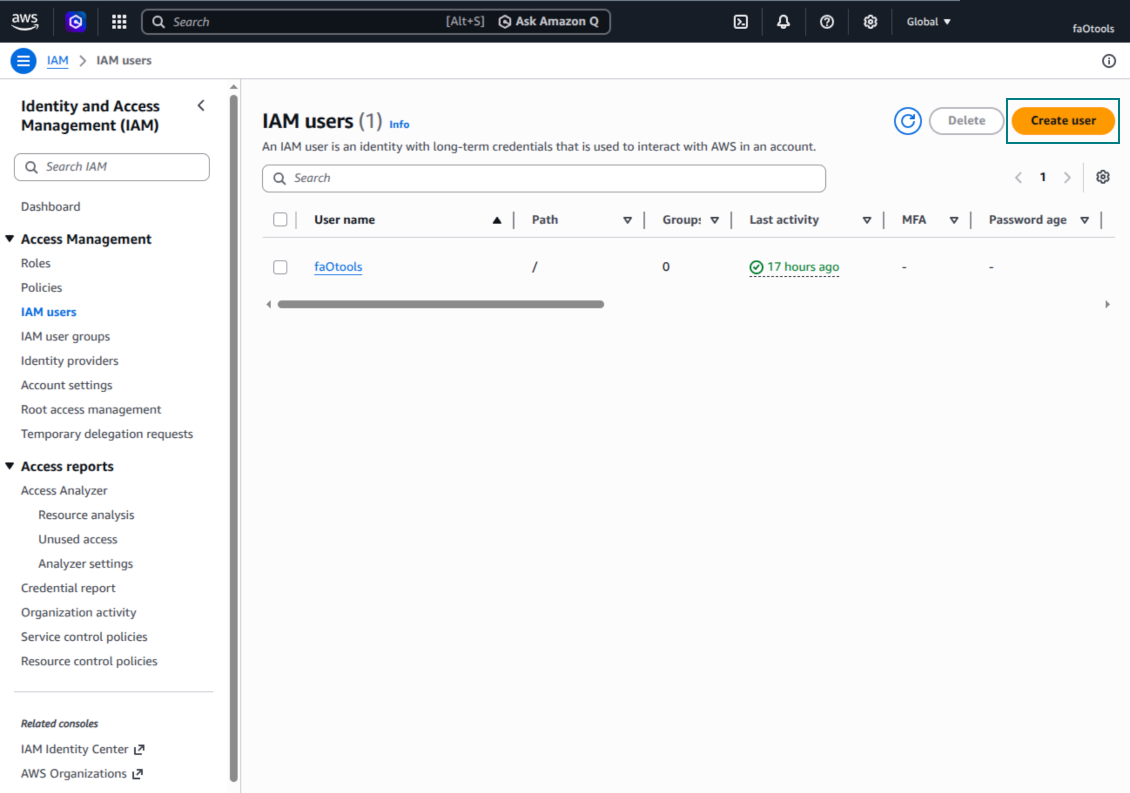
Chỉ định tên người dùng IAM
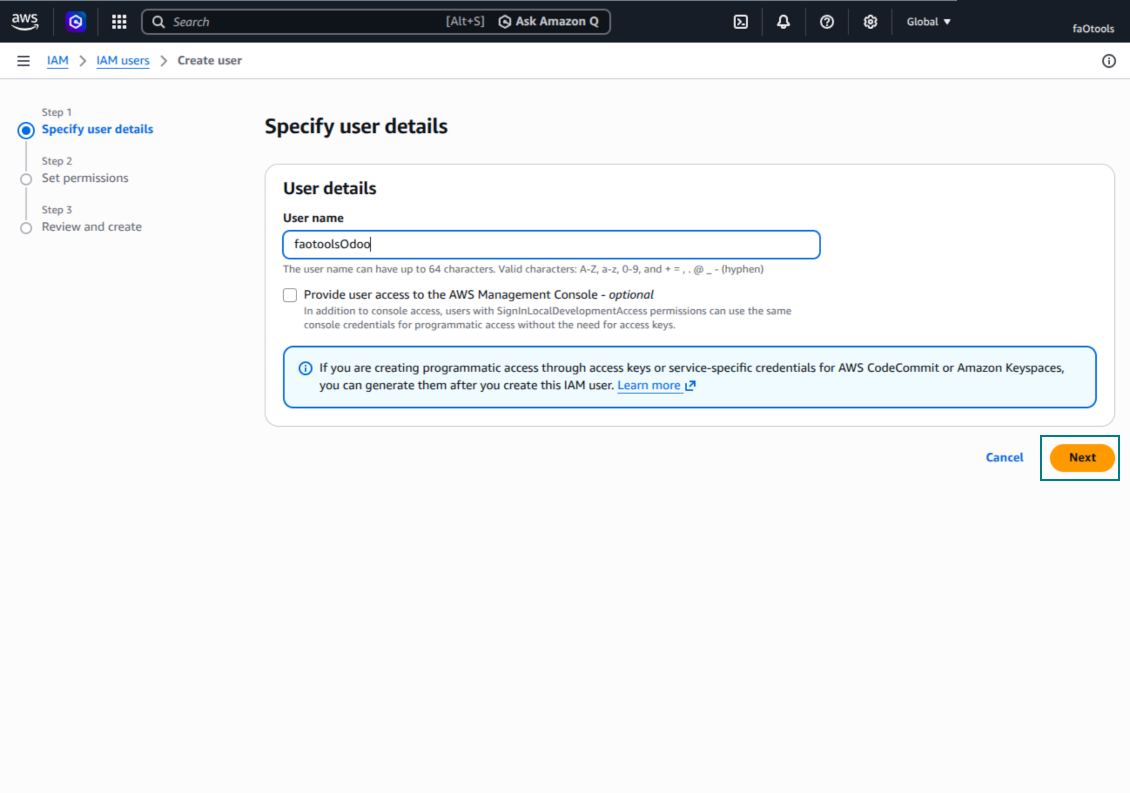
Gắn chính sách quyền trực tiếp
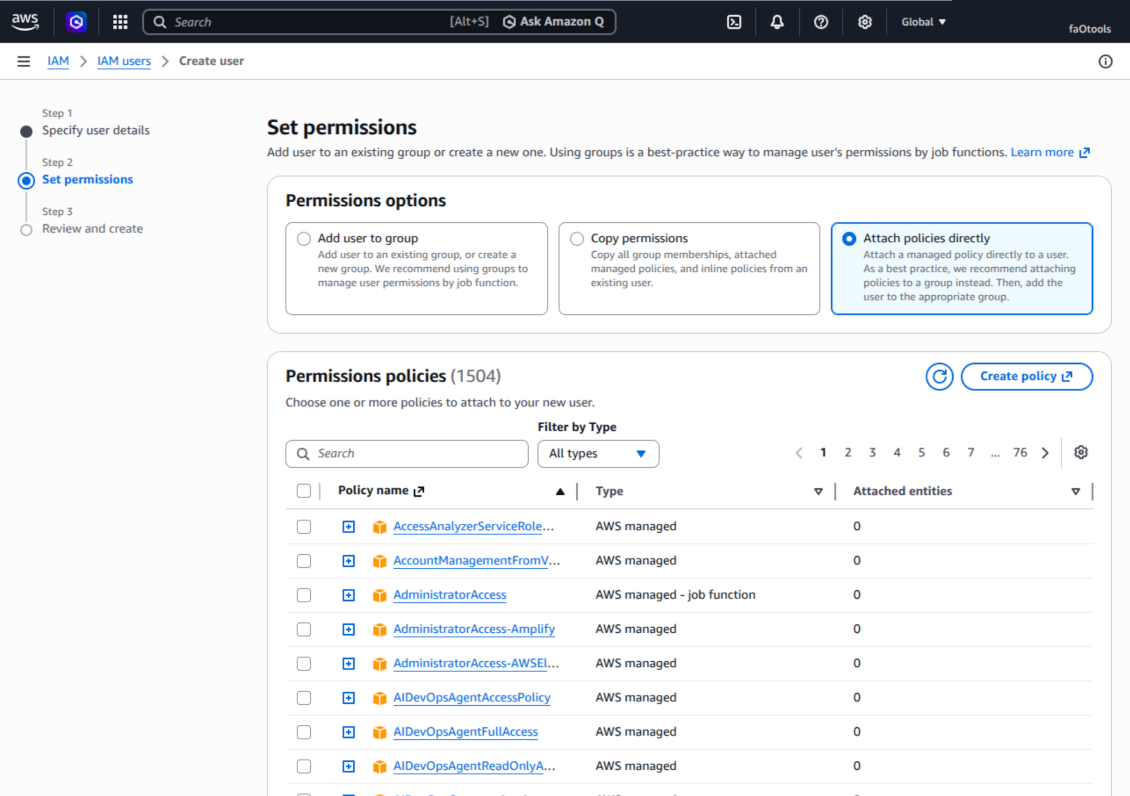
Ví dụ JSON chính sách bucket Amazon S3
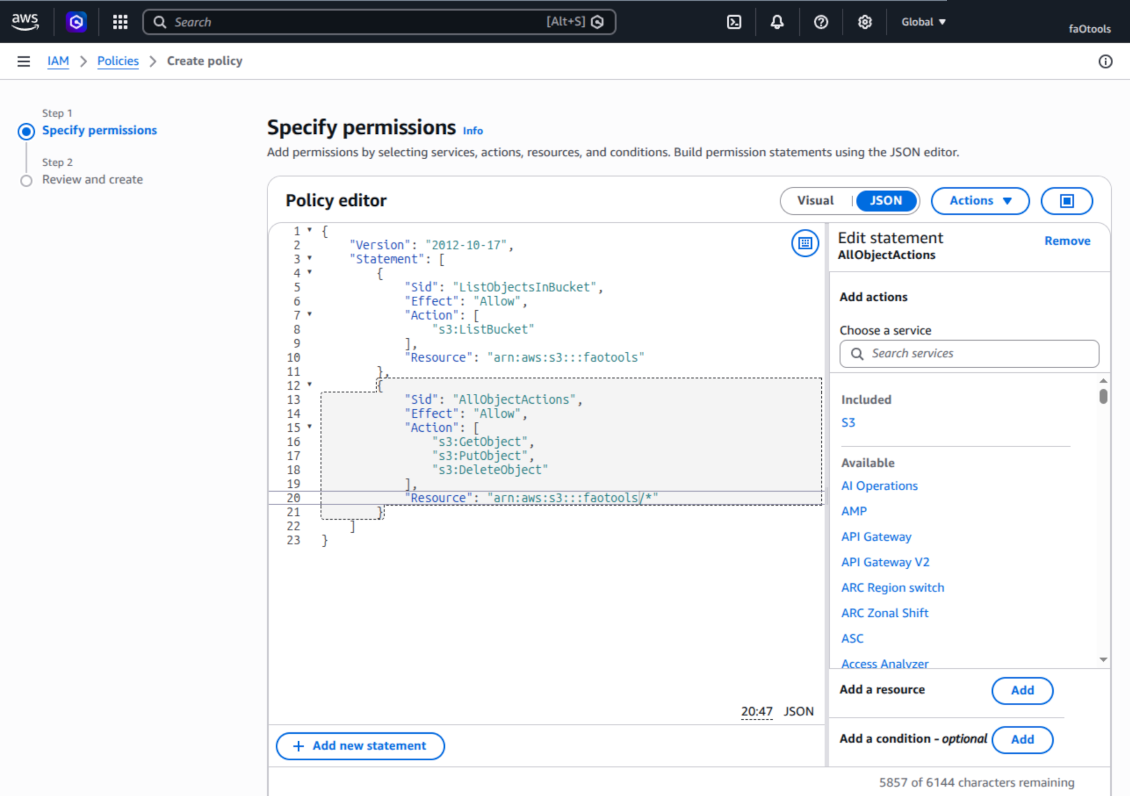
Xem lại và đặt tên chính sách S3
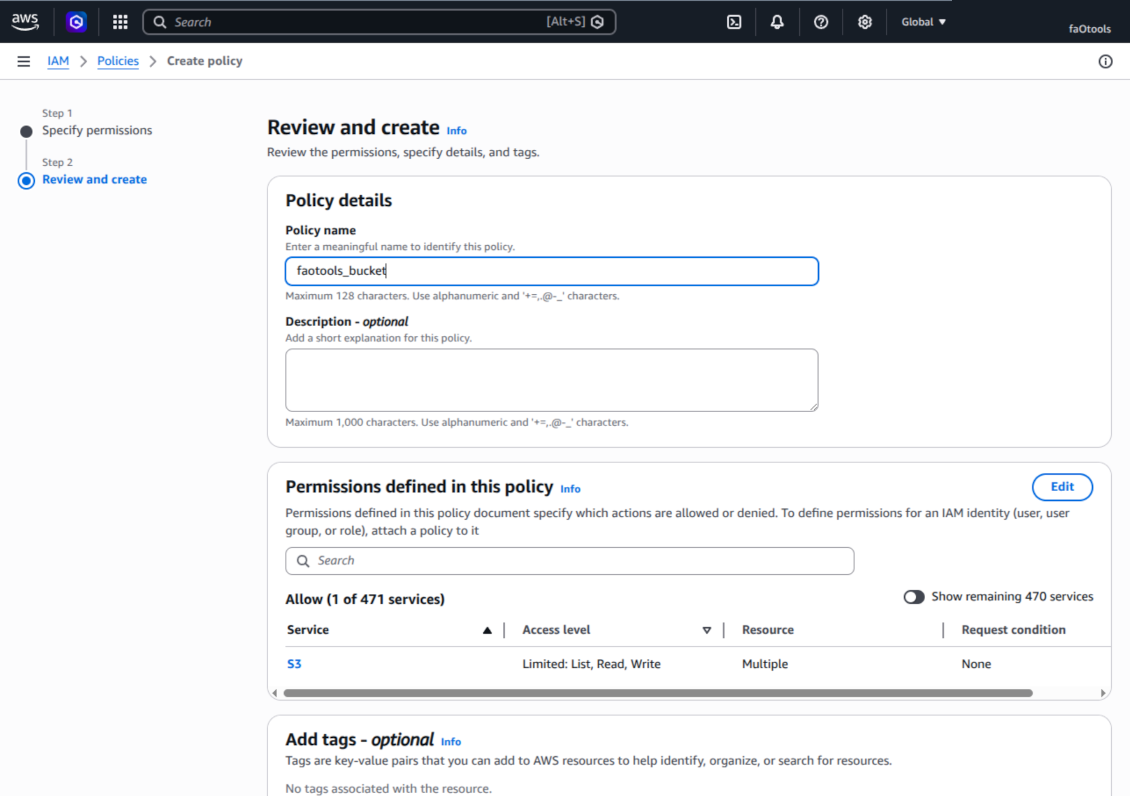
Chọn chính sách bucket cho người dùng
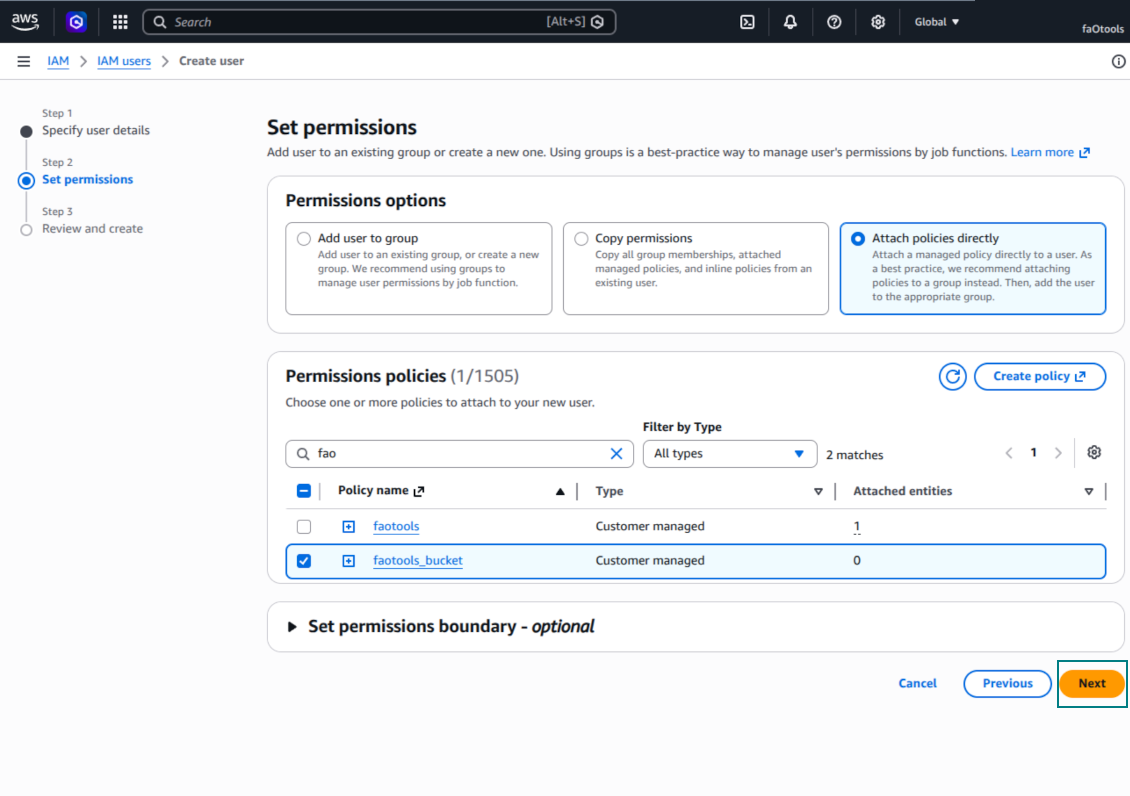
Xem lại và tạo người dùng IAM
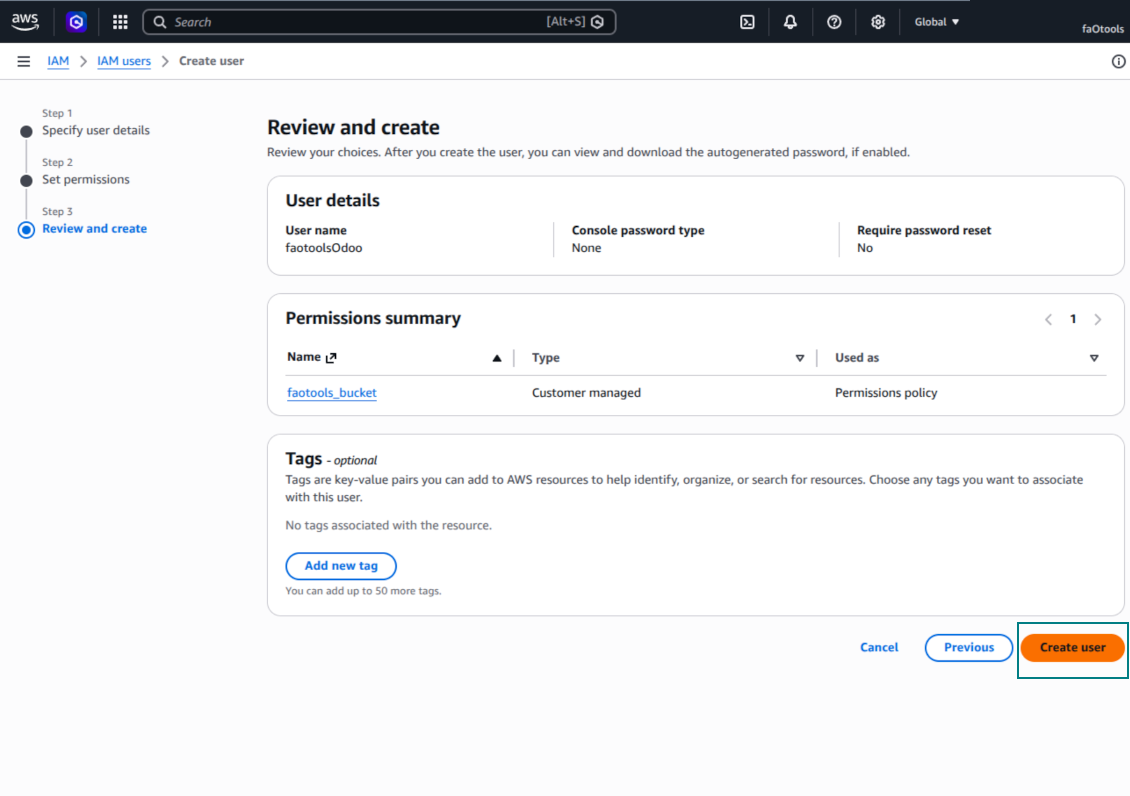
Tạo khóa truy cập cho người dùng
Chọn trường hợp dùng khóa truy cập
Đặt thẻ mô tả khóa truy cập
Lấy khóa truy cập và bí mật
Cấu hình máy khách Amazon S3 trong Odoo
Thiết lập tích hợp Nextcloud hoặc/và ownCloud
Cấu hình và đăng nhập
- Bật tùy chọn 'onwCloud / Nextcloud Sync' (cloud Storage > Configuration > Configuration). Cần add-on tùy chọn ownCloud / Nextcloud Odoo Integration
- Vào Odoo Cloud Storage > Cấu hình > Cloud Clients rồi nhấn 'Create'
- Với tham chiếu, nhập tên rõ với mọi người dùng
- Với Cloud client, chọn 'Nextcloud' hoặc 'ownCloud' tùy phần mềm bạn đang dùng
- Với tên Root folder, nhập tiêu đề sẽ dùng làm directory cha cho mọi thư mục đồng bộ. Ví dụ 'Odoo' hoặc 'OdooERP'
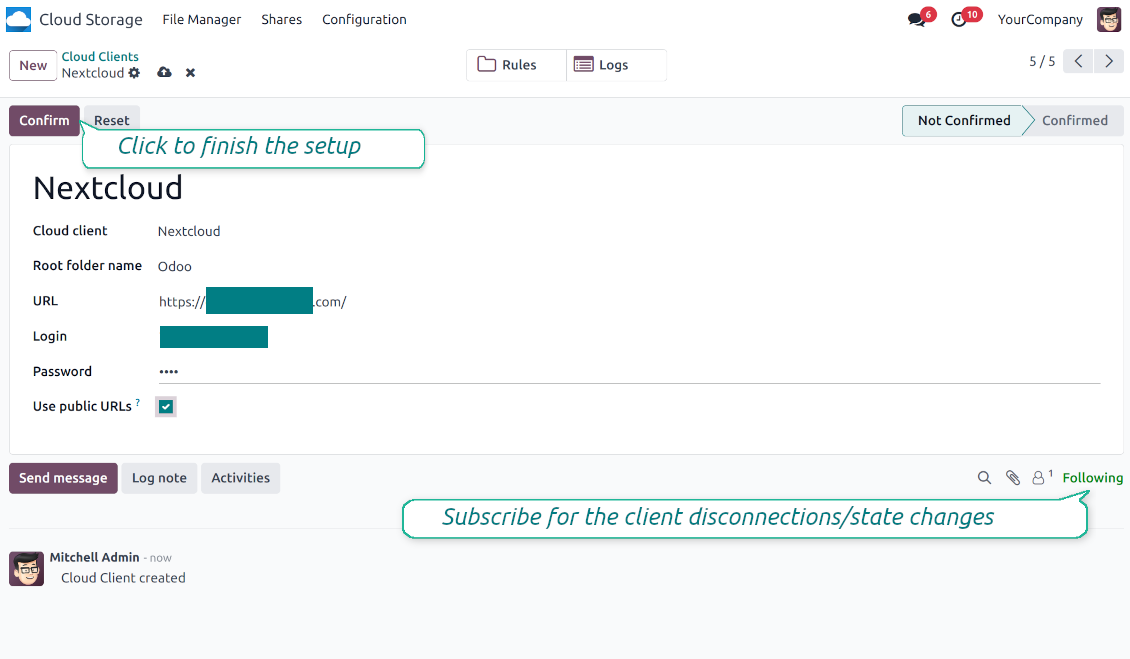
- Nhập URL đầy đủ ownCloud / Nextcloud của bạn
- Chọn người dùng ownCloud / Nextcloud có đầy đủ quyền đọc, tạo, ghi và xóa tệp cùng thư mục trong một thư mục gốc
- Nhập tên đăng nhập và mật khẩu của người dùng này vào các trường 'Đăng nhập' và 'Mật khẩu'
- Chọn áp dụng URL công khai hay nội bộ (xem bên dưới)
- Nhấn 'Xác nhận'. Đồng bộ Odoo đã sẵn sàng
- Áp dụng cloud client vừa tạo cho quy tắc thư mục và/hoặc thư mục thủ công cần đồng bộ với phiên bản Nextcloud hoặc ownCloud đó
- Chờ công việc đồng bộ đã lên lịch khởi chạy. Chỉ dùng để kiểm thử: kích hoạt tích hợp thủ công từ Cloud Storage > Cấu hình > Cấu hình > nút 'Launch sync'.
URL nội bộ và công khai
Mặc định liên kết từ Odoo tới ownCloud / Nextcloud là nội bộ: chỉ người dùng được ủy quyền mới truy cập. Có thể đặt liên kết công khai (cài đặt 'Use Public URLs'). Khi đó URL sẽ 'được chia sẻ' và mọi người truy cập mục bằng liên kết trực tiếp.
Hãy thận trọng nếu quyết định dùng URL chia sẻ (công khai). Dù liên kết khó bị người ngoài biết, vẫn có khả năng nhỏ chúng trở nên sẵn có do một số thao tác người dùng. Ngoài ra, tạo liên kết chia sẻ không nhanh và có thể làm chậm đồng bộ.
Xem thêm video cấu hình
Nhập thông tin xác thực ownCloud / Nextcloud
Thiết lập NAS (Synology, QNAP, TrueNAS, v.v.)
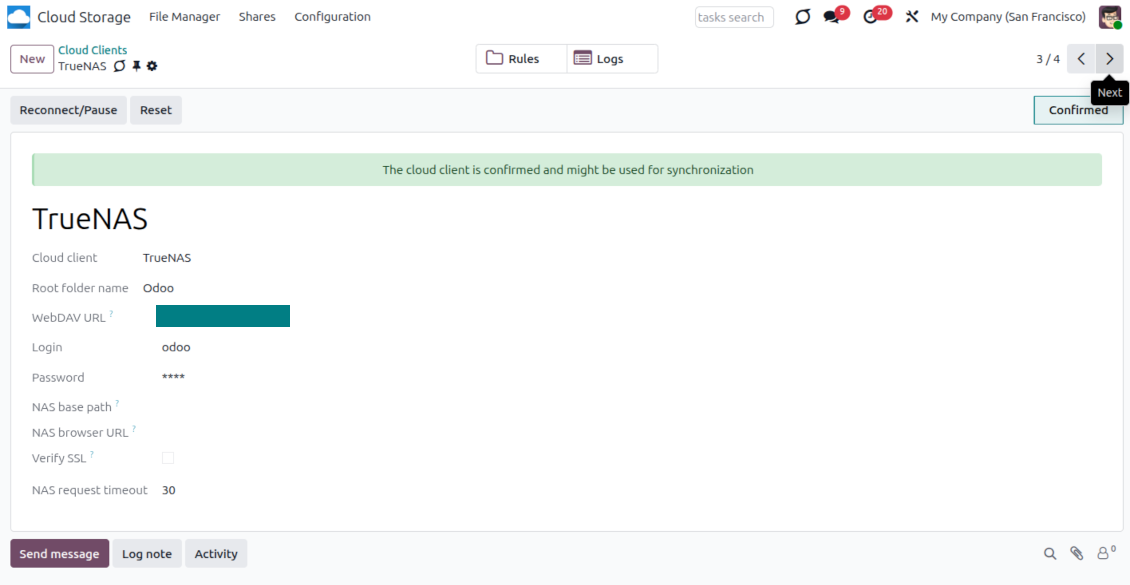
- Bật tùy chọn 'NAS Sync' (Cloud Storage > Configuration > Configuration). Cần add-on tùy chọn NAS Odoo Integration
- Chuẩn bị điểm cuối WebDAV của NAS:
- Synology: cài và bật WebDAV Server trong DSM và chọn HTTPS khi có thể
- QNAP: bật WebDAV cho thư mục chia sẻ đích và dùng HTTPS khi có thể
- TrueNAS CORE: bật dịch vụ WebDAV; TrueNAS SCALE: cài và cấu hình ứng dụng WebDAV, vì WebDAV gốc đã bị gỡ ở các bản SCALE hiện đại
- WebDAV chung: đảm bảo PROPFIND, MKCOL, PUT, GET, MOVE và DELETE sẵn sàng
- Nếu Odoo được lưu ngoài mạng NAS nội bộ, hãy làm điểm cuối WebDAV truy cập an toàn. Ưu tiên reverse proxy với chứng chỉ TLS hợp lệ, VPN/đường hầm bảo mật như WireGuard, Tailscale hoặc Cloudflare Tunnel, hoặc rơle nhà cung cấp như Synology QuickConnect hoặc QNAP myQNAPcloud. Tránh mở giao diện quản trị ra Internet
- Tạo người dùng NAS riêng với đủ quyền chỉ trong thư mục dùng chung đích: đọc, tạo, ghi, di chuyển và xóa. Không dùng tài khoản quản trị
- Vào Odoo Cloud Storage > Configuration > Cloud Clients rồi nhấn 'Create'
- Với tham chiếu, nhập tên rõ với mọi người dùng
- Với Cloud client, chọn «Synology NAS», «QNAP NAS», «TrueNAS» hoặc «WebDAV NAS»
- Với tên Root folder, nhập tiêu đề sẽ dùng làm NAS directory cha cho mọi thư mục đồng bộ. Ví dụ 'Odoo' hoặc 'OdooERP'
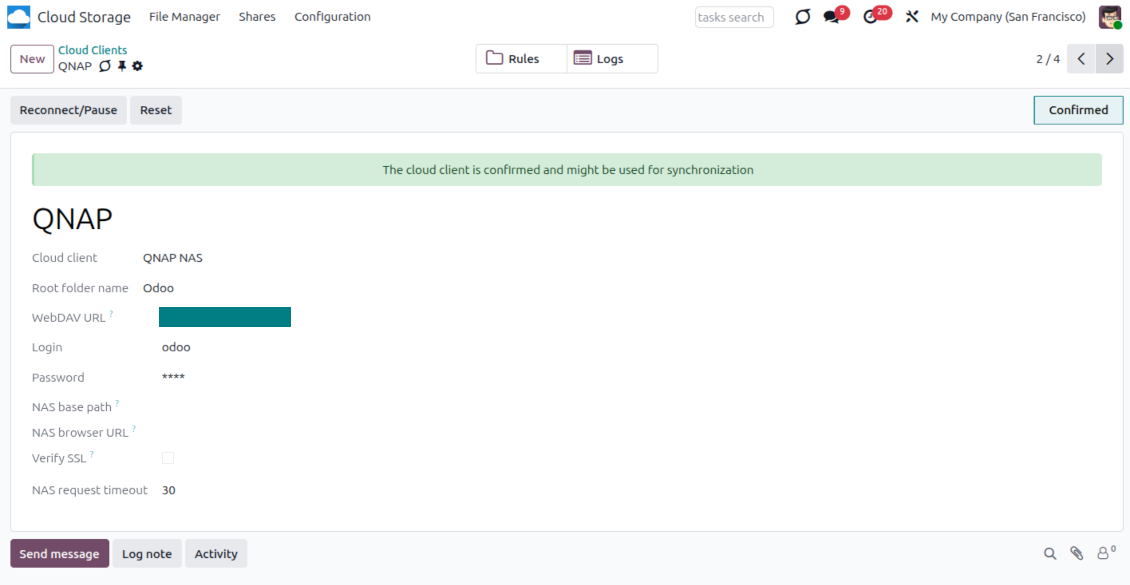
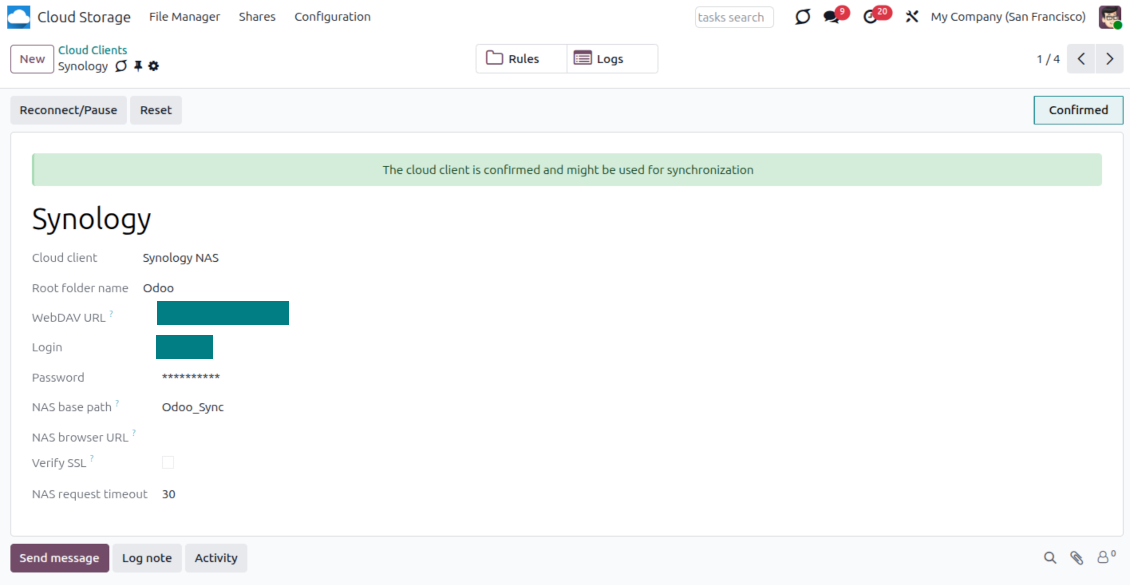
- Nhập URL WebDAV đầy đủ, đăng nhập và mật khẩu. Tùy chọn đặt đường dẫn gốc nếu Odoo cần tạo thư mục gốc trong chia sẻ hoặc thư mục sẵn có
- Giữ 'Verify SSL' bật cho điểm cuối HTTPS công khai. Chỉ tắt với điểm cuối riêng tin cậy dùng chứng chỉ tự ký
- Tùy chọn đặt URL gốc trình duyệt nếu tệp NAS cần mở qua URL file station của nhà cung cấp thay vì URL WebDAV thô
- Nhấn 'Confirm'. Odoo kiểm tra kết nối WebDAV và tạo hoặc tìm thư mục gốc. Đồng bộ NAS - Odoo đã sẵn sàng
- Áp dụng cloud client vừa tạo cho quy tắc thư mục và/hoặc thư mục thủ công cần đồng bộ với kho NAS đó
- Chờ công việc đồng bộ đã lên lịch khởi chạy. Chỉ dùng để kiểm thử: kích hoạt tích hợp thủ công từ Cloud Storage > Cấu hình > Cấu hình > nút 'Launch sync'.
Cấu hình trước NAS
Hệ thống NAS thường lộ tệp qua mạng cục bộ. Nếu máy chủ Odoo của bạn được lưu ngoài mạng đó, điểm cuối WebDAV phải tới được từ Odoo qua kênh an toàn. Tùy chọn khuyến nghị là proxy đảo với chứng chỉ HTTPS hợp lệ, VPN hoặc đường hầm bảo mật như WireGuard, Tailscale hoặc Cloudflare Tunnel, hoặc rơ-le nhà cung cấp như Synology QuickConnect hoặc QNAP myQNAPcloud. Chuyển tiếp cổng thuần có thể nhưng nên xem là lựa chọn kém ưu tiên nhất.
Dùng tài khoản NAS riêng với quyền tối thiểu trên một thư mục dùng chung: đọc, tạo, cập nhật, di chuyển và xóa. Tránh tài khoản quản trị. Điểm cuối công khai luôn dùng HTTPS và chứng chỉ TLS hợp lệ. Bộ kết nối có tùy chọn "Verify SSL" cho chứng chỉ tự ký đáng tin, nhưng thường nên để bật.
Nhập thông tin xác thực QNAP
Nhập thông tin xác thực Synology
Nhập thông tin xác thực TrueNAS
Thiết lập Box
- Bật tùy chọn 'Box Sync' (cloud Storage > Cấu hình > Cấu hình). Cần tiện ích bổ sung tùy chọn Box Odoo Integration
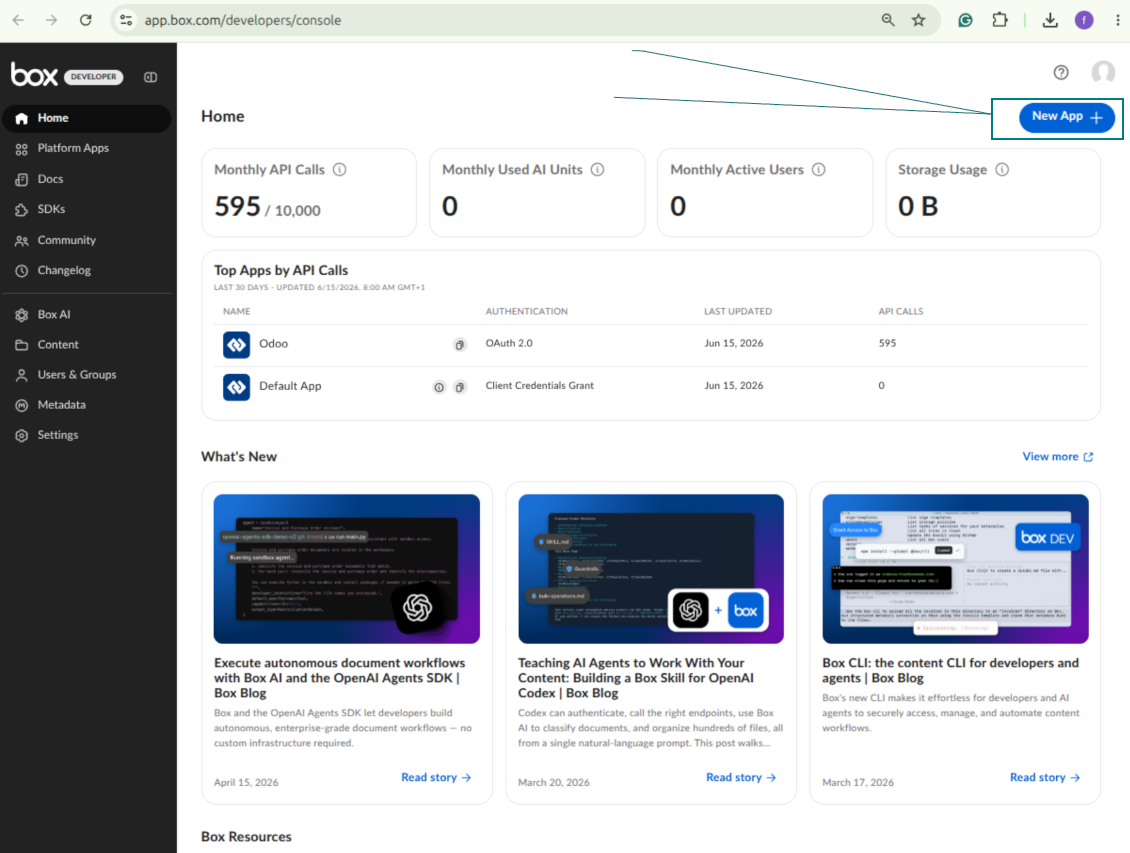
- Tạo hoặc mở tài khoản nhà phát triển Box rồi vào Box Developer Console: https://app.box.com/developers/console
- Tạo một Custom App và chọn OAuth 2.0 (Authorization Code Grant) làm phương thức xác thực
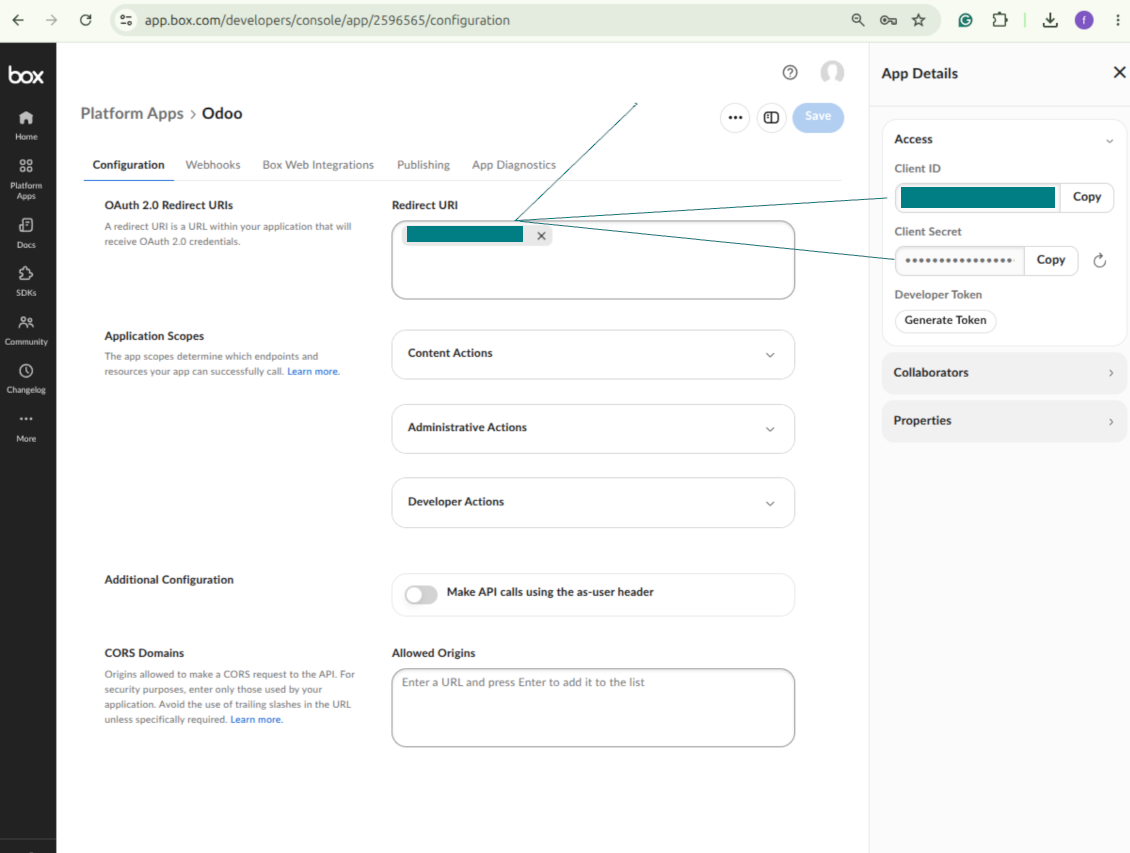
- Thêm URI chuyển hướng dạng [YOURODOOSITENAME]/box_token (vd. https://faotools.com/box_token). Cần chứng chỉ SSL hợp lệ (https)
- Cấp ứng dụng quyền đọc và ghi tệp cũng như thư mục. Tránh gán quyền không liên quan
- Vào Odoo Cloud Storage > Configuration > Cloud Clients rồi nhấn 'Create'
- Với tham chiếu, nhập tên rõ với mọi người dùng
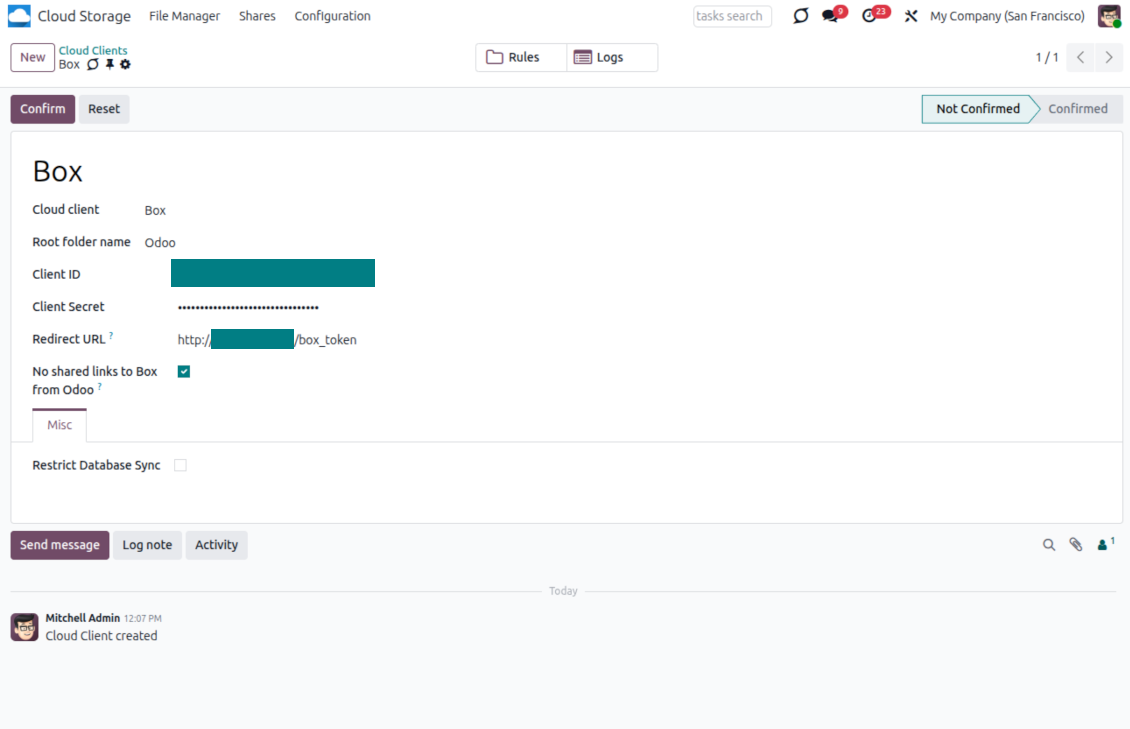
- Với Cloud client, chọn «Box»
- Với tên Root folder, nhập tiêu đề sẽ dùng làm Box directory cha cho mọi thư mục đồng bộ. Ví dụ 'Odoo' hoặc 'OdooERP'
- Sao chép Box Client ID vào trường 'Client ID'
- Sao chép Box Client Secret vào trường 'Client Secret'
- Chèn URL chuyển hướng đã tạo trước
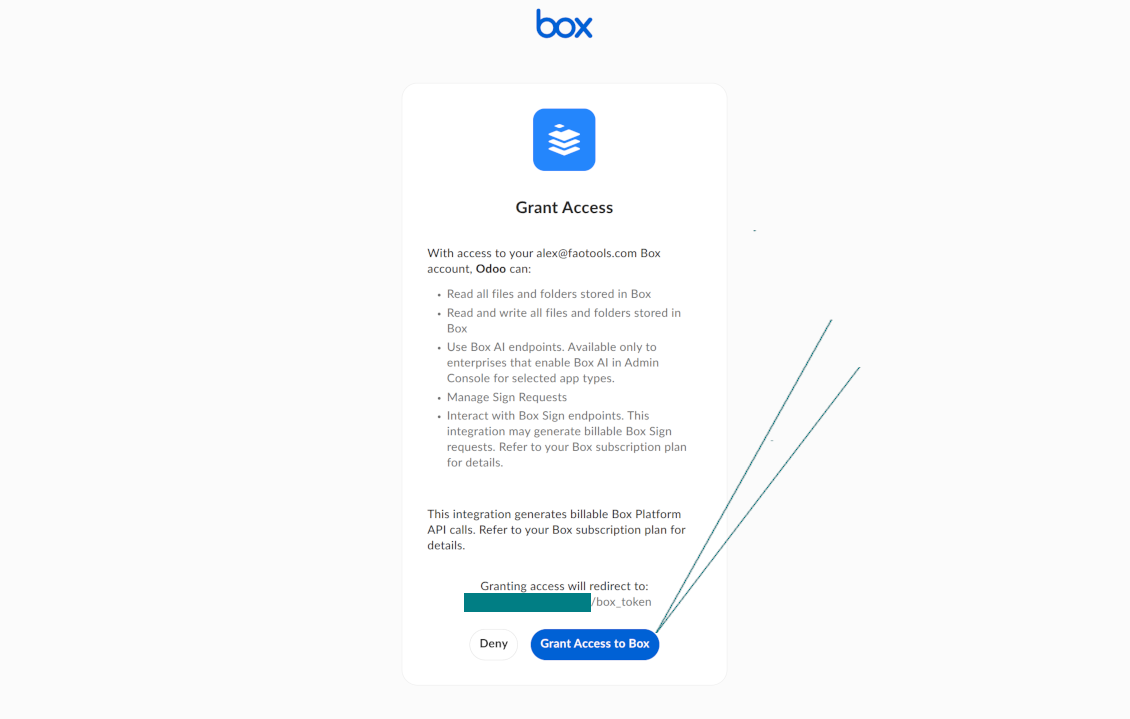
- Nhấn 'Confirm'. Odoo chuyển bạn tới trang đăng nhập Box. Kiểm tra trong hệ thống, đồng ý mọi điều kiện và cấp mọi quyền được hỏi
- Sau khi đăng nhập, Box chuyển bạn trở lại Odoo. Đồng bộ Box - Odoo đã sẵn sàng
- Áp dụng cloud client vừa tạo cho quy tắc thư mục và/hoặc thư mục thủ công cần đồng bộ với tài khoản Box đó
- Chờ công việc đồng bộ đã lên lịch khởi chạy. Chỉ dùng để kiểm thử: kích hoạt tích hợp thủ công từ Cloud Storage > Cấu hình > Cấu hình > nút 'Launch sync'.
Tạo ứng dụng nhà phát triển Box mới
Sao chép thông tin OAuth của Box
Cấu hình máy khách đám mây Box trong Odoo
Cấp cho Odoo quyền truy cập Box
Thiết lập MinIO
- Chuẩn bị máy chủ MinIO đang chạy
- Mở bảng điều khiển MinIO
- Tạo bucket mới hoặc chọn bucket có sẵn. Sao chép đúng tên bucket: phải điền vào Odoo trong trường 'Bucket'
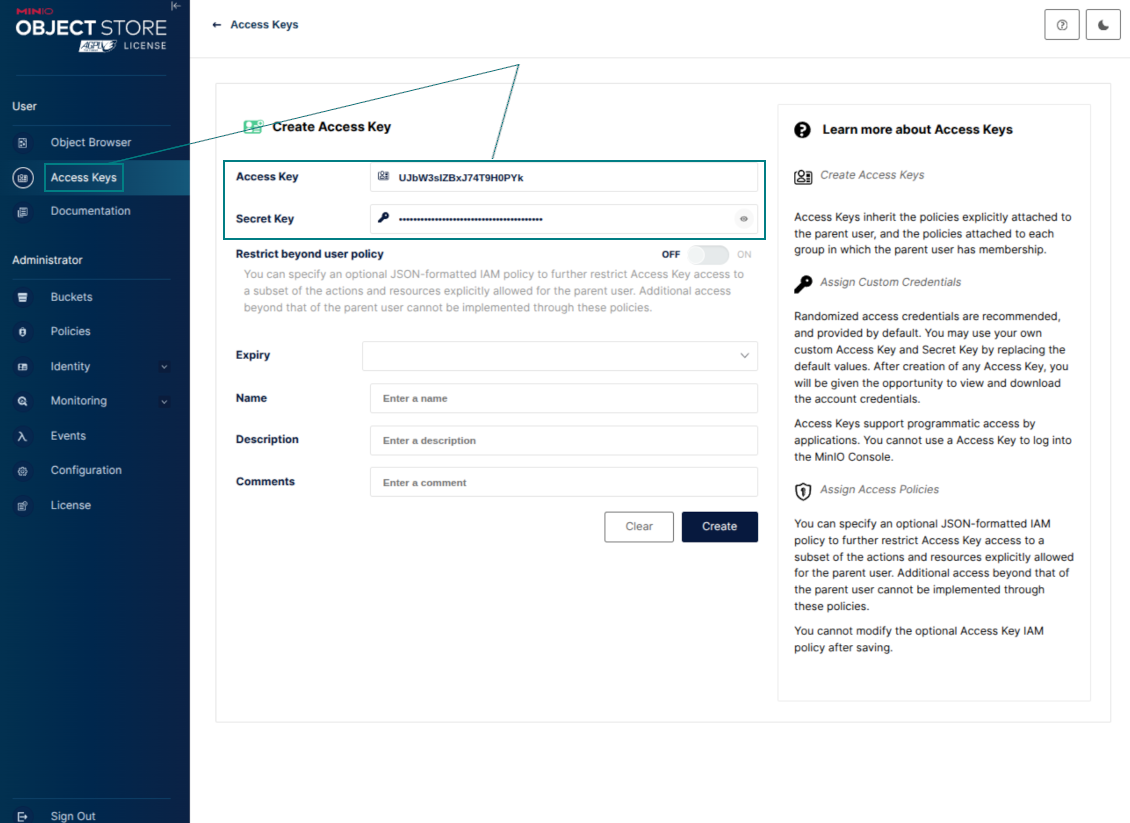
- Tạo thông tin đăng nhập truy cập cho Odoo. Trong MinIO, dùng cặp access key / secret key hoặc tài khoản dịch vụ có quyền liệt kê, đọc, tạo, ghi, sao chép và xóa đối tượng trong bucket đã chọn
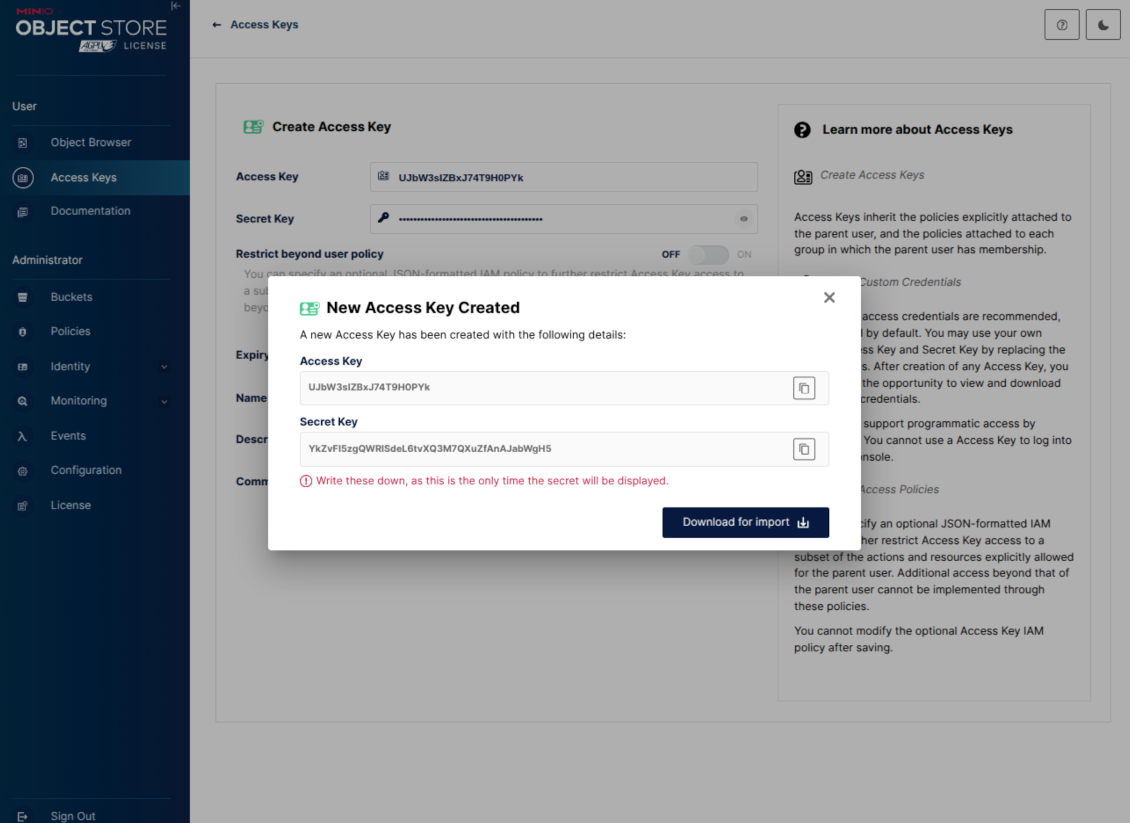
- Sao chép MinIO Access Key vào trường Odoo 'Access Key'
- Sao chép MinIO Secret Key vào trường Odoo 'Secret Key'. Quan trọng: lưu bí mật trước khi đóng trang MinIO nếu MinIO chỉ hiện một lần
- Sao chép URL điểm cuối API S3 MinIO vào Odoo vào trường 'Amazon S3 endpoint URL'. Ví dụ, máy chủ cục bộ thường dùng http://localhost:9000, còn máy chủ production có thể dùng https://minio.example.com
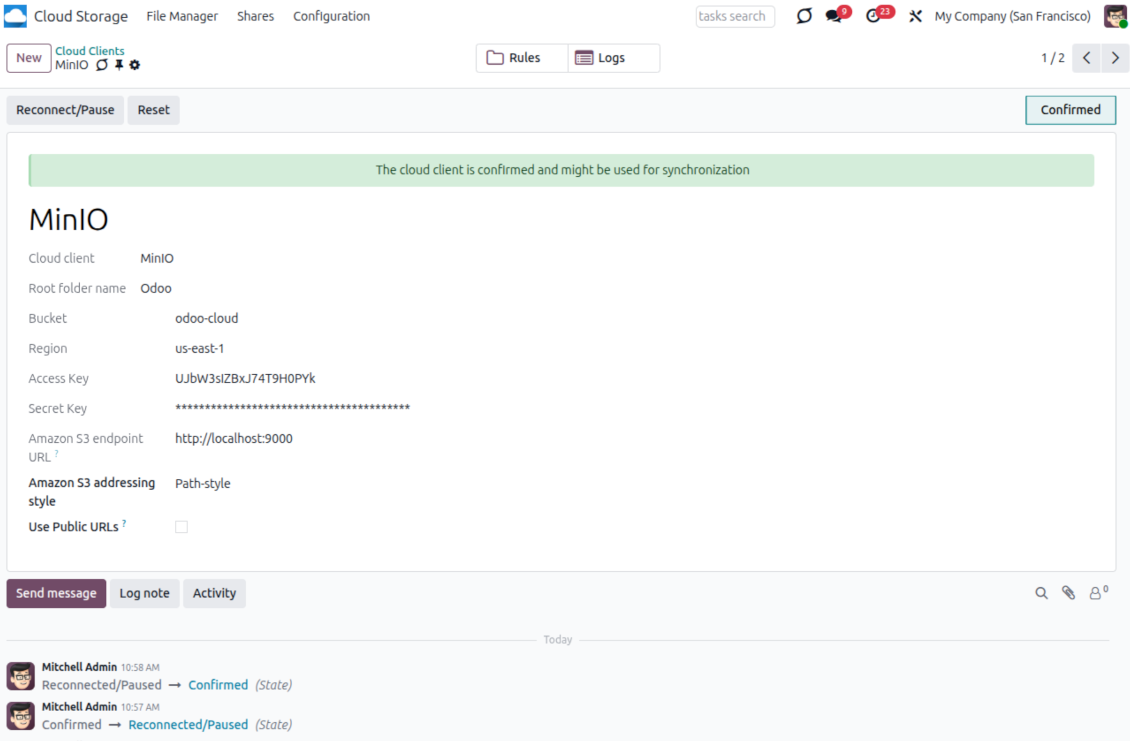
- Vào Odoo Cloud Storage > Configuration > Cloud Clients rồi nhấn 'Create'
- Với tham chiếu, nhập tên rõ với mọi người dùng
- Với Cloud client, chọn «MinIO»
- Với tên Root folder, nhập tiêu đề sẽ dùng làm MinIO object prefix cha cho mọi thư mục đồng bộ. Ví dụ 'Odoo' hoặc 'OdooERP'
- Điền các trường 'Bucket', 'Access Key', 'Secret Key' và 'Amazon S3 endpoint URL'. Trường 'Region' là tùy chọn với MinIO; nếu trống, Odoo dùng us-east-1 để ký tương thích S3
- Giữ kiểu địa chỉ là Path-style. Đây là tùy chọn khuyến nghị cho endpoint MinIO, nhất là khi máy chủ MinIO không cung cấp tên DNS riêng cho từng bucket
- Chọn Odoo có dùng URL MinIO công khai trực tiếp hay không. Bật «Use Public URLs» chỉ khi bucket, tiền tố, proxy ngược hoặc CDN đọc được công khai. Với bucket MinIO riêng, hãy để tắt
- Nhấn 'Confirm'. Odoo kiểm tra quyền bucket và tạo hoặc xác minh tiền tố thư mục gốc. Đồng bộ MinIO - Odoo đã sẵn sàng
- Áp dụng cloud client vừa tạo cho quy tắc thư mục và/hoặc thư mục thủ công cần đồng bộ với bucket MinIO đó
- Chờ công việc đồng bộ đã lên lịch khởi chạy. Chỉ dùng để kiểm thử: kích hoạt tích hợp thủ công từ Cloud Storage > Cấu hình > Cấu hình > nút 'Launch sync'.
Useful MinIO documentation: https://min.io/docs/minio/linux/administration/identity-access-management.html, https://min.io/docs/minio/linux/reference/minio-server/minio-server.html.
Tạo khóa truy cập MinIO
Sao chép thông tin MinIO mới
Cấu hình máy khách đám mây MinIO trong Odoo
Thiết lập tích hợp Dropbox
Phụ thuộc Python
Công cụ phụ thuộc thư viện ngoài 'dropbox'. Cài cho máy chủ Odoo bằng lệnh:
pip3 install dropbox
Cấu hình và đăng nhập
- Bật tùy chọn 'Dropbox Sync' (cloud Storage > Cấu hình > Cấu hình). Cần tiện ích bổ sung tùy chọn Dropbox Odoo Integration
- Follow the URL https://www.dropbox.com/developers/apps/create
- Chọn API là «Scoped access»
- Chọn loại truy cập «Full Dropbox»
- Chọn tên phù hợp cho ứng dụng và nhấn nút 'Create app'
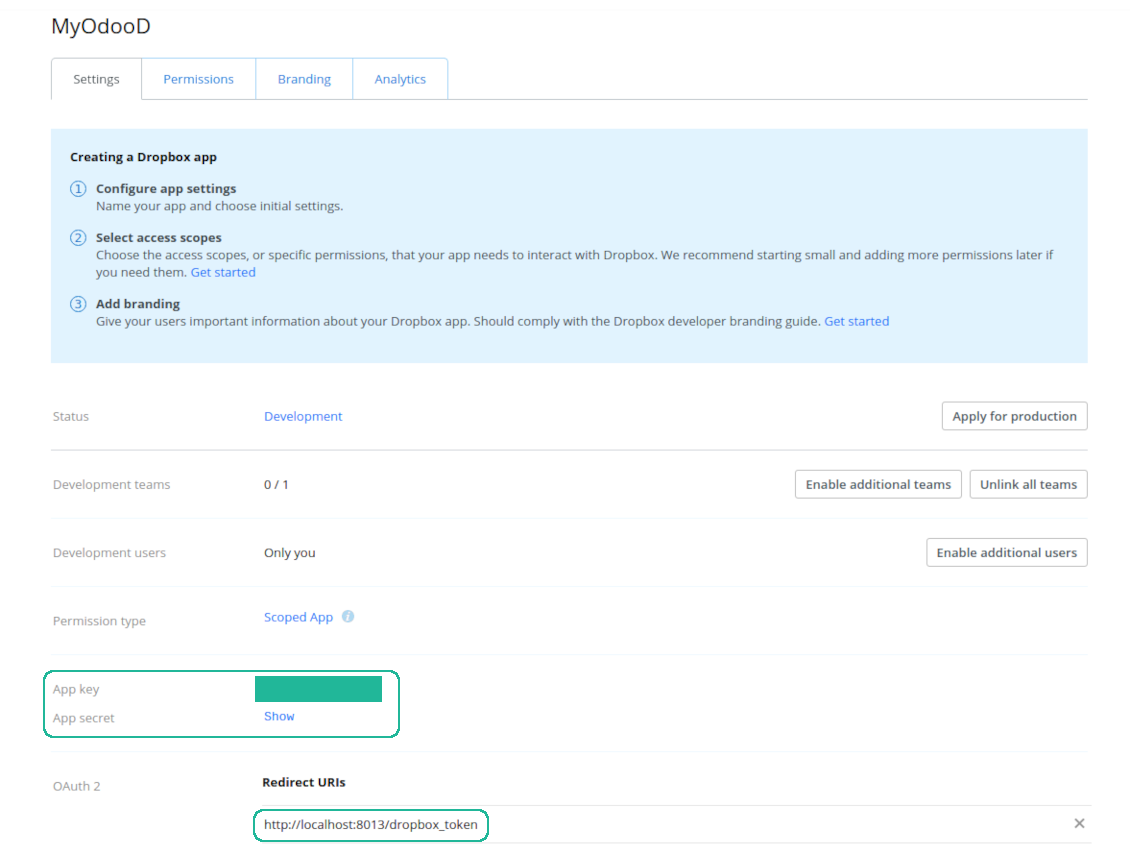
- Thêm URI chuyển hướng dạng [YOURODOOSITENAME]/dropbox_token (vd. https://faotools.com/dropbox_token). Cần chứng chỉ SSL hợp lệ (https)
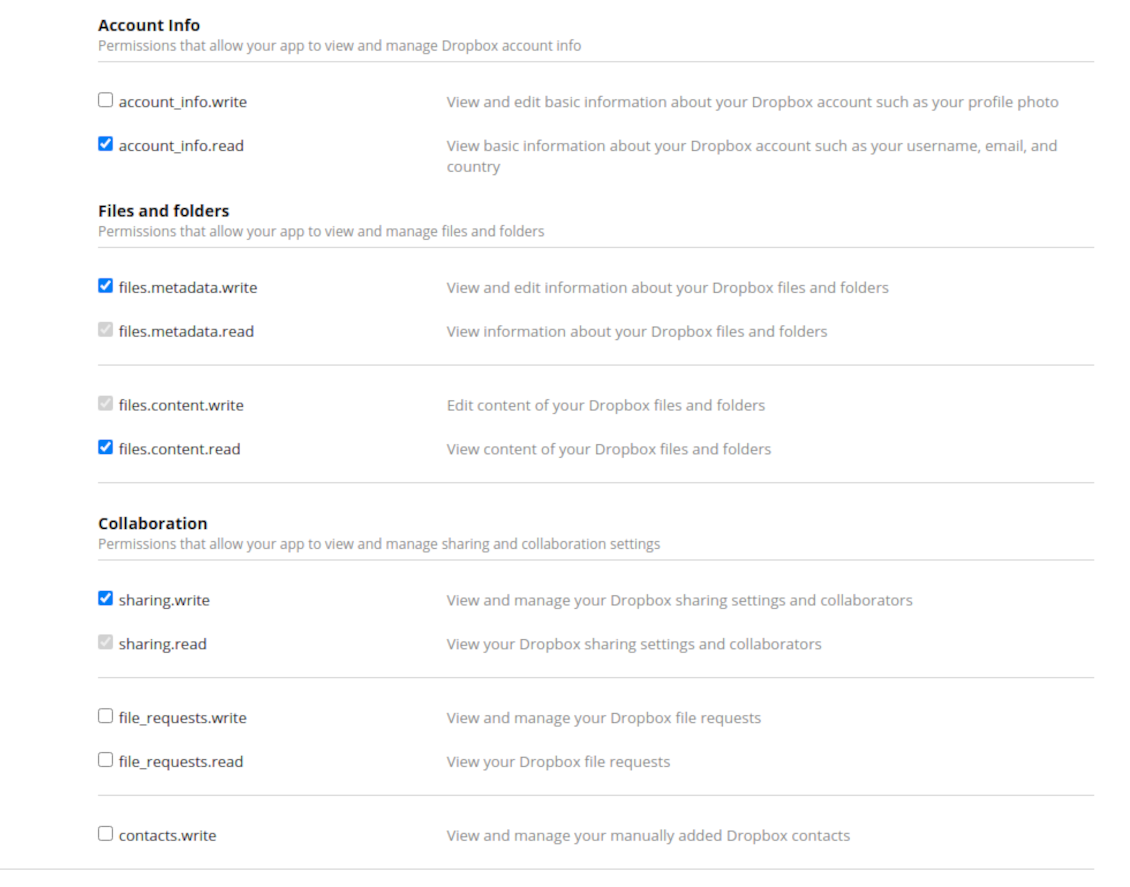
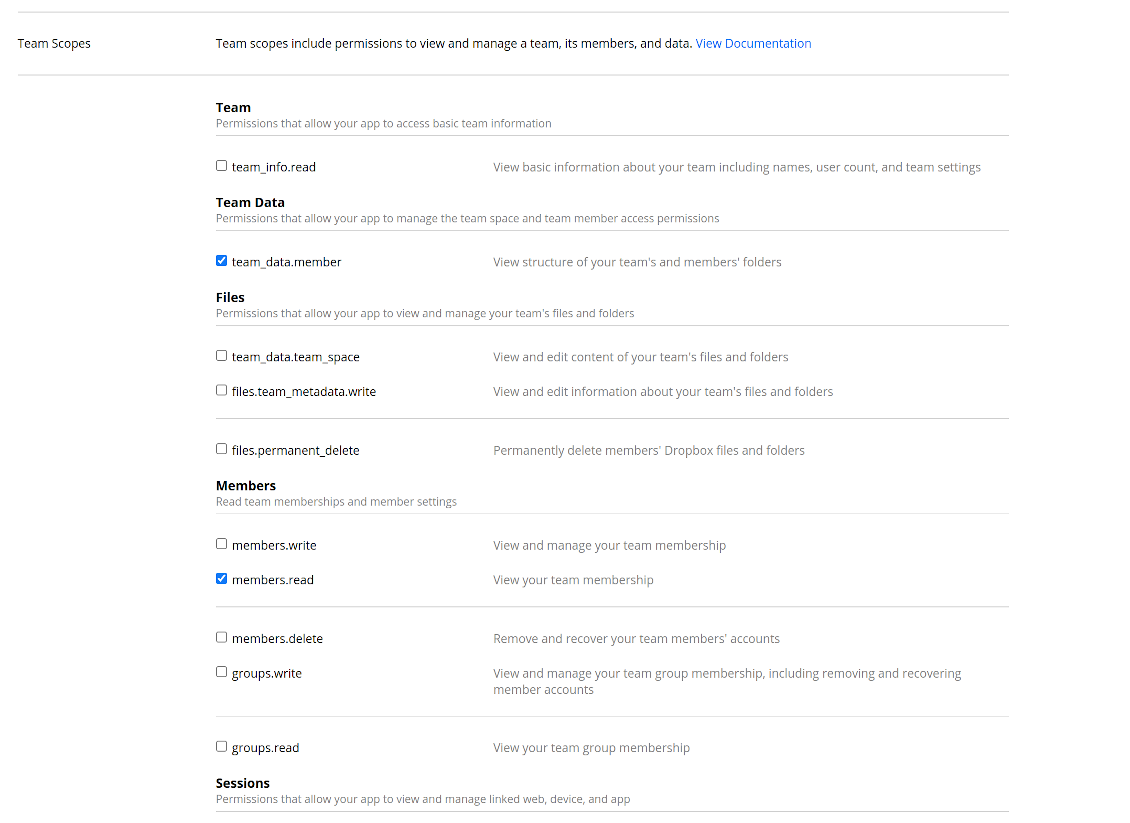
- Cấp quyền cho ứng dụng: 'Account Info (Read)', 'Files and folders Metadata (Write)', 'Files Content (Write)', 'Collaboration (Write)'. Với DropBox nhóm cũng gán 'Team Data Members', 'Members (Read)'. Đảm bảo không gán quyền nào khác.
- Gửi ứng dụng
- Vào Odoo Cloud Storage > Cấu hình > Cloud Clients rồi nhấn 'Create'
- Với tham chiếu, nhập tên rõ với mọi người dùng
- Với Cloud client, chọn «Dropbox»
- Với tên Root folder, nhập tiêu đề sẽ dùng làm Google Drive directory cha cho mọi thư mục đồng bộ. Ví dụ 'Odoo' hoặc 'OdooERP'
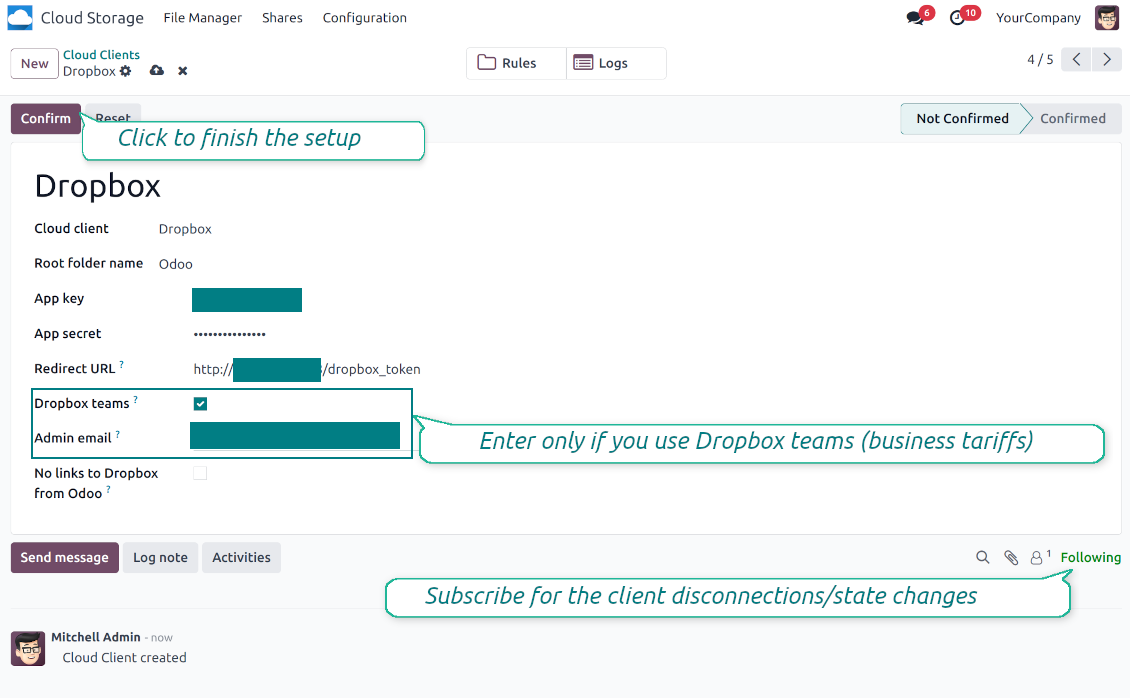
- Sao chép 'App key' vào 'App key'
- Sao chép 'App Secret' vào trường 'App secret'
- Chèn URL chuyển hướng đã tạo trước
- Nếu bạn dùng ổ nhóm Dropbox
- Đánh ô liên quan
- Đặt email của người dùng Dropbox. Trong thư mục người dùng này mọi mục liên quan Odoo được tạo, rồi mới chia sẻ với người khác. Dưới người dùng này mọi tệp và thư mục được tạo, sửa, chuyển và xóa
- Nhấn 'Confirm'. Odoo chuyển bạn tới trang đăng nhập Dropbox. Kiểm tra trong hệ thống, đồng ý mọi điều kiện và cấp mọi quyền được hỏi
- Sau khi đăng nhập, Dropbox chuyển bạn trở lại Odoo. Đồng bộ Dropbox - Odoo đã sẵn sàng
- Áp dụng cloud client vừa tạo cho quy tắc thư mục và/hoặc thư mục thủ công cần đồng bộ với phiên bản Dropbox đó
- Chờ công việc đồng bộ đã lên lịch khởi chạy. Chỉ dùng để kiểm thử: kích hoạt tích hợp thủ công từ Cloud Storage > Cấu hình > Cấu hình > nút 'Launch sync'.
URL Dropbox
Dropbox có cách riêng để tạo liên kết cho tệp và thư mục sẵn có. Cụ thể, không có khái niệm URL nội bộ hay riêng tư. Thay vào đó, mỗi mục Dropbox có thể nhận URL chia sẻ. Liên kết chia sẻ đó là công khai hoặc chỉ cho nhóm. Hơn nữa, tính năng sau chỉ có trên tài khoản Dropbox business.
Công cụ dựa trên cơ chế liên kết chia sẻ. Nghĩa là mỗi liên kết tệp đính kèm là công khai (mọi tài khoản Dropbox cá nhân) hoặc chỉ nhóm (mọi tài khoản Dropbox doanh nghiệp).
Đôi khi được xem là chưa hoàn toàn an toàn. Dù người ngoài khó biết URL trang web, vẫn có khả năng chúng lộ ra do một số thao tác. Việc tạo liên kết chia sẻ cũng không nhanh và có thể làm chậm đồng bộ. Vì vậy có tính năng tắt URL chia sẻ.
If checked, all Dropbox URLs in Odoo will be of type https://www.dropbox.com/home/Odoo/[PATH]. Such links will not work in many cases. Thus, if you need to open Dropbox files/folders from Odoo, be careful with the setting 'No links to Dropbox from Odoo'.
Xem thêm video cấu hình
Tạo ứng dụng Dropbox
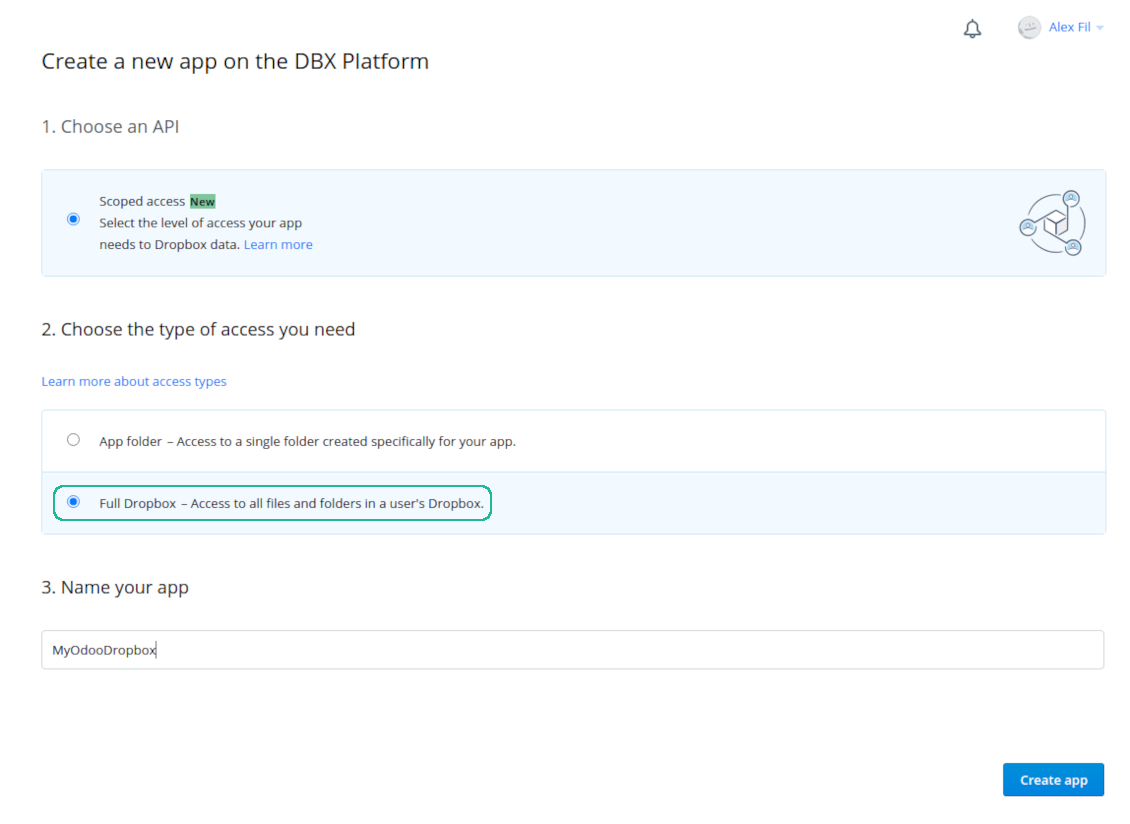
Thiết lập ứng dụng Dropbox: URL chuyển hướng
Quyền Dropbox cho tài khoản cá nhân
Quyền Dropbox cho tài khoản doanh nghiệp
Thiết lập Odoo cho tích hợp Dropbox
Câu hỏi thường gặp về Cloud Storage Solutions Odoo v.18
Trường đã đồng bộ lưu ở đâu? Có bị nhân đôi sang Odoo và clouds không?
Ứng dụng giả định nội dùng nhị phân của tệp đính kèm được lưu trong Cloud Client thay vì trên máy chủ Odoo. Những tệp đính kèm đó trong Odoo trở thành kiểu URL và bạn có thể mở chúng bất cứ lúc nào từ hộp đính kèm hoặc từ Cloud Client.
Sau khi thiết lập, không cần thao tác thủ công vì đồng bộ hoàn toàn tự động. Hãy chọn loại chứng từ Odoo cần đồng bộ và thiết lập model liên quan cho từng loại (Khách hàng, đơn bán hoặc đơn mua, Nhiệm vụ, Dự án, v.v.).
Tôi có thể có vài thư mục cho cùng một loại chứng từ không? Ví dụ dự án nội bộ và dự án khách hàng?
Có. Hãy chuẩn bị một quy tắc cho từng loại, rồi áp bộ lọc: ví dụ theo kiểu dự án.
Hãy làm bộ lọc loại trừ lẫn nhau để một chứng từ được gán chắc chắn. Ví dụ 'khách hàng nhưng không phải nhà cung cấp', 'nhà cung cấp nhưng không phải khách hàng'. Nếu không, thư mục của một chứng từ sẽ nhảy từ model này sang model khác.
Có thể đồng bộ theo thời gian thực không?
Không. Chúng tôi có lý do vững chắc để tránh đồng bộ thời gian thực:
Vấn đề hiệu năng. Nếu đồng bộ theo thời gian thực, mỗi lần tải tệp lên sẽ hiện màn hình chờ.
Vấn đề xung đột. Nếu 2 người dùng cùng lúc sửa một mục, có thể dẫn đến tình huống không giải quyết được. Với tác vụ định kỳ ta sửa sau được; còn thời gian thực phải lưu thành hàng đợi, càng khiến người dùng bối rối.
Vấn đề chức năng. Đặc biệt là đổi tên và tổ chức lại mục. Ở chiều đồng bộ ngược, công cụ dựa chặt vào logic thư mục và mỗi lần đồng bộ kiểm tra 100% mục. Nếu làm sau mỗi lần cập nhật, sẽ có hàng nghìn yêu cầu mỗi giây. Nếu không: thay đổi sẽ bị mất.
Tôi có thể đổi tên thư mục mặc định trên các đám mây không?
Bạn có thể đặt tên riêng cho thư mục mô hình (đơn bán, cơ hội, nhà cung cấp, v.v.) với mọi loại chứng từ.
Với thư mục đối tượng (SO-001, John Smith, v.v.), công cụ dựa trên phương thức Odoo để dựng tên hiển thị của loại chứng từ này. Tuy nhiên bạn có thể đổi bằng cách định nghĩa biểu thức tên. Cú pháp đúng như mẫu email Odoo được dùng.
Tôi có thể đổi tần suất công việc đồng bộ không?
Không, từ phiên bản 15 bạn không nên đổi các job đã lên lịch. Chúng được tối ưu chạy mỗi 15 phút để kết nối ổn định và nhanh nhất.
Bảo đảm thời gian chờ máy chủ Odoo đặt ít nhất 15 phút (900 giây).
Nếu cần tạm dừng đồng bộ, hãy làm trên form cloud client tương ứng.
Tôi có thể đồng bộ tệp đính kèm với vài máy khách đám mây
Có, từ phiên bản 15 bạn có thể thiết lập nhiều kết nối. Như vậy một số thư mục đồng bộ với một cloud client, số khác với client khác.
Lưu ý rằng không thể đồng bộ cùng một thư mục với nhiều cloud storages cùng lúc.
Chúng tôi dùng trình soạn thảo đặc biệt trên đám mây (ví dụ OnlyOffice, Office 365…). Tệp có mở trong trình đó không?
Có, tùy cấu hình cloud client của bạn.
Tôi có chỉ cần ứng dụng Cloud Storage Solution không?
Từ phiên bản 15, ứng dụng có thể dùng độc lập để sắp xếp tệp đính kèm theo thư mục và cung cấp giao diện trình quản lý tệp.
Tuy nhiên, nếu mục tiêu là kết nối với một máy khách đám mây, bạn cần cài ít nhất một ứng dụng tùy chọn liên quan máy khách.
Điều gì xảy ra khi tôi đổi quy tắc thư mục?
Khi quy tắc thư mục thay đổi, danh sách thư mục cũng đổi. Nếu thư mục không còn khớp điều kiện quy tắc thì bị gỡ. Nếu tệp đã đồng bộ, đồng bộ ngược trả chúng về Odoo và xóa khỏi Cloud Client.
Nếu đối tượng của tài liệu không khớp điều kiện quy tắc thư mục thì thư mục của nó sẽ không được tạo. Nếu sau đó khớp, thư mục liên quan sẽ được tạo.
Tôi có thể chỉ giữ đồng bộ trực tiếp hoặc tắt đồng bộ từ đám mây không?
Có. Trên máy khách đám mây, mở trang Thiết lập và bật Tắt đồng bộ từ đám mây.
Đồng bộ vẫn một chiều. Thay đổi trong Odoo vẫn được đẩy lên kho đám mây. Tệp và thư mục được tạo, đổi tên hoặc xóa trên kho đám mây không xuất hiện trong Odoo, và thư mục bị xóa ở đó không được khôi phục.
Tắt lại tùy chọn để áp dụng các thay đổi đã tích lũy, kể cả việc xóa, ở lần đồng bộ tiếp theo.
Thiết lập này có từ phiên bản 18. Gỡ, đặt lại hoặc tắt máy khách vẫn chạy đồng bộ ngược, trừ khi bạn cũng tắt đồng bộ đó.
Chính sách cập nhật của các công cụ của bạn là gì?
Theo chính sách hiện tại của Odoo Apps Store:
- Mọi mô-đun mua cho phiên bản 12.0 trở về trước cho phép truy cập mọi phiên bản đến 12.0.
- Từ phiên bản 13.0, mỗi phiên bản mô-đun phải mua riêng.
- Bất kể phiên bản, mua công cụ cho quyền mọi cập nhật và sửa lỗi trong một phiên bản chính.
Lưu ý rằng nhóm faOtools không kiểm soát các chính sách đó. Mọi câu hỏi xin liên hệ trực tiếp đại diện Odoo Apps Store.
Làm sao cài ứng dụng của bạn trên Odoo.sh?
Cách thẳng nhất là dùng quy trình có sẵn của cửa hàng Odoo:
1. Mở trang phân hệ và bấm nút Deploy on odoo.sh
2. Sau đó bạn sẽ được chuyển tới trang GitHub. Đăng nhập tài khoản, rồi bấm 'Create a new repo' hoặc dùng repo có sẵn. Hãy đảm bảo kho là riêng tư. Không được phép công bố ứng dụng theo giấy phép OPL-1. Nếu cần, tạo repo mới cho dự án Odoo.sh
3. Rồi vào odoo.sh và bấm nút Deploy. Trong cửa sổ pop-up, gửi quyết định và bấm 'Continue.' Thao tác này sẽ kích hoạt cài đặt.
Các bước này sẽ cài ứng dụng cho nhánh production của dự án. Nếu muốn triển khai ứng dụng cho nhánh khác hoặc cập nhật phân hệ, hãy làm các bước sau:
1. Tải mã nguồn ứng dụng từ cửa hàng Odoo
2. Commit phân hệ vào kho GitHub cần thiết. Đảm bảo không thư mục/tệp ứng dụng nào bị bỏ qua (tức không nằm trong .gitignore của repo). Kho được odoo.sh tạo tự động và mặc định có thể gồm mục quan trọng (vd. /lib). Hãy tải lên mọi thư mục, thư mục con và tệp của phân hệ, không ngoại lệ
3. Triển khai nhánh đích của dự án odoo.sh hoặc, nếu thiết lập của bạn giả định vậy, đợi đến khi được xây tự động.
Tôi nên cài ứng dụng của bạn trên máy chủ riêng thế nào?
2. Khởi động lại máy chủ Odoo;
3. Bật chế độ nhà phát triển (cài đặt kỹ thuật);
4. Cập nhật danh sách ứng dụng (menu ứng dụng);
5. Tìm ứng dụng và bấm 'Activate'/'Install';
6. Làm theo hướng dẫn trên trang ứng dụng nếu có.
Tôi thấy ứng dụng có tiện ích thêm. Có thể mua sau không?
Có, chắc chắn. Đồng thời Odoo tự thêm mọi phụ thuộc vào giỏ, nên bạn nên loại các công cụ đã mua để tránh trả hai lần.
Tôi triển khai ứng dụng trên Odoo.sh và thấy cảnh báo/lỗi trong kiểm thử
Cảnh báo đỏ/cam không ảnh hưởng đến tính năng của ứng dụng. Đáng tiếc, đôi khi phân hệ của chúng tôi không qua được các kiểm thử tự động chuẩn vì chúng giả định hành vi xung đột với mục tiêu ứng dụng. Ví dụ chúng tôi đổi cách tính giá, trong khi kiểm thử phân hệ Odoo chuẩn so giá cuối với thuật toán chuẩn.
Trước hết, hãy kiểm tra tính năng của cơ sở dữ liệu đã triển khai. Mọi thứ có chạy đúng không?
Nếu vẫn cho rằng cảnh báo ảnh hưởng tính năng thật, hãy liên hệ chúng tôi và gửi nhật ký cài đặt đầy đủ cùng danh sách đầy đủ phân hệ đã triển khai (gồm lõi và bên thứ ba).
Tôi có thể mua ứng dụng trực tiếp từ công ty bạn không?
Không, chúng tôi chỉ phân phối công cụ qua cửa hàng ứng dụng Odoo chính thức.
Tôi muốn được giảm giá
Rất tiếc, chúng tôi không có phương tiện kỹ thuật để cung cấp giá riêng.
Tôi có thể cài ứng dụng trên cơ sở dữ liệu Odoo Online (SaaS) không?
Không, ứng dụng bên thứ ba không dùng được trên Odoo Online. Rất tiếc Odoo SaaS chặn khả năng đó.
Công cụ của bạn phụ thuộc ứng dụng khác. Tôi có cần mua chúng không?
Có, công cụ cần tất cả phân hệ ghi trong phụ thuộc để chạy đúng. Giá trên trang ứng dụng đã gồm mọi phụ thuộc cần thiết.
Giá mô-đun bằng đô la Mỹ là bao nhiêu? Sao lại đổi?
Giá phân hệ của chúng tôi tính bằng euro. Cửa hàng Odoo đổi sang các tiền tệ khác theo tỷ giá nội bộ. Vì vậy giá bằng đô la Mỹ có thể đổi khi tỷ giá được cập nhật.
Lời ứng dụng và trang web ở ngôn ngữ khác tiếng Anh được hỗ trợ bởi AI và khớp với bản dịch Odoo chính thức. Nếu bạn thấy sai, gửi phiếu hỗ trợ về đúng bản dịch và chúng tôi sẽ sửa.
Cơ sở trình diễn Odoo (xem trước trực tiếp)
Với ứng dụng này, chúng tôi có thể cung cấp cơ sở demo cá nhân miễn phí.
Bạn không cần số điện thoại hay thẻ tín dụng để liên hệ. Chỉ cần đăng ký email ngắn, không quá 30 giây.
Theo yêu cầu, chúng tôi sẽ chuẩn bị cơ sở xem trước trực tiếp riêng, nơi bạn có thể thử nghiệm và kiểm tra giả định khoảng hai tuần.
Báo lỗi
Nếu gặp lỗi hoặc hành vi không nhất quán, hãy liên hệ. Chúng tôi cam kết sửa trong 60 ngày kể từ khi mua và vẫn muốn cải thiện công cụ sau giai đoạn đó.
Bạn không cần số điện thoại hay thẻ tín dụng để liên hệ. Chỉ cần đăng ký email ngắn, không quá 30 giây.
Hãy nêu càng nhiều chi tiết càng tốt trong yêu cầu: ảnh chụp màn hình, nhật ký máy chủ Odoo, mô tả đầy đủ cách tái hiện sự cố, v.v. Thường mất vài ngày làm việc để chuẩn bị kế hoạch xử lý (nếu xác nhận lỗi) hoặc hướng dẫn việc cần làm (nếu không).
Yêu cầu tính năng công khai và ý tưởng module (phát triển miễn phí)
Chúng tôi rất muốn cải thiện công cụ và biết ơn mọi phản hồi. Nếu yêu cầu của bạn hữu ích cho mọi người và có thể triển khai hiệu quả, nhóm sẽ đưa vào danh sách việc cần làm.
Danh sách việc cần làm như vậy được xử lý đều đặn và không phát sinh phí thêm. Dù chúng tôi không hứa hạn chót và thiết kế cuối, đây có thể là cách tốt để có tính năng mong muốn mà không đầu tư và rủi ro.
Bạn không cần số điện thoại hay thẻ tín dụng để liên hệ. Chỉ cần đăng ký email ngắn, không quá 30 giây.
18.0.1.4.54
- The issue of the sync queue stopping with a recursion error when a large number of tasks is planned at once has been fixed.
- Tasks of a paused or not connected cloud client now wait for the client instead of being failed and canceled.
18.0.1.4.53
- Đã thêm tính năng tắt đồng bộ từ đám mây cho một máy khách đám mây.
- Đã thêm tính năng tắt đồng bộ ngược cho một máy khách đám mây.
- Đã sửa sự cố hàng đợi đồng bộ vẫn bị chặn sau khi máy khách đồng bộ ngược của nó bị xóa.
18.0.1.4.52
- The issue of folder lookup failing when the document id was a recordset has been fixed.
18.0.1.4.51
- Optimized folder sync by searching only attachments of updated records instead of all model attachments.
18.0.1.4.50
- The feature to requeue failed tasks has been added.
18.0.1.4.49
- Support for Amazon S3, MinIO S3, Synology, QNAP, TrueNAS, other NAS/WebDAB, and BOX has been added.
18.0.1.4.48
- The feature to control the maximum number of folders per rule has been added.
18.0.1.4.47
- The issue with attachments linked to documents disappearing from the attachment box has been fixed.
18.0.1.4.46
- The issue fix text break in folder titles has been fixed.
18.0.1.4.45
- The issue with the non-synced invoice report has been fixed.
18.0.1.4.44
- Kiểm tra thư mục không đồng bộ đã được tối ưu.
18.0.1.4.43
- Đã sửa sự cố tìm kiếm thư mục mới chọn.
18.0.1.4.42
- Đã khắc phục sự cố cây thư mục không làm mới khi chuyển giữa các bản ghi.
18.0.1.4.41
- Đã khắc phục sự cố phải nhấp đúp để gỡ tệp đính kèm đã chọn.
18.0.1.4.40
- Hàng đợi xóa bản sao lưu đã đổi thành first-in, first-out.
18.0.1.4.39
- Ứng dụng được điều chỉnh theo logic domain mới để hỗ trợ phần động.
18.0.1.4.38
- Đánh giá filestore được thêm vào trang cấu hình.
- Đã thêm tính năng giới hạn đồng bộ cloud client theo một tên cơ sở dữ liệu cụ thể.
18.0.1.4.37
- Đã thêm tính năng khóa tạo bản sao lưu.
18.0.1.4.36
- Đã khắc phục sự cố cảnh báo chưa dịch.
18.0.1.4.35
- Đã thêm đồng bộ tự động và thủ công bản sao lưu cơ sở dữ liệu hiện tại tới các cloud client đã chọn. Cấu hình lịch sao lưu và thời gian giữ. Bản sao lưu có thể kèm hoặc không kèm filestore và manifest.
18.0.1.4.34
- Đã sửa lỗi không nhập đúng thư viện Python khi làm mới thư mục.
18.0.1.4.33
- Domain nay hỗ trợ dùng thư viện Python, gồm datetime ('date', 'datetime', 'time', 'timedelta', 'timezone', 'tzinfo', 'MAXYEAR', 'MINYEAR'), time ('time', 'strptime', 'strftime'). Cũng có thể dùng context_today (viết tắt của datetime.now) và relativedelta.
18.0.1.4.32
- Tương thích với module Email Marketing đã được sửa theo các cập nhật Odoo 18 gần đây.
18.0.1.4.31
- Tệp đính kèm bị bỏ chọn sau khi xóa.
18.0.1.4.30
- URL của tệp đính kèm đã đồng bộ có thể được tính trước.
18.0.1.4.29
- Thư mục tạo theo máy khách đám mây được tăng sequence.
18.0.1.4.28
- Các chế độ xem Kanban được điều chỉnh theo nguyên tắc XML mới của Odoo 18.
- Dải Archived cho bản ghi không hoạt động được thêm vào chế độ xem biểu mẫu quy tắc, thư mục, thẻ và chia sẻ.
18.0.1.4.27
- Giao diện được cập nhật để phản ánh thay đổi khung nhìn danh sách đính kèm của lõi.
18.0.1.4.26
- Đã khắc phục sự cố không thêm liên kết vào một số thư mục.
18.0.1.4.25
- Ứng dụng đã được xuất bản cho phiên bản 18.
17.0.1.4.25
- Đã khắc phục sự cố không tạo thư mục con cho thư mục cha liên quan đến không gian làm việc.
17.0.1.4.24
- Đã khắc phục sự cố không cập nhật thư mục con đã đồng bộ trước đó.
17.0.1.4.23
- Đã thêm tính năng xóa ngày chặn của các thư mục liên quan đến quy tắc.
17.0.1.4.22
- Đã thêm tính năng chọn tệp đính kèm sẵn có (kể cả đã đồng bộ) khi soạn tin nhắn Odoo.
- Tính năng thêm tệp đính kèm URL được thêm vào hộp đính kèm và giao diện trình quản lý tệp.
17.0.1.4.21
- Đã sửa sự cố tự cuộn sau khi ghi chú.
17.0.1.4.20
- Đã thêm tính năng lọc nhật ký theo ngày và giờ.
- Giờ có thể đặt số nhật ký xuất trên trang cấu hình.
17.0.1.4.19
- Số lần thử lại khi thất bại giờ có thể cấu hình và có thể khác nhau cho tác vụ chuẩn và reverse/move.
17.0.1.4.17
- Cơ chế chặn tác vụ cha được tối ưu để phục vụ trước tác vụ ưu tiên cao nhất.
17.0.1.4.15
- Cơ chế chặn được nêu rõ cho các thao tác đồng bộ chuyển mục.
17.0.1.4.13
- Quyền truy cập thư mục trung gian của quy tắc dựa trên quyền thư mục cha, không dựa trên mô hình quy tắc.
17.0.1.4.12
- Kích thước tối đa của URL được tăng lên 4096.
17.0.1.4.11
- Đồng bộ ngược đã được tối ưu. Các tác vụ treo do chặn lẫn nhau đã được gỡ.
17.0.1.4.10
- Đã khắc phục các sự cố đồng bộ ngược và lùi đồng thời.
17.0.1.4.9
- Thuật toán xử lý thư mục được sắp xếp lại và di chuyển đã được tối ưu.
17.0.1.4.8
- Đã sửa sự cố tạo thẻ và thư mục qua cổng.
17.0.1.4.7
- Đã sửa tìm kiếm chia sẻ cổng theo tiêu đề thẻ/thư mục.
17.0.1.4.6
- Đã thêm thao tác hàng loạt "Slideshow". Cho phép người dùng backend bắt đầu trình chiếu cho các tệp đính kèm hình đã chọn.
- Tùy chọn "Allow slideshow" được thêm vào cài đặt chia sẻ. Nếu bật, người dùng cổng/công khai có thể kích hoạt trình chiếu cho các tệp đính kèm hình hiện tìm thấy trong giao diện cổng của phần chia sẻ.
- Thuật toán đồng bộ ngược đã được tối ưu.
17.0.1.4.5
- Đã thêm kiểm tra trước sự cố cho tác vụ bị treo. Nếu tác vụ dừng hẳn cron (ví dụ lỗi giới hạn bộ nhớ), cron tiếp theo sẽ làm tác vụ khác.
17.0.1.4.4
- Xem trước Odoo chuẩn được thêm vào thẻ tệp đính kèm trên giao diện trình quản lý tệp. Để mở trình xem trước liên quan trong chế độ xem Kanban, người dùng nhấn hình thu nhỏ. Các loại tệp được hỗ trợ và hành vi giống hộp đính kèm.
- Biểu mẫu tệp đính kèm có thể mở bằng menu 3 chấm của Kanban. Tại đó cũng có thể đổi màu tệp đính kèm.
- Mức nhật ký đồng bộ được tô màu theo mức của thông báo.
- Hệ thống ghi nhật ký được tối ưu để ghi nhận tin nhắn ngày cả khi tác vụ thất bại và dừng hoàn toàn luồng.
17.0.1.4.3
- Đã sửa thư mục chọn sai khi tải lần đầu giao diện trình quản lý tệp.
17.0.1.4.2
- Đã thêm tính năng ưu tiên thư mục theo tần suất đồng bộ của quy tắc.
17.0.1.4.1
- Cấu trúc mô-đun được cập nhật theo giao diện trình quản lý tệp mới nhất, drag-and-drop và tính năng chia sẻ cổng thông tin
17.0.1.3.14
- Đã sửa nhân bản tệp đính kèm khi truyền rõ res_model và res_id (tương thích HR Expenses).
17.0.1.3.13
- Có thể chọn nhiều thư mục trong giao diện trình quản lý tệp.
- Thư mục hiện tại để tải tệp đính kèm được hiện trên tiêu đề nút "Tải lên".
- Đã giới thiệu tính năng chia sẻ tệp đính kèm/thư mục. Chia sẻ tệp, thư mục hoặc thẻ với đối tác cổng cụ thể hoặc công khai. Tùy chọn cho phép tải lên, điều hướng cây và tạo thẻ cùng thư mục.
- Đã thêm tính năng tải tất cả tệp đính kèm của một thẻ cụ thể. Điều hướng theo thẻ trở thành tùy chọn.
17.0.1.3.12
- Đã thêm kéo-thả tệp để tải lên từ máy tính cục bộ.
- Giờ có thể cập nhật thư mục và thẻ bằng cách thả tệp đính kèm vào bảng điều hướng bên trái.
17.0.1.3.11
- Đã sửa lỗi khi cập nhật hàng loạt thẻ.
- Đã khắc phục sự cố thư mục sai cho bản ghi mới.
- Đã khắc phục trường hợp không tạo được thư mục trên bảng điều hướng khi chưa có thư mục nào khác.
- Giao diện nhật ký đồng bộ được điều chỉnh để hiện nội dùng HTML của phản hồi nhận được.
17.0.1.3.10
- Đã xử lý trường hợp hiếm khi thiết lập ban đầu của thư mục thất bại 8 lần nhưng vẫn cần được đồng bộ.


The tool to build a deep and structured knowledge base for internal and external use. Knowledge System. KMS. Wiki-like revisions.
398€
The tool to set up KPI targets and control their fulfillment by periods. KPI dashboards. Dashboard designer. KPI charts

The tool for time-based service management from booking appointments to sales and reviews
398€
The tool to manage your Odoo from your favorite AI chats through MCP. Claude. Any MCP-supporting AI.

The tool to automatically synchronize Odoo attachments with OneDrive files in both ways
487€
The tool to automatically synchronize Odoo attachments with Google Drive files in both ways
487€
The tool to automatically synchronize Odoo attachments with ownCloud/Nextcloud files in both ways
487€
The tool to automatically synchronize Odoo attachments with NAS Solutions in both ways. Synology, QNAP, TrueNAS and any other WebDav-supporting NAS solutions
487€