Stock Demand Trends and Forecast v.14
The tool to calculate stock demand trends and make prediction for future demand statistically. Stock Forecast




If you knew stock demand trends per warehouses, you would have a clue to decrease keeping costs and to have a flawless supply chain. Regretfully, you can't know the future. However, you can predict it with a certain reliability. This is an Odoo tool for that goal. The app let you construct stock demand per periods and forecast further demand.
Scientific approach for forecasting
The app assumes applying statistical methods to calculate historical trends and make a forecast. Make a few experiments with suggested solutions and coefficients to achieve the most accurate prediction
Focused analysis
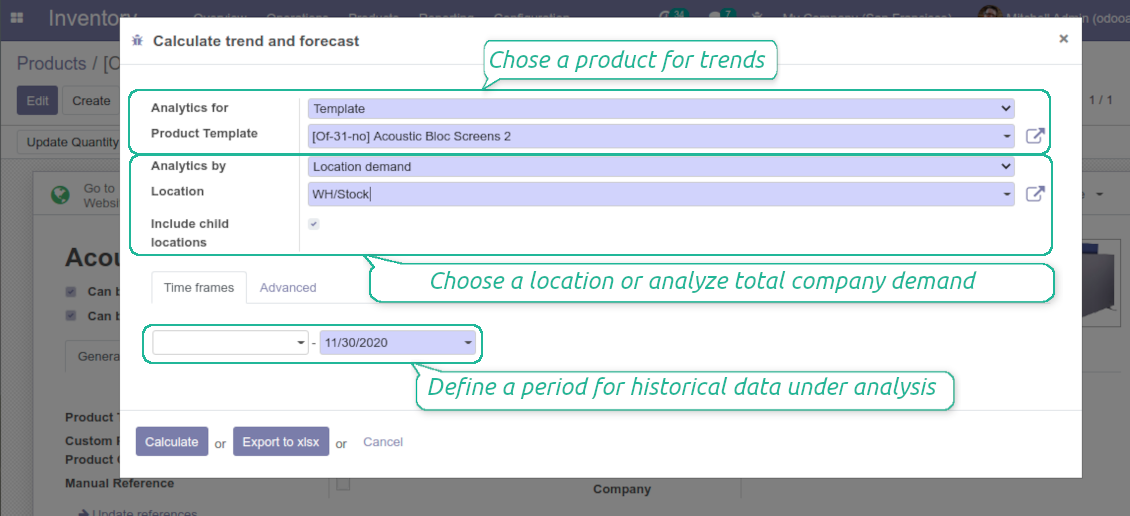
Shrink considered stock operations for a definite warehouse location (with or without child locations) or analyze global company stocks demand
Topical data
Apply time frames for historical data to check statistical reliability through 'predicting' actually passed intervals. Stock demand is calculated as all done stock moves for this period which source location is one of internal locations under consideration and which destination location is not of this range
Trends interfaces
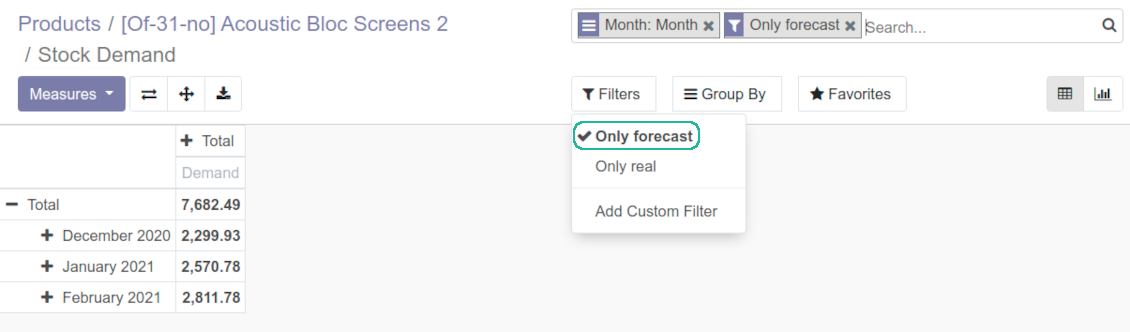
Work with stock demands forecasts in a way you like: as an Odoo chart, as an Odoo report (pivot), as an Excel table
Widely applicable solutions
Analyze trends for both a product template in general (e.g. all iPads) or a specific product variant (iPad 32Gb). The app might be of especial use for markets experiencing seasonal changes: try to define statistical factors in your industry to make reliable forecasts
Inventory trends analysts
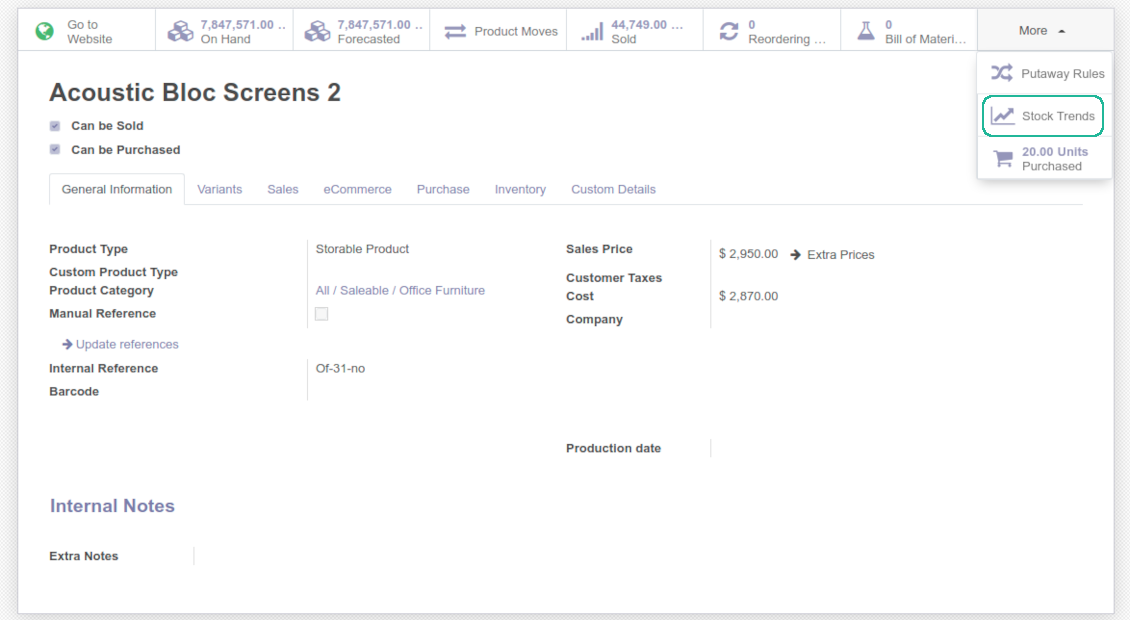
Grant the right for forecast tools for any WMS user (the group Other > Stock Demand Forecast). To start analysis it is needed to push the button 'Stock Trends' on a product template, variant, or stock location form. Be cautious: all stock operations of a current company would be under consideration.
Statistical methods to forecast stock demand
-
The tool allows to calculate inventory demand trends based on a number of statistical methods. They have different complexity and might be suitable for a definite market or a specific business. The final choice of the method and related statistical parameters is up to end users
-
Autoregression (AutoReg) is the simplest but still widely used statistical method for time series forecast
-
Autoregressive Distributed Lag (ARDR) takes into account 'errors' in previous observations
-
Autoregressive Moving Average (ARMA) is a combination of both AR and MA methods. To apply the ARMA method use the MA method with auto regression coefficient (P coefficient) as 2
-
Autoregressive Integrated Moving Average (ARIMA) combines the methods AR and MA, but beside that it tries to make data stationary. It is appropriate to use for historical data with pure trend but without seasonal changes
-
Seasonal Autoregressive Integrated Moving-Average (SARIMA) enriches the ARIMA method with considering seasonal changes. It is one of the most complex and wide spread methods utilized for forecasting time series now
-
Simple Exponential Smoothing (SES) is similar to the AR method, but instead of relying upon linear function, it exploits exponential one
-
Holt Winter's Exponential Smoothing (HWES) enriches the SES method to work with time series trends and seasonal effects
-
For more technical details have a look at the page: https://www.statsmodels.org/stable/api.html
Usage requirements
-
You have enough historical stock moves data (per location or a company), since it is senseless to make forecast based on last 5 days of operations
-
Stock demand is regular and is not chaotic, meaning that your decisions do not have 100% impact and there is at least some correlation between market demand and your WMS operations.
-
You consider seasonal changes and/or trends, which you noticed but can't fully analyze. You understand which assumptions you try to check.
-
You have clear understanding of how statistics works.
設定とインストールのヒント: Stock Demand Trends and Forecast Odoo v.14
Python dependencies
To guarantee tool correct work you would need a number of Python libraries: pandas, numpy, statsmodels, scipy, xlsxwriter. To install those packages execute the command:
pip3 install pandas numpy statsmodels scipy xlsxwriter
If you run Odoo on Python prior or equal to version 3.7, please install the following versions of the packages pandas==1.3.5, statsmodels==0.13.1
に関するよくある質問 Stock Demand Trends and Forecast Odoo v.14
ツールの更新ポリシーは何ですか?
現行の Odoo Apps Store ポリシーによると:
- バージョン 12.0 以前向けに購入したモジュールは、12.0 までの全バージョンにアクセスできます。
- バージョン 13.0 以降、各モジュールバージョンは個別に購入します。
- バージョンに関係なく、購入するとメジャーバージョン内の すべての更新と不具合修正の権利が得られます。
faOtools チームはこれらのポリシーを管理していません。ご質問は Odoo Apps Store の担当者へ直接お問い合わせください。
アプリを Odoo.sh にインストールする方法は?
最も単純な方法は、Odooストア組み込みのワークフローを使うことです:
1. モジュールのページを開き、Deploy on odoo.sh ボタンをクリックします。
2. その後 GitHub ページにリダイレクトされます。アカウントにログインし、'Create a new repo' をクリックするか既存のものを使います。リポジトリはプライベートにしてください。OPL-1 ライセンスのアプリを公開することは許可されていません。必要なら Odoo.sh プロジェクト用に新しい repo を作成します。
3. 次に odoo.sh に行き、Deploy ボタンをクリックします。ポップアップで決定を送信し、'Continue.' をクリックします。これでインストールが始まります。
これらの手順でプロジェクトの本番ブランチにアプリがインストールされます。他のブランチにデプロイする、またはモジュールを更新する場合は、次の操作を行います:
1. Odooストアからアプリのソースコードをアップロードします。
2. モジュールを必要な GitHub リポジトリにコミットします。アプリのフォルダ/ファイルが無視されていないこと(repo の .gitignore に含まれていないこと)を確認してください。リポジトリは odoo.sh が自動作成し、既定で重要な項目(例: /lib)が含まれることがあります。モジュールのディレクトリ、サブディレクトリ、ファイルを例外なくすべてアップロードしてください。
3. odoo.sh プロジェクトの対象ブランチを Deploy するか、 設定がそうなっている場合は自動ビルドされるまで待ちます。
自分のサーバーにアプリをインストールするには?
2. Odoo サーバーを再起動します;
3. 開発者モードをオンにします(技術設定);
4. アプリ一覧を更新します(アプリメニュー);
5. アプリを見つけて「Activate」/「Install」を押します;
6. アプリページにガイドラインがあれば従ってください。
アプリに追加アドオンがあるのに気づきました。後から購入できますか?
はい、もちろんです。同時に Odoo は依存関係をすべてカートに自動追加するので、二重払いを避けるには既に購入したツールを除外してください。
アプリを Odoo.sh にデプロイしたらテストで警告/エラーが出ます
赤/オレンジの警告はアプリの機能に影響しません。残念ながら、標準の自動テストがアプリの目的と衝突する動作を想定するため、モジュールが通らないことがあります。たとえば価格計算を変える一方、標準 Odoo モジュールのテストは最終価格を標準アルゴリズムと比較します。
まず、デプロイ済みデータベースの機能を確認してください。すべて正しく動いていますか?
それでも警告が実機能に影響すると考える場合はご連絡のうえ、インストールログ一式とデプロイ済みモジュールの全一覧(コアおよびサードパーティ含む)を送ってください。
アプリを御社から直接購入できますか?
いいえ、ツールは 公式の Odoo アプリストア.
割引をいただきたいです
残念ながら、個別価格を提示する技術的手段が ありません。
Odoo Online (SaaS)データベースにアプリをインストールできますか?
いいえ、サードパーティアプリは Odoo Online では使えません。残念ながら Odoo SaaS がその可能性をブロックします。
ツールは他のアプリに依存しています。それらも購入すべきですか?
はい、ツールが正しく動くには依存関係に記されたすべてのモジュールが必要です。アプリページの価格には必要な依存関係がすでに含まれています。
モジュールの米ドル価格はいくらですか?なぜ変わりましたか?
モジュールの価格はユーロ建てです。Odoo ストアは内部為替レートで他通貨に換算します。そのため為替が更新されると米ドル価格が変わることがあります。
英語以外のアプリ・サイト文言は AI 支援で作成され、 公式の Odoo 翻訳に揃えています。誤りを見つけたら、 翻訳の正確さについてチケットを送る 修正します。
不具合報告
不具合や一貫しない動作があれば、遠慮なくご連絡ください。購入から60日以内の修正を保証し、その後もツール改善に力を入れています。
ご連絡に電話番号やクレジットカードは不要です。30 秒以内の短いメール登録だけです。
リクエストにはできるだけ多くの詳細を含めてください:スクリーンショット、Odoo サーバーログ、問題の再現手順の完全な説明など。通常、問題の作業計画の作成(不具合が確認された場合)または実施すべき内容の案内(それ以外)には数営業日かかります。
公開の機能リクエストとモジュールのアイデア(無償開発)
ツール改善への意欲は強く、フィードバックには感謝します。要件が広く役立ち、効率よく実装できる場合、チームは To-do リストに加えます。
このような To-do リストは定期的に処理され、追加料金は発生しません。期限や最終デザインは約束できませんが、投資とリスクなしで望む機能を得る良い方法になることがあります。
ご連絡に電話番号やクレジットカードは不要です。30 秒以内の短いメール登録だけです。

Odoo の添付ファイルをフォルダに柔軟に整理し、Google Drive、OneDrive/SharePoint、Nextcloud/ownCloud、Dropbox、Amazon S3、Box、NAS とディレクトリを同期するツール。DMS。ファイルマネージャー。文書管理システム
398€

社内・社外向けに深く構造化されたナレッジベースを構築するツール。Knowledge System。KMS。Wiki のような改訂。
398€