Stock Demand Trends and Forecast v.14
The tool to calculate stock demand trends and make prediction for future demand statistically. Stock Forecast




If you knew stock demand trends per warehouses, you would have a clue to decrease keeping costs and to have a flawless supply chain. Regretfully, you can't know the future. However, you can predict it with a certain reliability. This is an Odoo tool for that goal. The app let you construct stock demand per periods and forecast further demand.
Scientific approach for forecasting
The app assumes applying statistical methods to calculate historical trends and make a forecast. Make a few experiments with suggested solutions and coefficients to achieve the most accurate prediction
Focused analysis
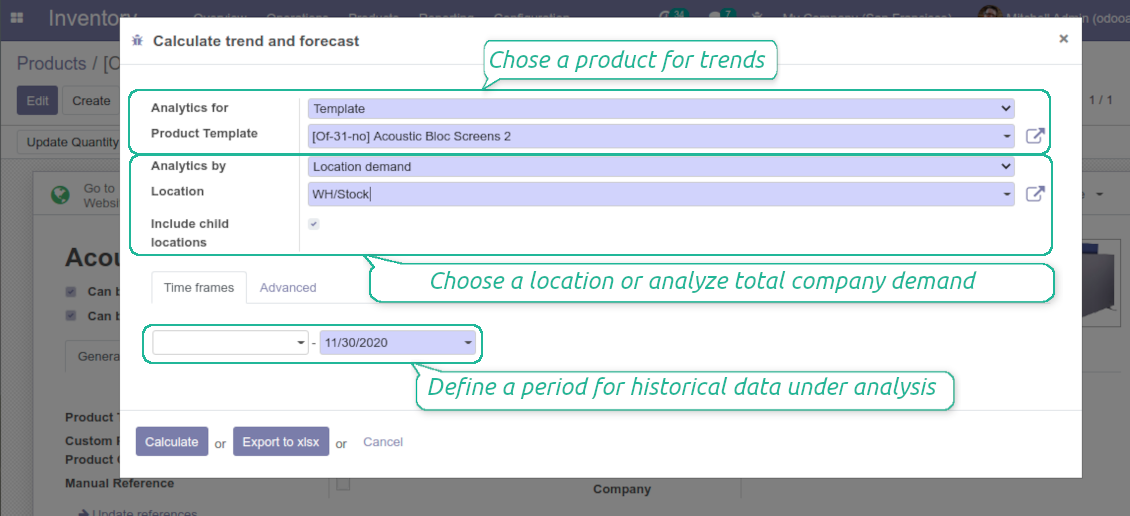
Shrink considered stock operations for a definite warehouse location (with or without child locations) or analyze global company stocks demand
Topical data
Apply time frames for historical data to check statistical reliability through 'predicting' actually passed intervals. Stock demand is calculated as all done stock moves for this period which source location is one of internal locations under consideration and which destination location is not of this range
Trends interfaces
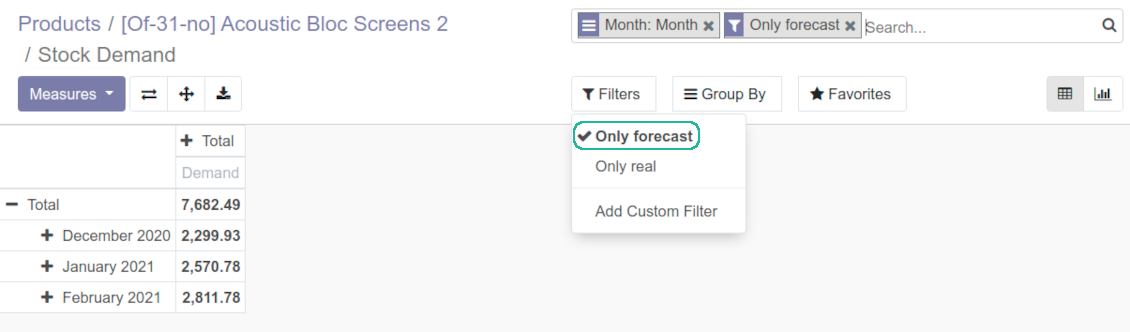
Work with stock demands forecasts in a way you like: as an Odoo chart, as an Odoo report (pivot), as an Excel table
Widely applicable solutions
Analyze trends for both a product template in general (e.g. all iPads) or a specific product variant (iPad 32Gb). The app might be of especial use for markets experiencing seasonal changes: try to define statistical factors in your industry to make reliable forecasts
Inventory trends analysts
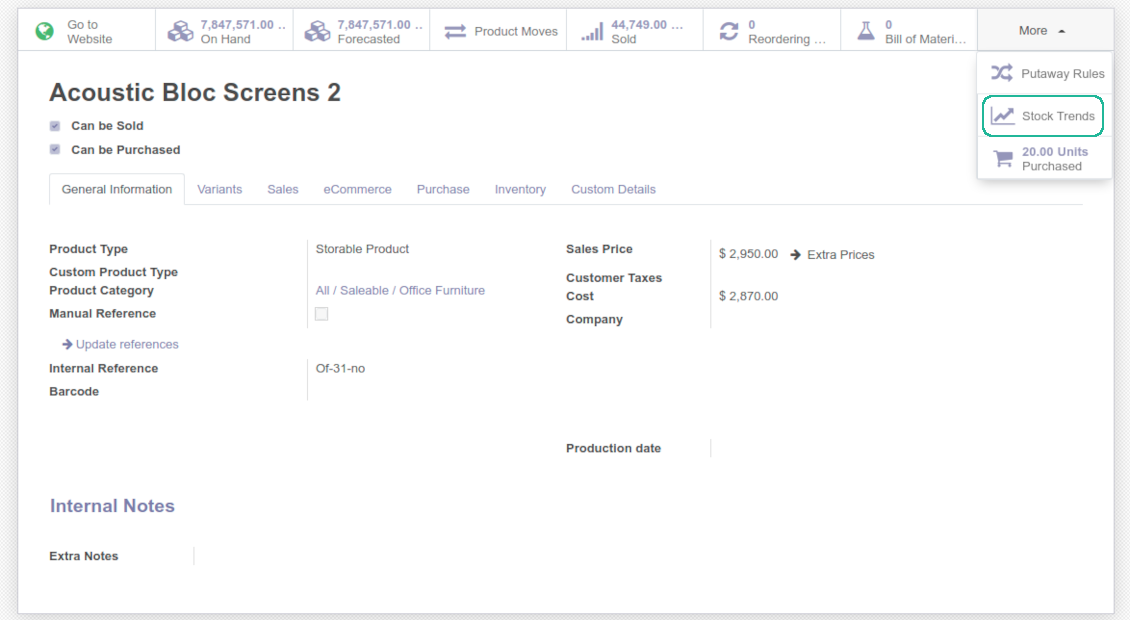
Grant the right for forecast tools for any WMS user (the group Other > Stock Demand Forecast). To start analysis it is needed to push the button 'Stock Trends' on a product template, variant, or stock location form. Be cautious: all stock operations of a current company would be under consideration.
Statistical methods to forecast stock demand
-
The tool allows to calculate inventory demand trends based on a number of statistical methods. They have different complexity and might be suitable for a definite market or a specific business. The final choice of the method and related statistical parameters is up to end users
-
Autoregression (AutoReg) is the simplest but still widely used statistical method for time series forecast
-
Autoregressive Distributed Lag (ARDR) takes into account 'errors' in previous observations
-
Autoregressive Moving Average (ARMA) is a combination of both AR and MA methods. To apply the ARMA method use the MA method with auto regression coefficient (P coefficient) as 2
-
Autoregressive Integrated Moving Average (ARIMA) combines the methods AR and MA, but beside that it tries to make data stationary. It is appropriate to use for historical data with pure trend but without seasonal changes
-
Seasonal Autoregressive Integrated Moving-Average (SARIMA) enriches the ARIMA method with considering seasonal changes. It is one of the most complex and wide spread methods utilized for forecasting time series now
-
Simple Exponential Smoothing (SES) is similar to the AR method, but instead of relying upon linear function, it exploits exponential one
-
Holt Winter's Exponential Smoothing (HWES) enriches the SES method to work with time series trends and seasonal effects
-
For more technical details have a look at the page: https://www.statsmodels.org/stable/api.html
Usage requirements
-
You have enough historical stock moves data (per location or a company), since it is senseless to make forecast based on last 5 days of operations
-
Stock demand is regular and is not chaotic, meaning that your decisions do not have 100% impact and there is at least some correlation between market demand and your WMS operations.
-
You consider seasonal changes and/or trends, which you noticed but can't fully analyze. You understand which assumptions you try to check.
-
You have clear understanding of how statistics works.
Configuration and Installation Tips for Stock Demand Trends and Forecast Odoo v.14
Python dependencies
To guarantee tool correct work you would need a number of Python libraries: pandas, numpy, statsmodels, scipy, xlsxwriter. To install those packages execute the command:
pip3 install pandas numpy statsmodels scipy xlsxwriter
If you run Odoo on Python prior or equal to version 3.7, please install the following versions of the packages pandas==1.3.5, statsmodels==0.13.1
Frequently Asked Questions about Stock Demand Trends and Forecast Odoo v.14
What are the update policies of your tools?
According to the current Odoo Apps Store policies:
- Every module bought for version 12.0 and prior gives you access to all versions up to 12.0.
- Starting from version 13.0, every module version should be purchased separately.
- Disregarding the version, purchasing a tool grants you a right to all updates and bug fixes within a major version.
Please note that the faOtools team does not control those policies. For all questions, please contact the Odoo Apps Store representatives directly.
How can I install your app on Odoo.sh?
The most straightforward approach is to use the Odoo store's built-in workflow:
1. Open the module's page and click the button Deploy on odoo.sh
2. After that, you will be redirected to the GitHub page. Log in to your account, then click 'Create a new repo' or use an existing one. Please ensure your repository is private. It is not permitted to publish the apps under the OPL-1 license. If necessary, create a new repo for your Odoo.sh project
3. Then, go to odoo.sh and click the Deploy button. In the pop-up window, submit the decision and click 'Continue.' This action will trigger the installation process.
These steps will install the app for your project's production branch. If you want to deploy the apps for other branches or update the module, you should undertake the following actions:
1. Upload the source code for the app from the Odoo store
2. Commit the module to a required GitHub repository. Ensure none of the app folders/files are ignored (i.e., not included in your repo's .gitignore). Repositories are automatically created by odoo.sh and may include some crucial items by default (e.g., /lib). You should upload all module directories, subdirectories, and files without exceptions
3. Deploy a target branch of the odoo.sh project or, if your settings assume that, wait until it is automatically built.
How should I install your app on my own server?
2. Re-start the Odoo server;
3. Turn on developer mode (technical settings);
4. Update the apps' list (the apps' menu);
5. Find the app and push the button 'Activate'/'Install';
6. Follow the guidelines on the app's page if those exist.
I noticed that your app has extra add-ons. May I purchase them afterwards?
Yes, sure. Simultaneously, Odoo automatically adds all dependencies to a cart, so you should exclude previously purchased tools to avoid double payment.
I deployed your app on Odoo.sh and see warning/error in tests
A red/orange warning does not influence the app's features. Regretfully, sometimes our modules do not pass standard automatic tests since the latter assume behaviour that conflicts with our app's goals. For example, we change the price calculation, while the standard Odoo module tests compare the final price to a standard algorithm.
So, first of all, please check the deployed database features. Does everything work correctly?
If you still assume that the warning influences real features, please contact us and forward full installation logs and the full list of deployed modules (including core and third-party ones).
May I buy your app from your company directly?
No, we only distribute the tools through the official Odoo apps store.
I would like to get a discount
Regretfully, we do not have the technical means to provide individual prices.
May I install the app on my Odoo Online (SaaS) database?
No, third-party apps can not be used on Odoo Online. Unfortunately, Odoo SaaS blocks such a possibility.
Your tool has dependencies on other app(s). Should I purchase those?
Yes, our tool requires all modules marked in dependencies to work correctly. The price marked on the app page already includes all necessary dependencies.
What is the price for the module in US Dollars? Why did it change?
The price for our modules is set in euros. The Odoo store converts prices to other currencies according to its internal exchange rate. Thus, the price in US Dollars may change when the exchange rate is updated.
App and website wording in languages other than English is AI-assisted and aligned with official Odoo translations. If you spot a mistake, send a translations-correctness ticket and we will fix it.
Bug reporting
If you encounter bugs or inconsistent behaviour, do not hesitate to contact us. We guarantee to provide fixes within 60 days of purchase and are intensely interested in improving our tools even after this period.
You do not need a phone number or credit card to contact us. You should only pass a short email sign-up, which does not take more than 30 seconds.
Please include as many details as possible in your request: screenshots, Odoo server logs, a full description of how to reproduce your problem, and so on. Usually, it takes a few business days to prepare a working plan for an issue (if a bug is confirmed) or provide you with guidelines on what should be done (otherwise).
Public features requests and module ideas (free development)
We are strongly motivated to improve our tools and would be grateful for any feedback. If your requirements are of public use and might be efficiently implemented, the team will include those in our to-do list.
Such a to-do list is processed regularly and does not assume extra fees. Although we cannot promise deadlines and final design, it might be a good way to get desired features without investments and risks.
You do not need a phone number or credit card to contact us. You should only pass a short email sign-up, which does not take more than 30 seconds.

The tool to flexibly structure Odoo attachments in folders and synchronize directories with cloud clients: Google Drive, OneDrive/SharePoint, Nextcloud/ownCloud, Dropbox, Amazon S3, Box, and NAS. DMS. File Manager. Document management system
398€

The tool to build a deep and structured knowledge base for internal and external use. Knowledge System. KMS. Wiki-like revisions.
398€
The tool to automatically synchronize Odoo attachments with OneDrive files in both ways
487€
The tool to set up KPI targets and control their fulfillment by periods. KPI dashboards. Dashboard designer. KPI charts

The tool for time-based service management from booking appointments to sales and reviews
398€
The tool to automatically synchronize Odoo attachments with Google Drive files in both ways
487€
The tool to configure variant prices based on attributes coefficients and surpluses
98€