Google Drive Odoo Integration v.14
The tool to automatically synchronize Odoo attachments with Google Drive files in both ways
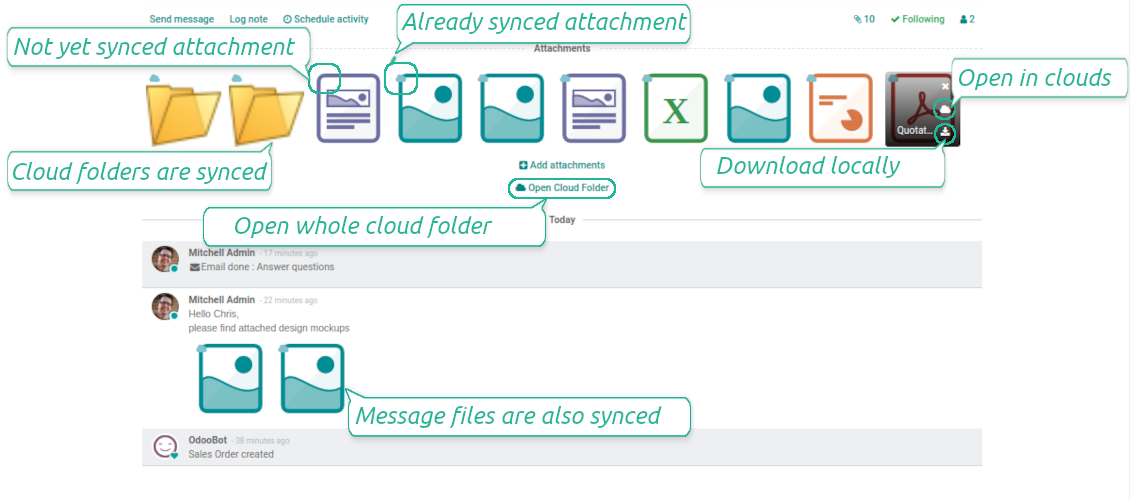
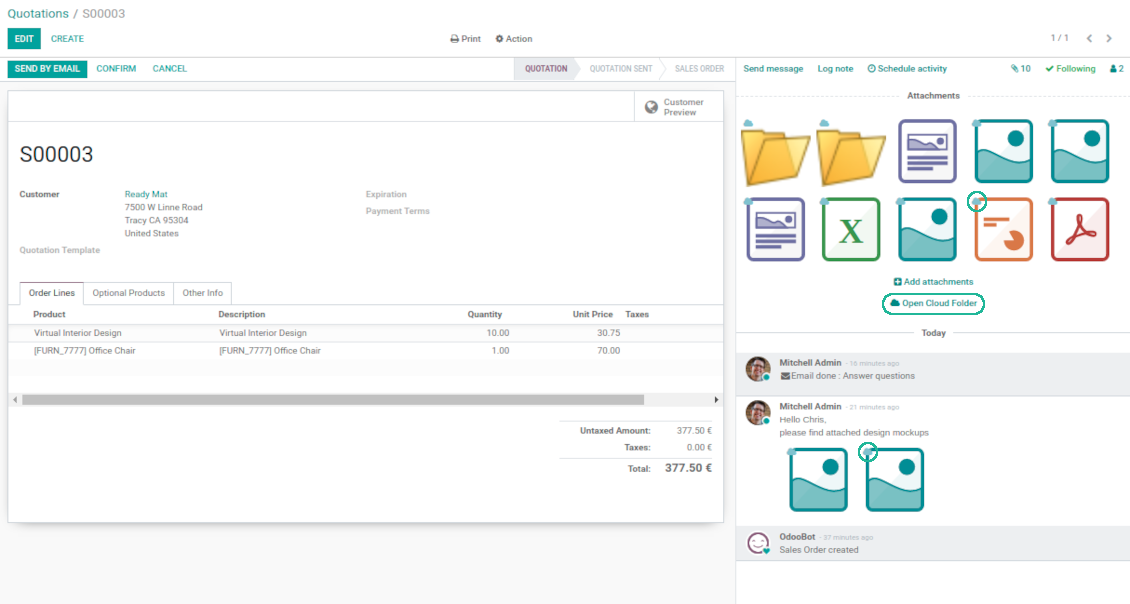
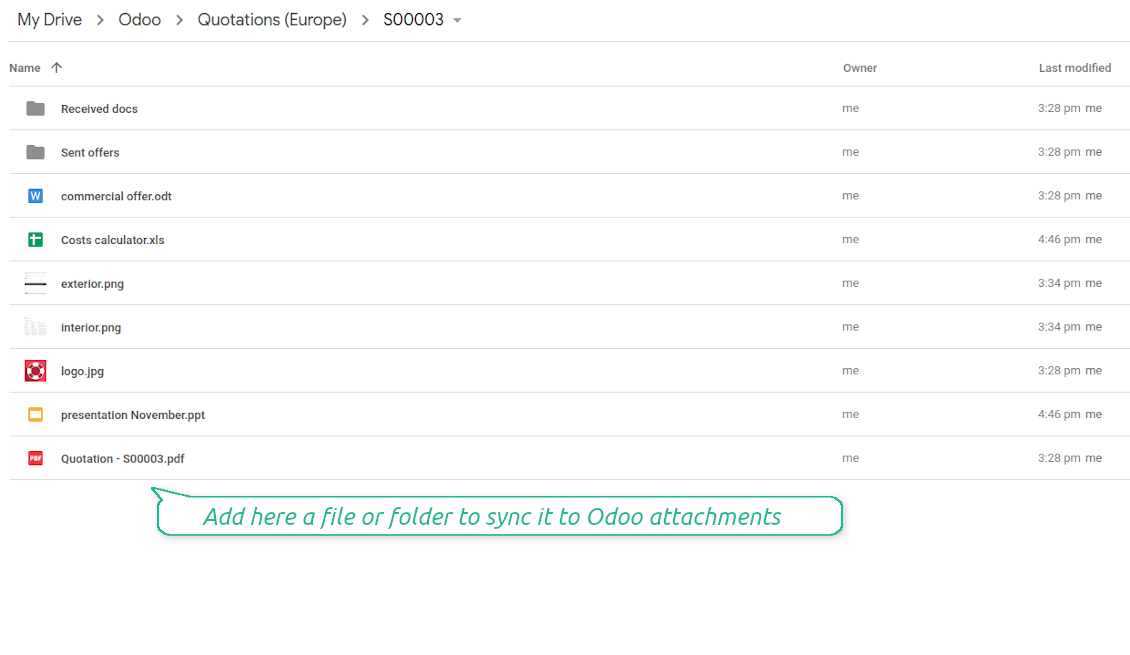
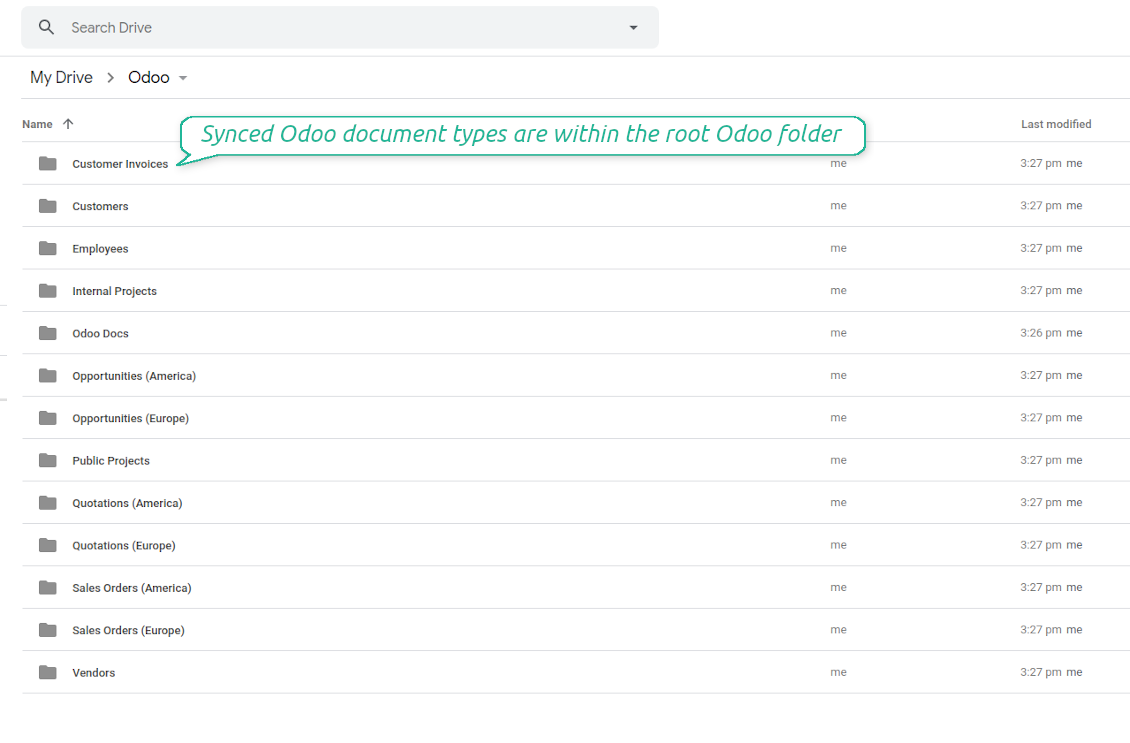
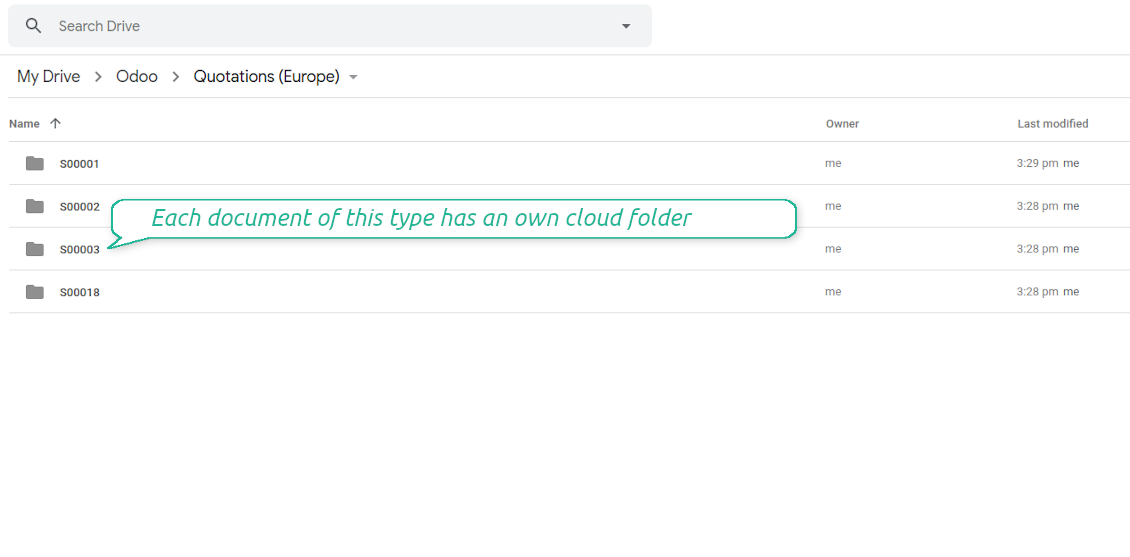
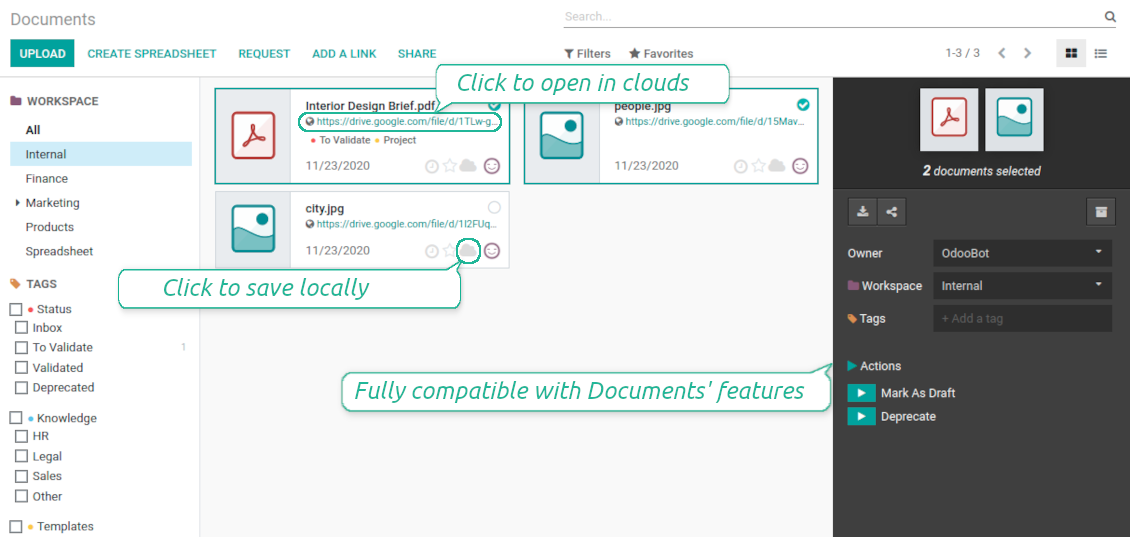
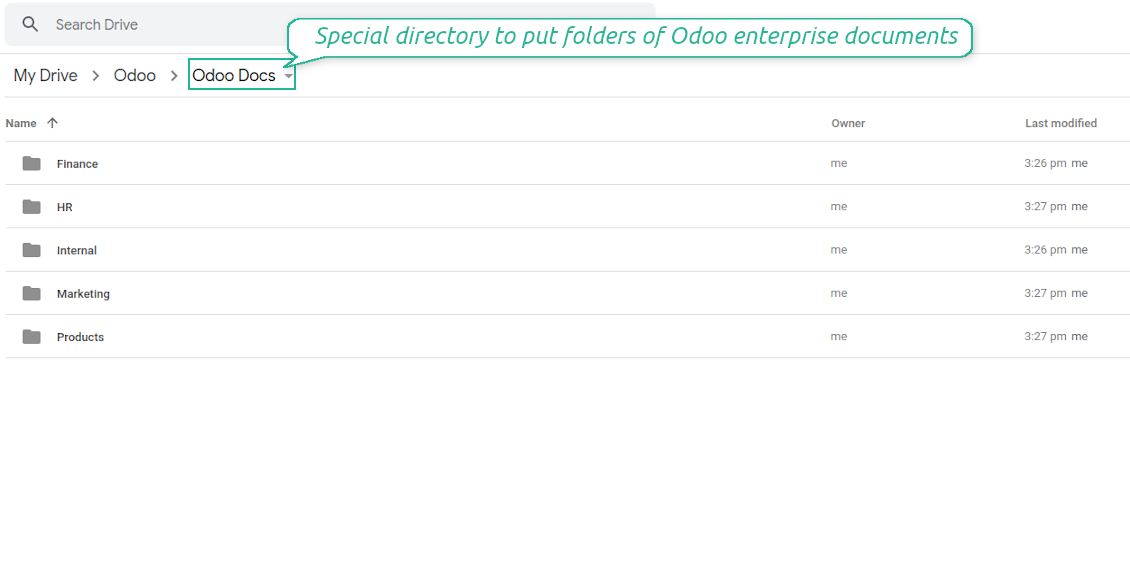

This is the tool to integrate Google Drive features into your Odoo business work flow. The app automatically stores Odoo attachments in Google Drive, and it provides an instant access to them via web links. In such a way users work with files comfortably in the cloud storage, while the results are fully available in Odoo.
- the technical core which provides basic mechanics of auto synchronization. This is a required module for integration. Az ára 398€.
- the connector itself which introduces links between Odoo and Google Drive. Az ára 89€.
- an optional add-on to sync Odoo documents (introduced by the enterprise app 'Documents') with clouds. The features assumed by this add-on are marked by the icon . Az ára 44€.
Automatic regular sync
Synchronization between Odoo and Google Drive is based on scheduled jobs. No manual interaction is required
Bilateral Google Drive sync
Odoo sends attachments to Google Drive and retrieves files from there. Binary content is kept in clouds, while Odoo provides direct access to synced items
Any Odoo document types for sync
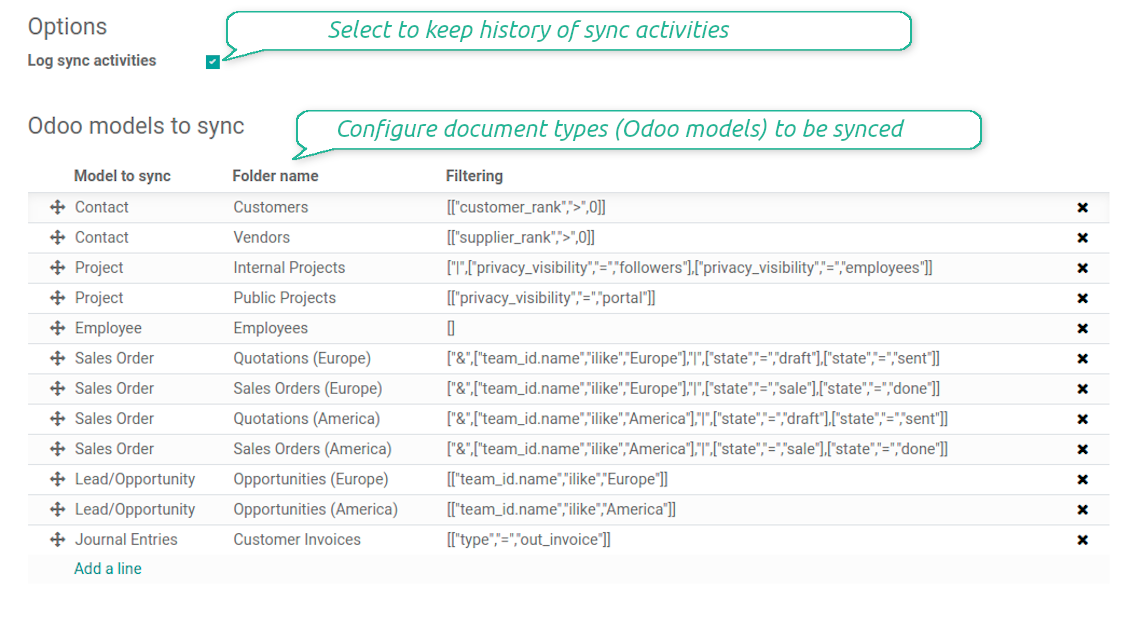
Decide which Odoo document types should be synced. Customers, opportunities, sale or purchase orders, tasks or issues, employees or users, etc. Custom models are also supported
Instant access for Google Drive
The tool redefines Odoo attachments boxes to make work comfortable: download files locally without login, open files and folders in Google Drive (if possible, items would be opened in Google Drive editors and previewers), use standard Odoo previewers
Compatible with Odoo Enterprise documents
Reflect Odoo Enterprise Documents' structure and items in Google Drive. All features (including sharing, downloading, and signing) would anyway work
Google team and individual drives
Sync works both for individual and team drives (Google Suite business and enterprise tariffs). In the latter case the root folder Odoo is placed within a chosen team drive, in the former case - within a current user drive
Google Drive sync history
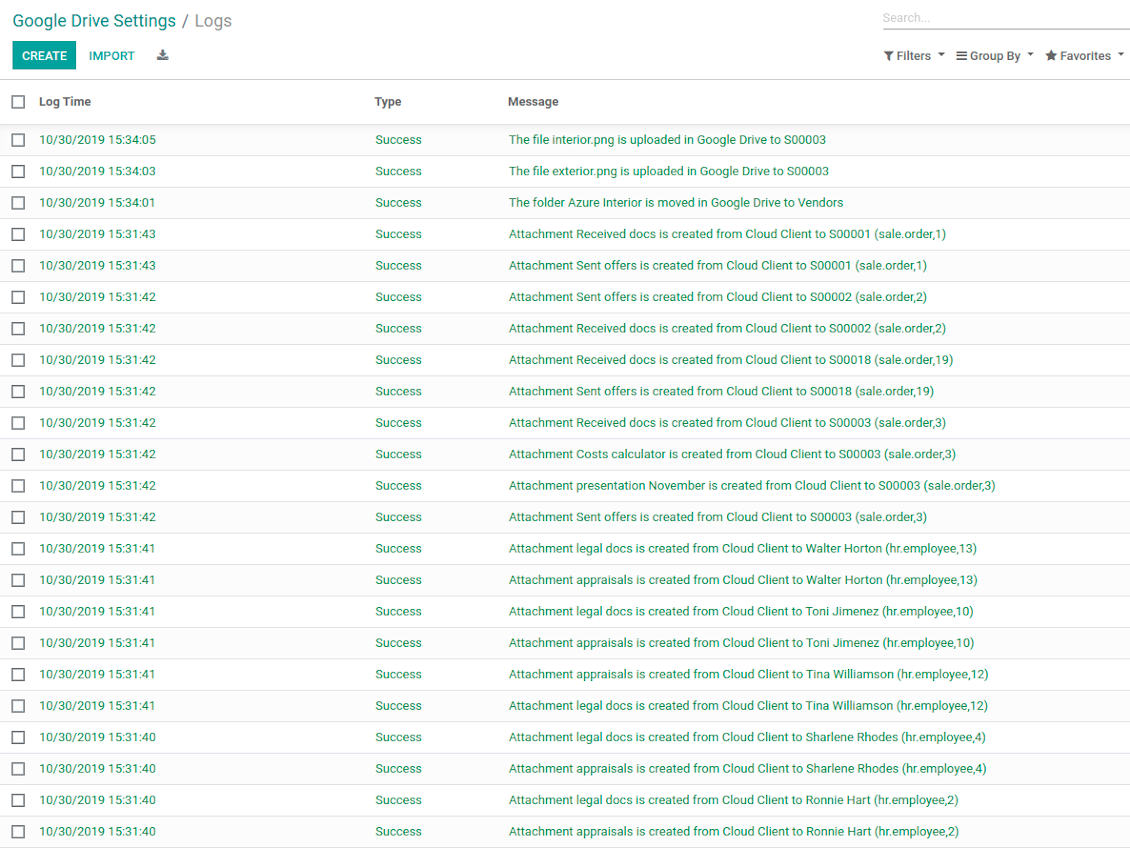
Sync activities might be logged. Control over files and folders creations, moves, name changes and removals. Just turn on the option 'Log sync activities', and you would be able to observe the history through the button 'Sync logs'
Default folders
The tool let generate default directories' structure for this document type during the very first sync of a related object. For example, for all employees you may have pre-defined folders 'Scans', 'Scans/Official', 'Photos', etc.
Tricky setup, but works perfectly now
Really solid module. We managed to get a very flexible folder structure (sorted by clients) and synced all our sales orders, invoices and tasks by projects to Google Drive.
Initial setup was a bit of a pain and kinda tricky to configure everything at first, but now it's running smoothly and works perfectly. The faotools team helped a lot. Def worth it if u need to keep your docs organized in Odoo and Google Drive.
Recommended!
Excellent !!!
Great App and great Service from faOtools.
Best module for integration with google drive
The module performs its function correctly and faOtools responds quickly to any problem and, in case of detecting any bug, quickly apply the changes. Its support is 10 stars.
Sync any documents you like
Configuring models to sync
-
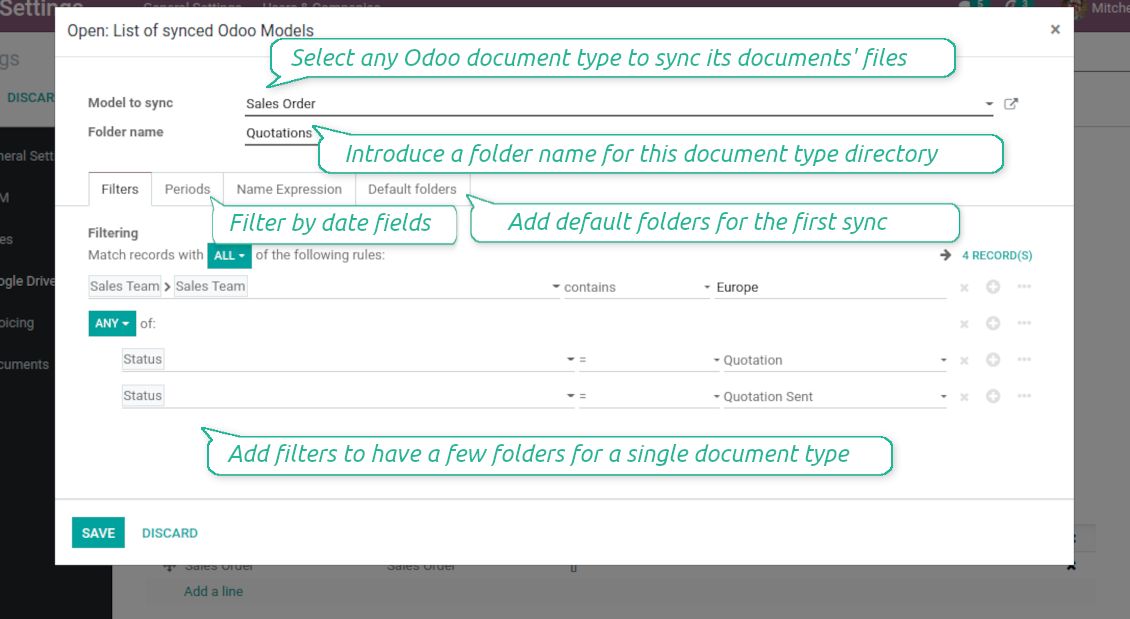
To sync a specific document type, you should add it as a model to sync. Any Odoo model might be chosen
-
The app let split models into a few folders based on selected filters. Use any document storable field to distinguish a directory. Have a separate folder for individuals and companies, for European and American opportunities, for quotations and confirmed orders, for each project, etc.
-
Limit also documents by relative periods through using date fields of linked documents. For example, leads registered in the last 3 months or invoices updated the last week
-
Define name expressions to specify titles of documents' Google Drive folders. For instance, to include project name to a task directory
-
Prepare hierarchy of default folders to be created when a document directory is synced to Google Drive for the first time
Typical use cases
-
Projects: have an own Google Drive folder for each customer project
-
Customers: add all partner files in a single directory available both from Odoo and from Google Drive. Modify those using default cloud editors and access them when working in Odoo
-
Employees: gather all files by this employee in a single cloud folder: photos, document scans, contracts. Access and upload those from Odoo and Google Drive alternatively
-
Opportunities: carefully store all specifications, requirements, any files which would let you make a good offer
-
Orders: keep all printings and contracts in Google Drive with instant availability from Odoo
-
Picking operations: save warehouse docs to Google Drive.
How synchronization works
Direct Sync
-
Direct synchronization is based on the scheduled job 'Synchronize attachments with cloud'
-
Direct sync make all synced Odoo attachments change their type to a link (URL), while binary content is removed with a next Odoo cleaner. So, no actual files would be stored on your Odoo server
-
Direct sync checks whether attachments are added or deleted for synced documents. If so, they would be created or removed in Google Drive
-
Direct sync checks whether a new document type (e.g. sale orders) is added / renamed / replaced in the to-sync-models configurations. If so, this should be reflected in Google Drive
-
Direct sync checks whether a new document (e.g. quotation SO-001) related to a synced document type is generated / updated / unlinked. If so, the connector would make the same changes in Google Drive
-
The final goal of direct Google Drive integration is to have the structure 'Odoo / Document Types / Documents / Files. For example, 'Odoo / Quotations / SO019 / commercial offer.pdf'
Backward Sync
-
Backward synchronization is based on the scheduled job 'Synchronize attachments from cloud'
-
Backward sync checks whether any items are added to a Google Drive document folder. If so, the app would create URL attachments for that items in a linked Odoo object
-
Backward sync checks whether any items are deleted / moved in a cloud document folder. If so, a linked Odoo attachment would be also unlinked or moved
-
Backward sync checks whether any item is renamed in Google Drive. If so, a chained Odoo attachment should be also renamed
-
In Google folders you can put not only files but also child folders. In that case a link for this folder (not its content) would be kept in Odoo attachments
-
If you deleted a folder related to this document type or this document, their child files would be deleted as well. Thus, Odoo would remove related attachments. The folders, however, will be recovered with a next direct sync
Misc notes
-
The connector works on a queue (first in - first out) principle: it tries to firstly reflect the oldest changes
-
Each sync, especially the very first one, might take quite a long. It is not recommended to make sync too frequent: once an hour seems reasonable frequency
-
File names and content should be managed in Google Drive: each backward sync would recover Google Drive names, Odoo is here less important
-
Take into account that files or folders deleted in Google Drive are really deleted only when you clean trash. Otherwise, such files still exist and would be reflected in Odoo
-
Try to avoid the following symbols in folders' and files' names: *, ?, ", ', :, <, >, /, +, %, !, @, \, /,. Direct sync will replace such symbols with '-'. It is done to avoid conflicts with file systems.
Odoo Enterprise Documents
-
The special add-on 'Cloud Sync for Enterprise documents' is introduced to synchronize Google Drive with the Odoo app 'Documents' (the latter is distributed under the Odoo Enterprise license)
-
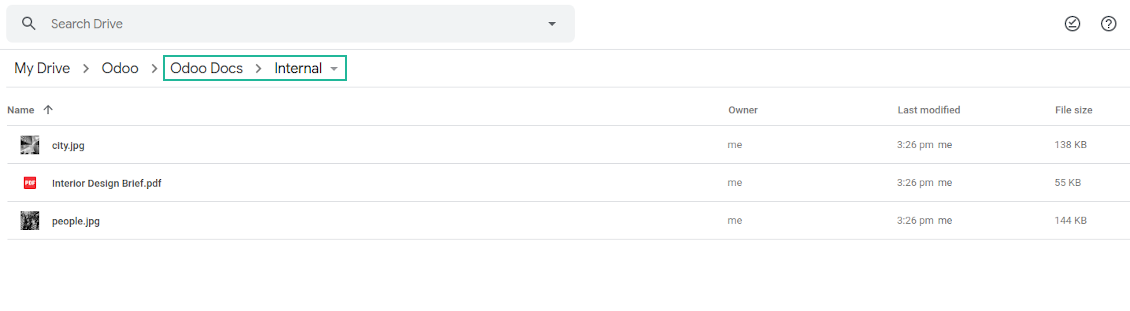
Based on that add-on the Odoo documents' hierarchy would be reflected within the folder 'Odoo / Odoo Docs'
-
Each Odoo folder would have a linked Google Drive folder. Take into account that folders created in the cloud storage will be synced as Odoo attachments. The key principle is: folders are managed by Odoo, files are managed by the cloud client
-
All files are synced with the same logic as usual attachments. Files created in Odoo will be added to the cloud storage and will be replaced with links in Odoo. Files created in cloud storage will generate URL attachments within a paired documents directory
-
Standard Google Drive sync and integration with Enterprise Documents are done within the same jobs. Avoid the scenarios when a single file is synced as a simple Odoo attachment and as an Odoo document simultaneously
-
Odoo spread sheet files are not synced by the connector: so, they are still manageable in Odoo
-
Please do not name synced models as 'Odoo Docs'. This is the reserved name for Odoo Enterprise Documents.
Konfigurációs és telepítési tippek: Google Drive Odoo Integration Odoo v.14
Login and Google Drive Credentials
- Go to the Google Cloud Console via the URL https://console.cloud.google.com
- Select or create a project
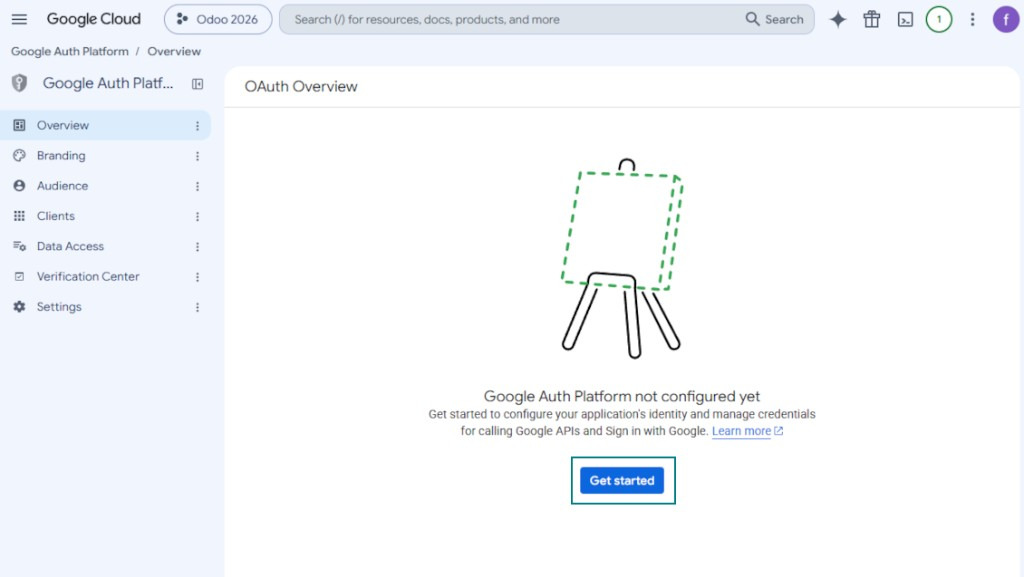
- After the project is selected, the console opens the Google Auth Platform. Press 'Get Started'
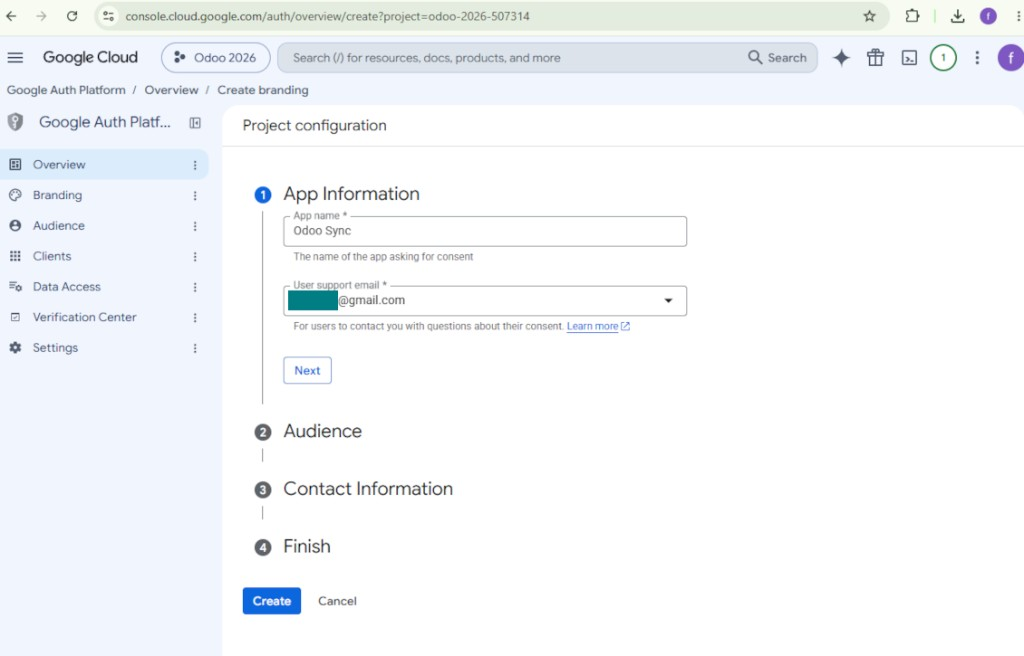
- Add app information
- As an app name select any suitable
- As a user support email select your email address
- Press 'Next'
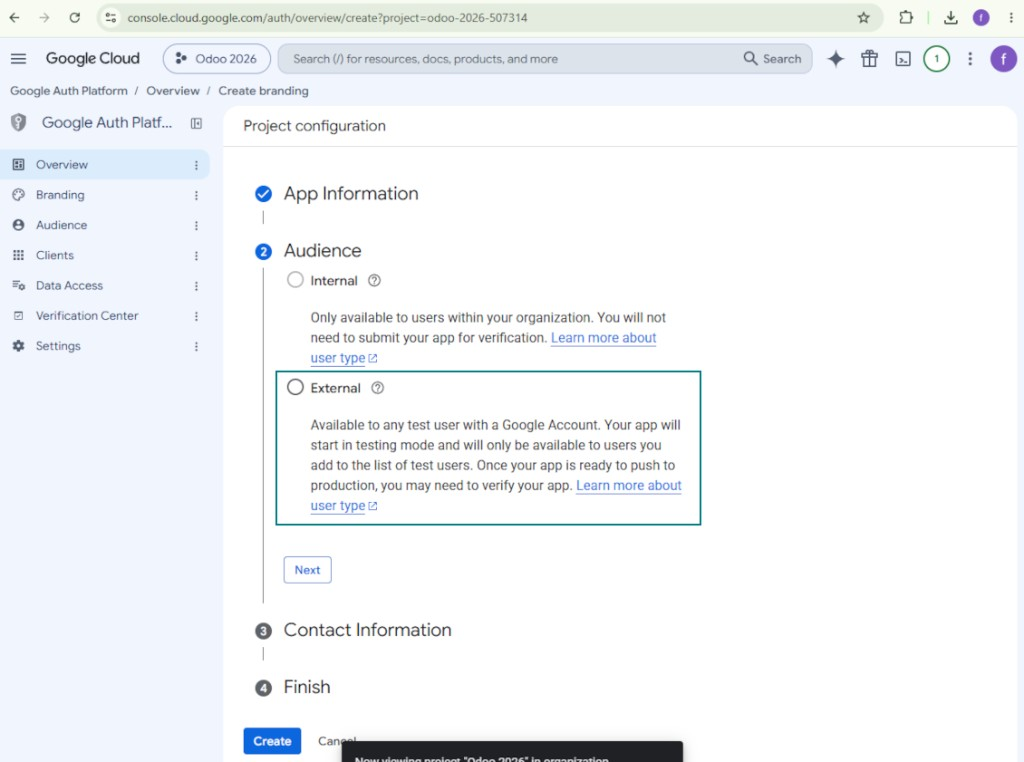
- As the audience select 'External' and press 'Next'. Note: you are anyway going to use this app only for your own Odoo connection
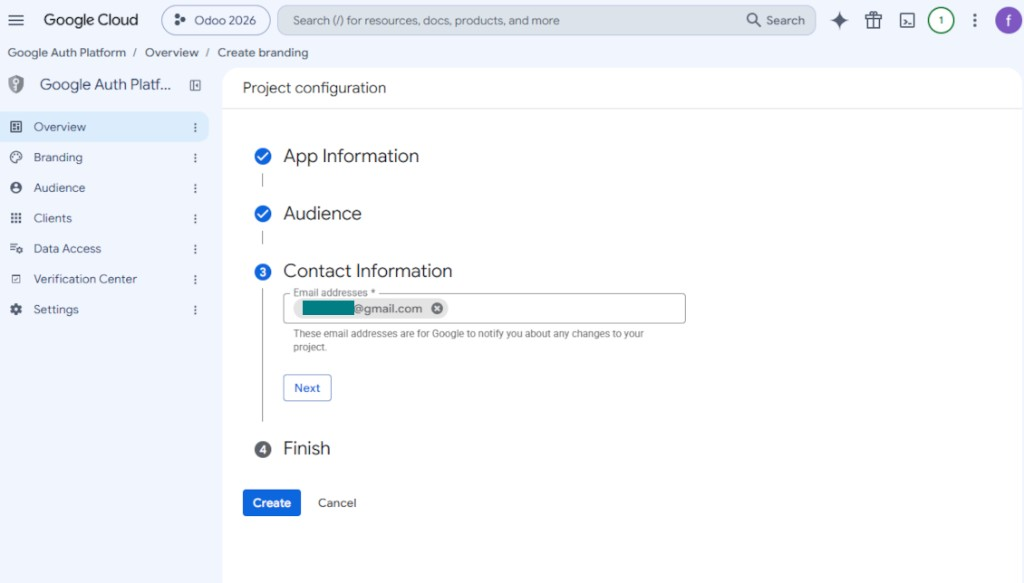
- As the contact information enter your Google or Google Workspace email address and press 'Next'
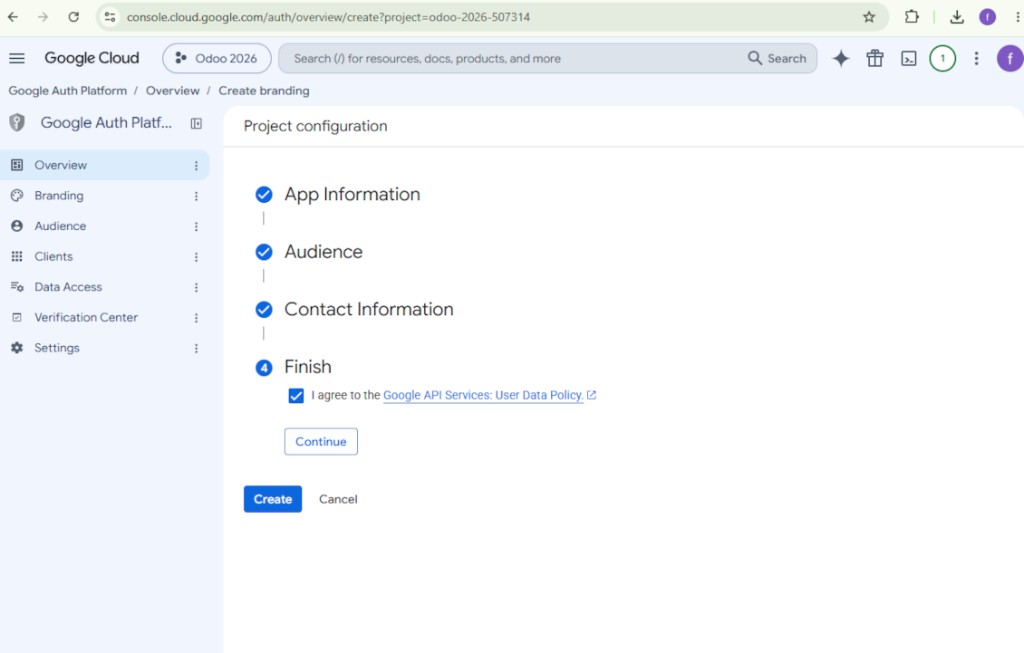
- Agree with the Google API Services User Data Policy, press 'Continue', and then press 'Create'
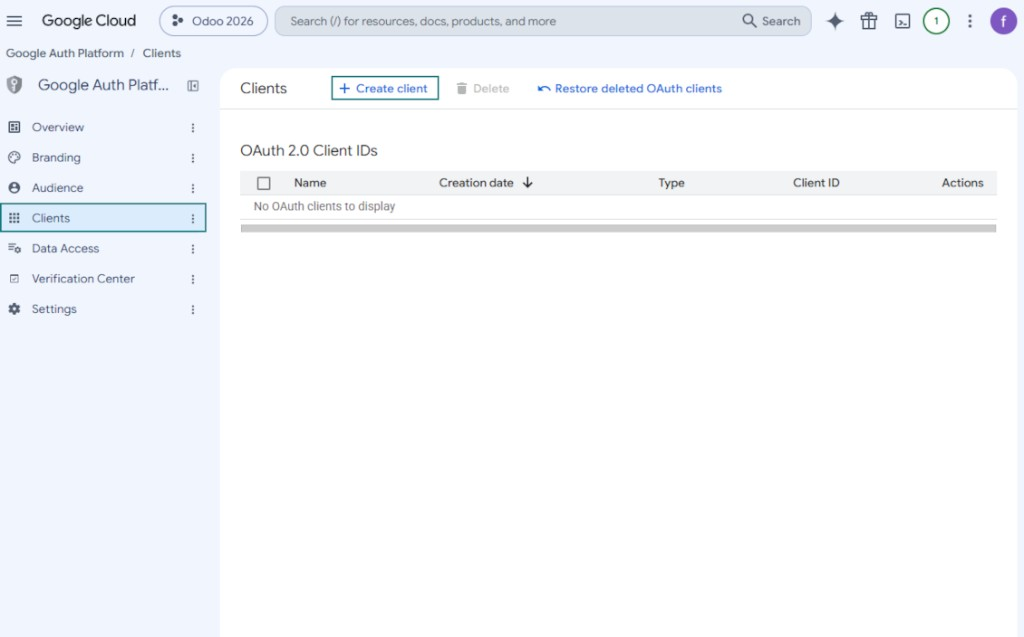
- Go to 'Clients' and press 'Create client'
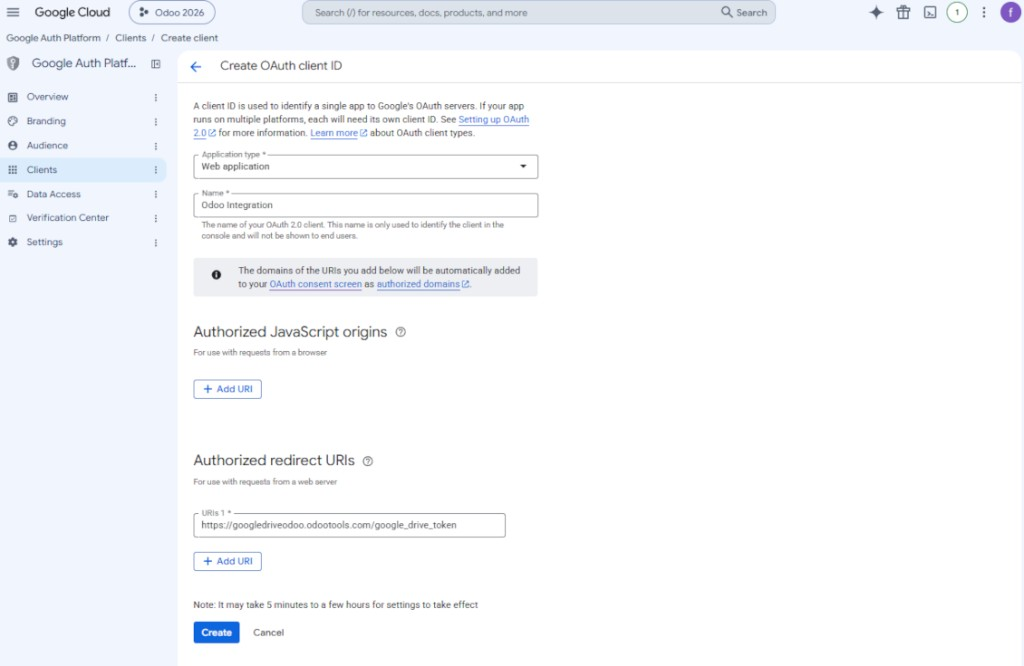
- As the application type select 'Web application'
- As a name select any suitable
- As the authorized redirect URI, add the link in a format [YOURODOOSITENAME]/google_drive_token (e.g. https://odootools.com/google_drive_token).
- Press 'Create'
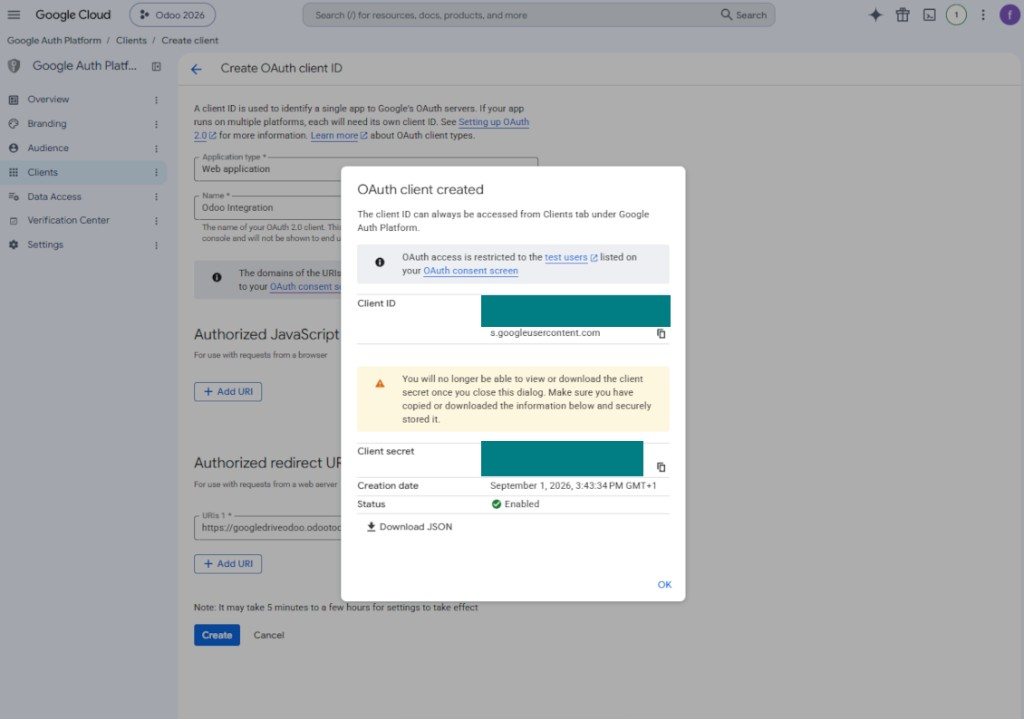
- Copy and safely store 'Client ID' and 'Client secret'. The client secret is shown only once
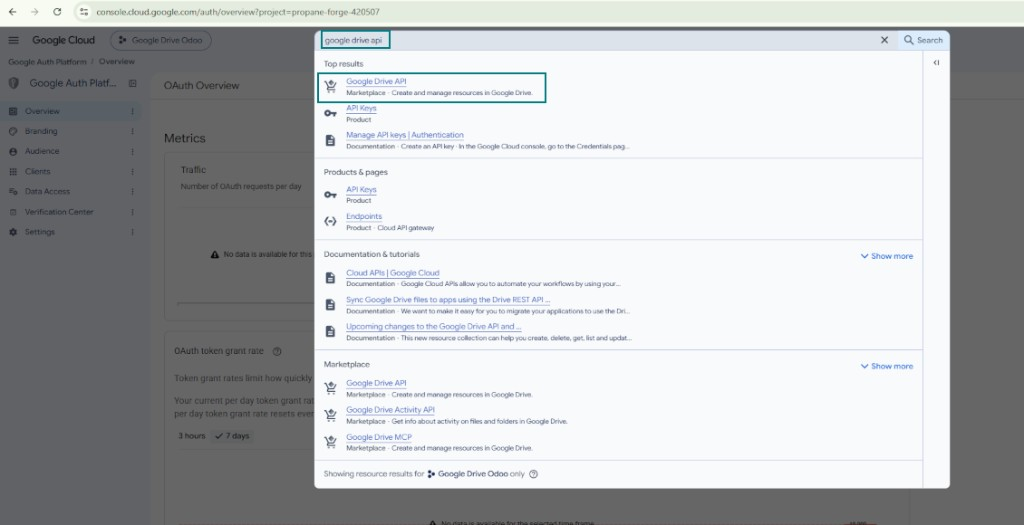
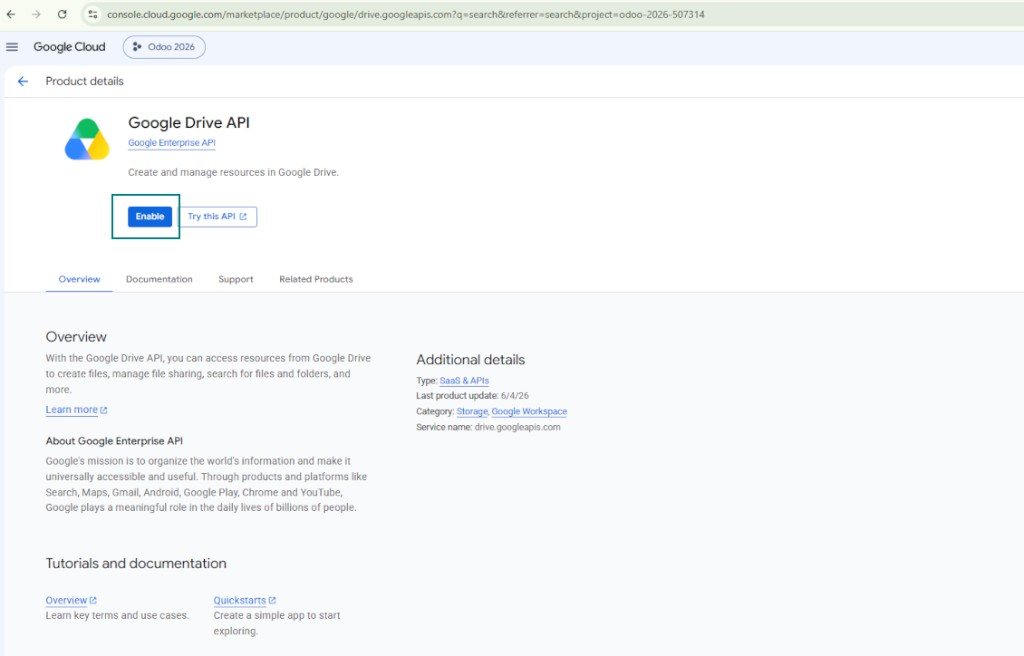
- Enable the Google Drive API for this project: type 'Google Drive API' in the top search box, open the found product, and press 'Enable'
- Go to 'Audience' and add your email address as a test user
- Publish the app. Otherwise, the app stays in the testing state and its token expires every 7 days
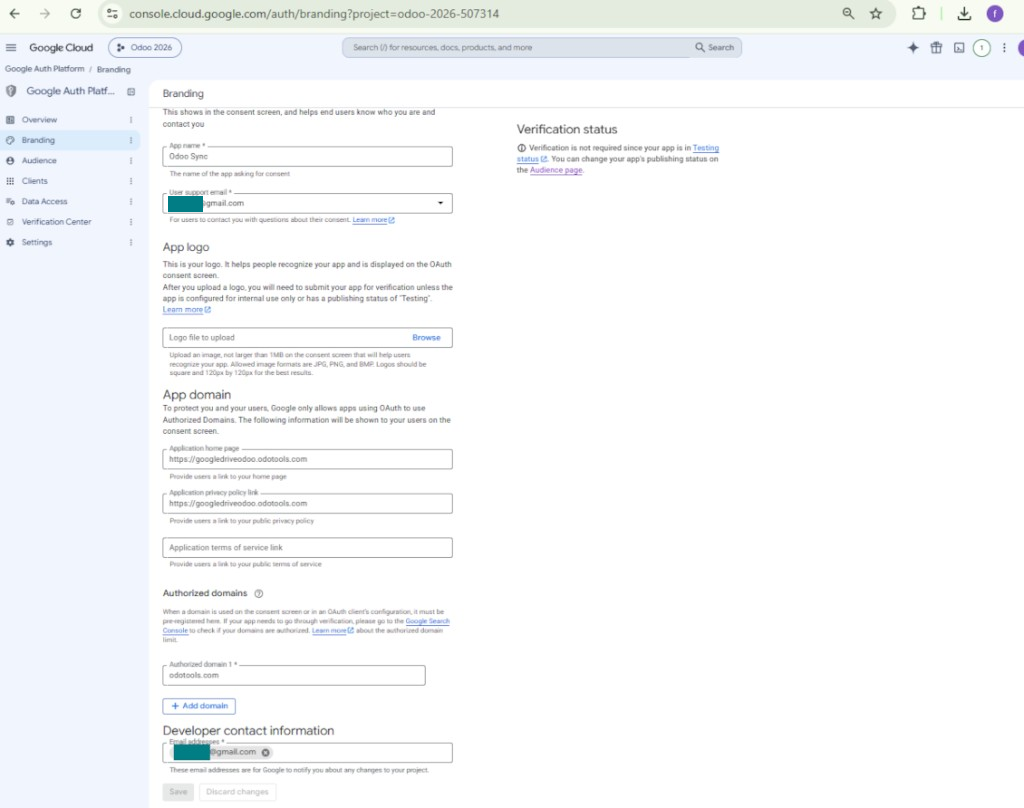
- Open 'Branding' and fill in the application home page and the application privacy policy link (for example, the links to your Odoo website). Add the domains of those links as the authorized domains
- Open 'Audience' and press 'Publish app'
- Do not upload an app logo. This would invoke a long and complex Google verification process that is of no actual need to you
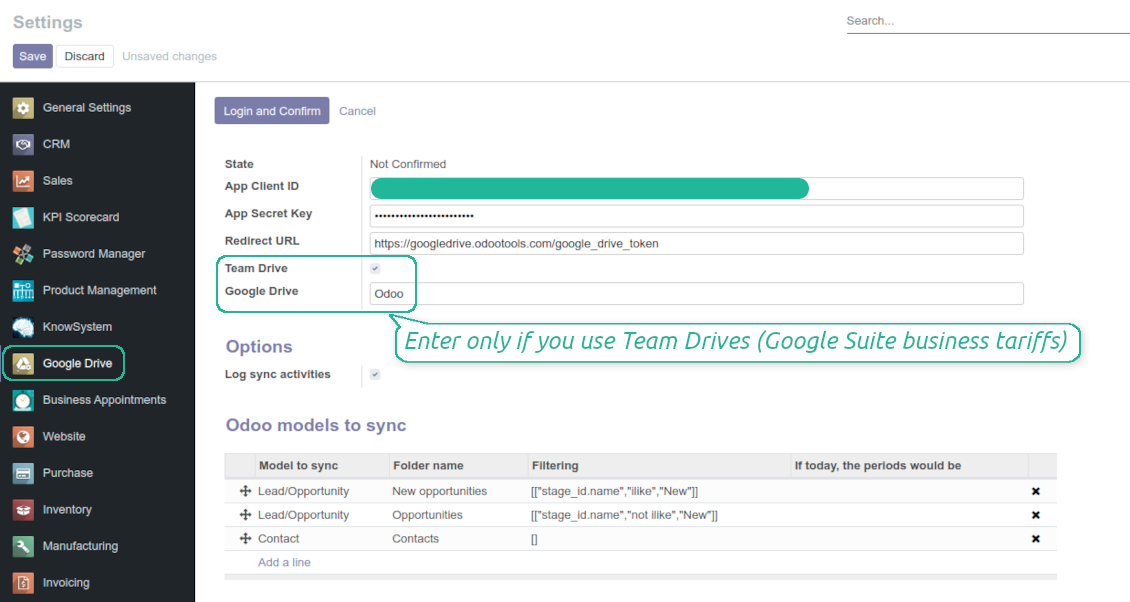
- Go to the Odoo Google Drive Settings
- Copy 'Client ID' from step 8 into the field 'App Client ID'
- Copy 'Client secret' from step 8 into the field 'App Secret Key'
- Insert the redirect URL you entered in step 8
- If you use team drives, check the related box. Make sure you really use team drives. In you Google Drive you should find the item 'Team Drives' in the left sidebar. This feature is available only for business and enterprise tariffs
- If the option 'Team Drive' is enabled, introduce its name. It should be absolutely the same as you see it in your Google Drive. Make sure that your user has full rights for this team drive
- Press 'Save'
- Press 'Login and Confirm'. Odoo redirects you to Google login page. Check in, agree with all conditions, and grant permissions asked
- After login, Google redirects you back to Odoo. Google Drive - Odoo synchronization is ready to be done.
Open the Google Auth Platform
Add app information
Select the external audience
Add contact information
Agree with the policies and create the app
Create an OAuth client
Configure the web application client
Copy the client ID and client secret
Find the Google Drive API
Enable the Google Drive API
Fill in branding to publish the app
Add test users and publish the app
Enter Google app credentials to Odoo
Odoo server configuration and cron job configuration
To make sure the synchronization works correctly apply proper timeouts to the Odoo configuration file: LIMIT_TIME_CPU, LIMIT_TIME_REAL, LIMIT_TIME_REAL_CRON should be more than 900 seconds.
For Odoo.sh this should not be done, since timeouts are predefined and are not configurable.
Then, timeout should be entered to your Odoo. To that goal find the section 'Settings' on the app configuration page and copy the number there.
Afterwards, it is needed to make the cron jobs suit the applied timeouts. In the debug mode go to the Settings > Technical > Automation > Scheduled Jobs:
- Set up the job 'Synchronize attachments with cloud' as (a) frequency - 2*timeout; (b) the next execution as the next hour +timeout. For example, for 900seconds timeout: frequency - as 30minutes; the next execution - at 08:15
- Set up the job 'Synchronize attachments from cloud' as (a) frequency - 2*timeout; (b) the next execution as the next hour + timeout*2. For example, for 900seconds timeout: frequency - as 30minutes; the next execution- at 08:30.
Gyakran ismételt kérdések: Google Drive Odoo Integration Odoo v.14
A létrehozott Google Drive-mappák automatikusan megosztásra kerülnek az Odoo-felhasználók között?
Az alkalmazás maga nem szabályozza a Google Drive oldali hozzáférési jogokat. Ezt ott kézzel kell megtenni. Az Odoo célmappákat hoz létre a Google Drive-ban; alapértelmezés szerint nincsenek megosztva, de bármely mappa jogait módosíthatja. Például teljes jog az «Odoo» könyvtárra vagy az «Odoo > Sale Orders» illetve «Odoo > Sale Orders > SO-001» mappára.
Az alkalmazás egyetlen felhasználói végpont elvén működik. Minden szinkronművelet ugyanazon Google Drive-felhasználó alatt fut (a beállított Google API alkalmazás szerint).
Töröltem egy fájlt a Google Drive-ban, de még mindig az Odoo-ban van
A fájl teljes törléséhez ürítse a Google Drive Lomtárát is.
A fájl még az Odoo-ban lehet, mert a visszafelé szinkron még nem dolgozta fel a mellékletet. Ez ütemezett folyamat, idő kell hozzá.
A Google az API-kérések alapján számláz?
A modul csak az ingyenes API-t használja, ezért a Google nem számláz.
Megváltoztathatom a szinkronizálási feladatok gyakoriságát?
Igen, lehet. Ehhez:
Kapcsolja be a hibakereső módot
Lépjen a műszaki beállítások > Automatizálás > Ütemezett műveletek menübe
Keresse meg a «Synchronize attachments with cloud» és «Update attachments from cloud» feladatokat.
Ne legyenek túl sűrűek. A feladatnak lehetőleg be kell fejeződnie, mielőtt a következő elindul. A beállítás a szinkronizálandó elemek számától függ. A gyakoriság általában 15 perc és 4 óra között van.
Állítson be elég időkorlátot az Odoo konfigurációs fájlban is. A LIMIT_TIME_CPU és a LIMIT_TIME_REAL legyen legalább a tervezett cron idő. A 13-as verziótól a LIMIT_TIME_REAL_CRON paramétert is vegye figyelembe.
Fontos megjegyzés Odoo.sh-ügyfeleknek: a cron feladat maximális ideje 15 perc lehet.
Beállíthatok a szinkronizálás által feltételezettől eltérő könyvtárszerkezetet?
Nem, ez a funkció csak a 15-ös verziótól érhető el. Előtte a modul előre megadott mappaszerkezettel dolgozik:
Odoo - a szinkron gyökérmappája
Modellek - mappa minden Odoo-dokumentumtípushoz. Például «Projects», «Partners». Tartomány szerint lehetnek szűkebb mappák: «Customer 1 Projects», «Projects of the Customer 2», «Internal Projects» stb.
Objektumok - mappa minden dokumentumhoz, pl. «Project 1» vagy «Customer 1»
Az adott Odoo-dokumentumhoz tartozó, szinkronizálandó fájlok és mappák.
Így például ez lehet:
Odoo / Projects / Project 1 / az 1. projekt fájljai és mappái
Odoo / Customer 1 Projects / Project 1; Odoo / Customer 2 Projects / Project 3, ...
Odoo / Customers / Customer 1 / az 1. ügyfél fájljai és mappái
A szerkezet mindig lapos: csak ezek a szintek. Különböző dokumentumtípusok nem lehetnek ugyanabban az ágban. A «Customer 1» mappában nem tarthatók együtt rendelések, számlák és projektek. Minden típusnak saját mappája (vagy mappái) van. Különben a visszafelé szinkronnak nem lenne szempontja.
Be kell állítanom speciális felhasználói hozzáféréseket az Odoo-ban?
Nem, az eszköz egyetlen felhasználói végpontra támaszkodik. Minden szinkronfolyamat egy felhőadminisztrátor (alkalmazás) alatt fut. A létrehozott mappák / fájlok jogai nem automatizáltak. Ezeket a felhőtárhelyen kell kezelni.
Hol tárolódnak a szinkronizált fájlok? Duplikálódnak az Odoo-ban és a felhőkben?
Az alkalmazás azt feltételezi, hogy a mellékletek bináris tartalma a Cloud Clientban van, nem az Odoo-kiszolgálón. Az ilyen mellékletek az Odoo-ban URL típusúak lesznek, és bármikor elérhetők a mellékletmezőből vagy a Cloud Clientból.
A beállítás után nincs szükség kézi lépésekre: a szinkronizálás teljesen automatikus. Döntse el, mely Odoo-dokumentumtípusokat kell szinkronizálni, és állítson be hozzájuk kapcsolódó modellt (ügyfelek, értékesítési vagy beszerzési rendelések, feladatok, projektek stb.).
Lehet több mappám ugyanahhoz a dokumentumtípushoz? Például belső projektek és ügyfélprojektek?
Igen, lehet. Készítsen szabályt mindegyikhez, majd alkalmazzon szűrőket: például a projekt típusa szerint.
Tegye a szűrőket egymást kizáróvá, hogy a dokumentum egyértelműen hozzárendelhető legyen. Például: «ügyfél, de nem szállító», «szállító, de nem ügyfél». Különben a dokumentum mappája modellről modellre ugrana.
Elég csak a Cloud Storage Solution alkalmazás?
Nem, az eszköz csak technikai mag. A felhőklient csatlakozójára is szükség van.
Rendben van, ha sok objektumot kell szinkronizálni, például 10000-et?
Igen, bár sok mappa/melléklet esetén a folyamat lassú lehet. Ügyfeleink azonban >10 ezer partneres és ~5 ezer termékváltozatos környezeteket jelentettek, és a folyamatok elfogadhatók voltak.
Néhány pont:
- A szinkron úgy van felépítve, hogy minden elem szinkronizálódik és nem vész el, még ha nem is gyors. FIFO-sorok és minden feladat commitja ezt garantálják.
- Az objektumok száma logikusan korlátozható. A modellek beállítása kizárhatja az elavult tételeket (pl. archivált partnerek vagy 2 éves rendelések).
Lehet valós idejű a szinkronizálás?
Nem. Erős okaink vannak a valós idejű szinkron kerülésére:
Teljesítmény. Valós idejű szinkronnál minden fájlfeltöltés betöltőképernyőt ad.
Ütközések. Ha 2 felhasználó egyszerre módosít egy elemet, a helyzet megoldhatatlan lehet. Rendszeres feladatoknál utólag javítható; valós időben sorra lenne szükség, ami még félrevezetőbb.
Működés. Különösen az átnevezés és az átszervezés. A visszafelé szinkron szigorúan a könyvtárlogikára támaszkodik, és minden futáskor az elemek 100%-át ellenőrzi. Minden frissítés után ez másodpercenként több ezer kérés lenne. Különben a változások elvesznének.
Megváltoztathatom a mappák alapértelmezett nevét a felhőkben?
Bármely dokumentumtípushoz megadhatja a modellkönyvtárak (értékesítési rendelések, lehetőségek, szállítók stb.) nevét.
Az objektummappáknál (SO-001, John Smith stb.) az eszköz az Odoo megjelenített név metódusát használja. Ezt egy névkifejezéssel módosíthatja. A szintaxis megegyezik az Odoo e-mail-sablonokéval.
Szinkronizálhatom a mellékleteket több felhőklientre
Nem, ez a funkció csak a 15-ös verziótól érhető el.
Speciális szerkesztőt használunk a felhőinkben (pl. OnlyOffice, Office 365). Megnyílnának a fájlok abban a szerkesztőben?
Igen, a felhőklient beállításától függően.
Mik az eszkozeik frissítési szabalyai?
Az Odoo Apps Store aktuális szabalyai szerint:
- A 12.0-s vagy korábbi verzióhoz vásárolt modul hozzáférést ad minden 12.0-ig tarto verzióhoz.
- A 13.0-s verzitol minden modulverziot külön kell megvasarolni.
- A verzioszamtol függetlenül a vásárlás jogot ad az adott foverzion belüli összes frissitesre es hibajavitasra.
A faOtools csapat nem irányítja ezeket a szabályokat. Kerdesekkel közvetlenül az Odoo Apps Store kepviseloit keresse.
Hogyan telepitem az alkalmazást Odoo.sh-re?
A legkozvetlenebb megkozelites az Odoo-aruhaz beépített munkafolyamata:
1. Nyissa meg a modul oldalat, es kattintson a Deploy on odoo.sh gombra
2. A GitHub oldalra kerül. Jelentkezzen be, majd kattintson a Create a new repo gombra, vagy használjon egy meglévőt. A tarhaznak privatnak kell lennie. OPL-1 licencu alkalmazások nem tehetok közzé. Szükség esetén hozzon létre uj repot az Odoo.sh-projekthez
3. Ezutan az odoo.sh-en kattintson a Deploy gombra, erősítse meg, majd kattintson a Continue gombra. Elindul a telepítés.
Ezek a lépések a production agra telepitik az alkalmazást. Mas agakhoz vagy frissiteshez:
1. Töltse le a forraskodot az Odoo-aruhazbol
2. Commitolja a modult a GitHub-tarhazba. Egyik alkalmazasmappa/-fájl sem kerulhet a .gitignore-ba. Az odoo.sh által létrehozott tarhazak fontos utvonalakat (pl. /lib) hagyhatnak figyelmen kívül. Töltse fel az összes modulkonyvtarat es fájlt
3. Deployolja az odoo.sh-projekt celagat, vagy várja meg az automatikus buildet, ha a beállítások igy szolnak.
Hogyan telepitem az alkalmazást a saját szerveremre?
2. Indítsa újra az Odoo-kiszolgálót;
3. Kapcsolja be a fejlesztői uzemmodot (technikai beállítások);
4. Frissítse az alkalmazaslistat (Alkalmazások menü);
5. Keresse meg az alkalmazást, es kattintson az Activate/Install gombra;
6. Kövesse az alkalmazasoldal utmutatasait, ha vannak.
Az alkalmazásnak extra kiegeszitoi vannak. Megvehetem őket később?
Igen. Az Odoo automatikusan a kosarba teszi a fuggosegeket: zárja ki a mar megvasarolt eszközöket, hogy ne fizessen kétszer.
Telepitettem az alkalmazást Odoo.sh-re, es figyelmeztetést/hibát latok a tesztekben
A piros/narancs figyelmeztetés nem befolyásolja az alkalmazás funkcióit. Néha a moduljaink nem mennek at a standard automatikus teszteken, mert azok az alkalmazás celjaival ellentetes viselkedést várnak. Például megvaltoztatjuk az arszamitast, miközben az Odoo-tesztek a végső árat a standard algoritmussal hasonlitjak össze.
Először ellenőrizze a telepített adatbázis funkciot. Minden működik?
Ha mégis ugy gondolja, hogy a figyelmeztetés valós funkciókat érint, írjon nekünk, es küldje el a teljes telepítési naplókat es a telepített modulok teljes listajat (mag es harmadik fel).
Megvehetem az alkalmazást közvetlenül onoktol?
Nem, az eszközöket csak a hivatalos Odoo alkalmazasboltban forgalmazzuk.
Kedvezmenyt szeretnék
Sajnos nincs technikai lehetosegunk egyedi árakat adni.
Telepithetem az alkalmazást az Odoo Online (SaaS) adatbazisomra?
Nem, harmadik feles alkalmazások nem használhatók az Odoo Online-on. Az Odoo SaaS ezt blokkolja.
Az eszköz mas alkalmazasoktol függ. Meg kell vennem őket?
Igen, az eszkoznek szüksége van minden függőségként jelölt modulra. Az alkalmazasoldal ara mar tartalmazza ezeket a fuggosegeket.
Mennyi a modul ara amerikai dollarban? Miért változott?
Moduljaink ara euroban van megadva. Az Odoo-aruhaz a belső arfolyama szerint vált mas penznemekre. Ezért az amerikai dollar ar valtozhat, amikor az arfolyam frissül.
Az alkalmazás és a webhely angolon kívüli nyelveken mesterséges intelligenciával készülnek és az hivatalos Odoo-fordításokhoz igazodnak. Ha hibát talál, küldjön fordításhelyességi jegyet és kijavítjuk.
Hibajelentés
Ha hibát vagy következetlen viselkedést lát, írjon nekünk. A vásárlástól 60 napon belül javítást vállalunk, és utána is fejlesztjük az eszközöket.
Nem kell telefonszám vagy bankkártya a kapcsolatfelvételhez. Elég egy rövid e-mailes regisztráció, ami 30 másodpercnél nem tart tovább.
Adjon meg minél több részletet: képernyőképek, Odoo-kiszolgálónaplók és a hiba reprodukálásának teljes leírása. Általában néhány munkanap kell a munkatervhez (ha a hiba megerősített) vagy az iránymutatáshoz (egyébként).
Nyilvános funkcióigények és modulötletek (ingyenes fejlesztés)
Erősen motiváltak vagyunk az eszközeink fejlesztésére, és hálásak minden visszajelzésért. Ha az igények közhasznúak és hatékonyan megvalósíthatók, a csapat felveszi őket a teendők listájára.
Az ilyen teendőlista rendszeresen feldolgozásra kerül, extra díj nélkül. Bár határidőt és végleges dizájnt nem ígérhetünk, jó módja lehet a kívánt funkciók befektetés és kockázat nélküli megszerzésének.
Nem kell telefonszám vagy bankkártya a kapcsolatfelvételhez. Elég egy rövid e-mailes regisztráció, ami 30 másodpercnél nem tart tovább.

Eszköz jelszavak biztonságos, megosztott tárolására Odooban. Megosztott trezorok
198€
Eszköz mély és strukturált tudásbázis építéséhez belső és külső használatra. Knowledge System. KMS. Wiki-szerű revíziók.
398€
Eszköz KPI-célok beállításához és teljesítésük időszakos ellenőrzéséhez. KPI-irányítópultok. Dashboard-tervező. KPI-diagramok
198€
Eszköz időalapú szolgáltatáskezeléshez a foglalástól az értékesítésig és az értékelésekig
398€
Eszköz az Odoo kezeléséhez a kedvenc AI-csevegőkből MCP-n keresztül. Claude. Bármely MCP-t támogató AI.
198€
Eszköz Odoo mellékletek mappákba rendezéséhez és könyvtárak szinkronizálásához felhőklientekkel: Google Drive, OneDrive/SharePoint, Nextcloud/ownCloud, Dropbox, Amazon S3, Box és NAS. DMS. Fájlkezelő. Dokumentumkezelő rendszer
398€
Eszköz Odoo-mellékletek automatikus kétirányú szinkronizálásához OneDrive-fájlokkal
487€
Eszköz Odoo-mellékletek automatikus kétirányú szinkronizálásához ownCloud/Nextcloud-fájlokkal
487€
Eszköz Odoo-mellékletek automatikus kétirányú szinkronizálásához DropBox-fájlokkal
487€